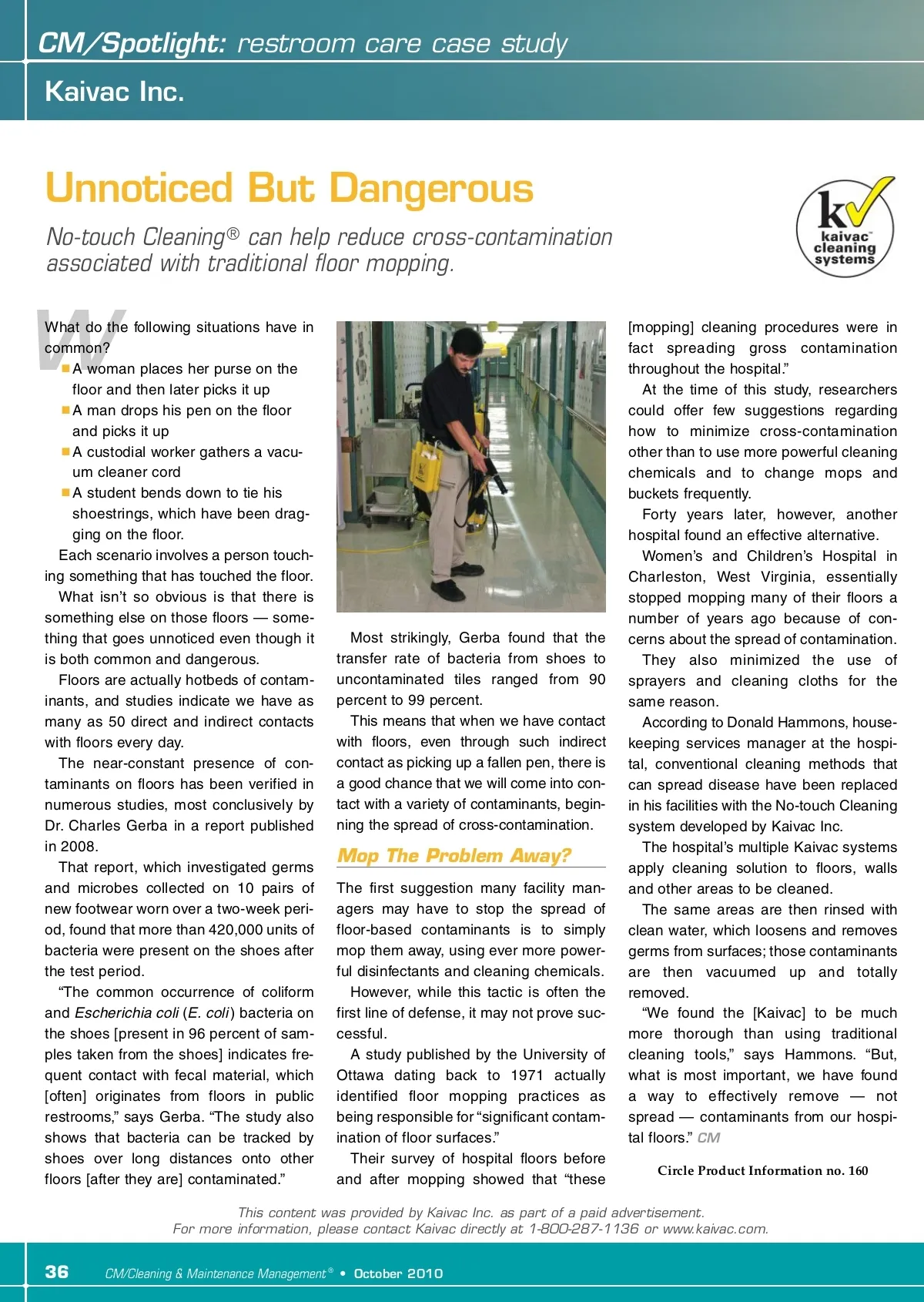
CM/Spotlight: restroom care case study Kaivac Inc. Unnoticed But Dangerous No-touch Cleaning ® can help reduce cross-contamination associated with traditional floor mopping. W What do the following situations have in common? A woman places her purse on the floor and then later picks it up A man drops his pen on the floor and picks it up A custodial worker gathers a vacu-um cleaner cord A student bends down to tie his shoestrings, which have been drag-ging on the floor. Each scenario involves a person touch-ing something that has touched the floor. What isn’t so obvious is that there is something else on those floors — some-thing that goes unnoticed even though it is both common and dangerous. Floors are actually hotbeds of contam-inants, and studies indicate we have as many as 50 direct and indirect contacts with floors every day. The near-constant presence of con-taminants on floors has been verified in numerous studies, most conclusively by Dr. Charles Gerba in a report published in 2008. That report, which investigated germs and microbes collected on 10 pairs of new footwear worn over a two-week peri-od, found that more than 420,000 units of bacteria were present on the shoes after the test period. “The common occurrence of coliform and Escherichia coli ( E. coli ) bacteria on the shoes [present in 96 percent of sam-ples taken from the shoes] indicates fre-quent contact with fecal material, which [often] originates from floors in public restrooms,” says Gerba. “The study also shows that bacteria can be tracked by shoes over long distances onto other floors [after they are] contaminated.” Most strikingly, Gerba found that the transfer rate of bacteria from shoes to uncontaminated tiles ranged from 90 percent to 99 percent. This means that when we have contact with floors, even through such indirect contact as picking up a fallen pen, there is a good chance that we will come into con-tact with a variety of contaminants, begin-ning the spread of cross-contamination. Mop The Problem Away? The first suggestion many facility man-agers may have to stop the spread of floor-based contaminants is to simply mop them away, using ever more power-ful disinfectants and cleaning chemicals. However, while this tactic is often the first line of defense, it may not prove suc-cessful. A study published by the University of Ottawa dating back to 1971 actually identified floor mopping practices as being responsible for “significant contam-ination of floor surfaces.” Their survey of hospital floors before and after mopping showed that “these [mopping] cleaning procedures were in fact spreading gross contamination throughout the hospital.” At the time of this study, researchers could offer few suggestions regarding how to minimize cross-contamination other than to use more powerful cleaning chemicals and to change mops and buckets frequently. Forty years later, however, another hospital found an effective alternative. Women’s and Children’s Hospital in Charleston, West Virginia, essentially stopped mopping many of their floors a number of years ago because of con-cerns about the spread of contamination. They also minimized the use of sprayers and cleaning cloths for the same reason. According to Donald Hammons, house-keeping services manager at the hospi-tal, conventional cleaning methods that can spread disease have been replaced in his facilities with the No-touch Cleaning system developed by Kaivac Inc. The hospital’s multiple Kaivac systems apply cleaning solution to floors, walls and other areas to be cleaned. The same areas are then rinsed with clean water, which loosens and removes germs from surfaces; those contaminants are then vacuumed up and totally removed. “We found the [Kaivac] to be much more thorough than using traditional cleaning tools,” says Hammons. “But, what is most important, we have found a way to effectively remove — not spread — contaminants from our hospi-tal floors.” CM Circle Product Information no. 160 This content was provided by Kaivac Inc. as part of a paid advertisement. For more information, please contact Kaivac directly at 1-800-287-1136 or www.kaivac.com. 36 CM/Cleaning & Maintenance Management ® • October 2010
CMM – Archives Oct 2010: 36