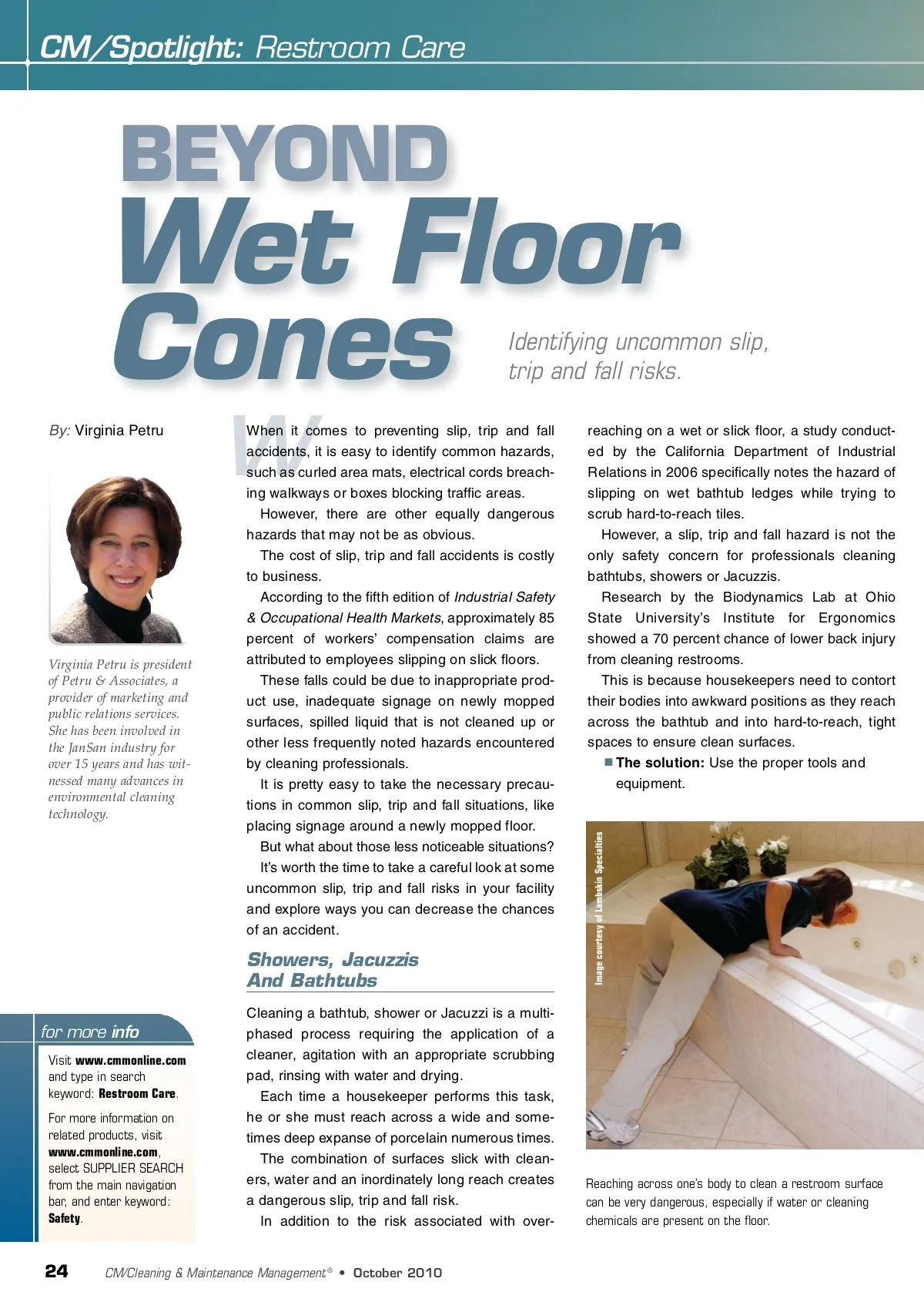
First, consider the cleaning tools being used and opt for one that is designed to elim-inate overreaching but will still effectively scrub, clean and dry. A new item on the market, designed expressly for these applications, is a flexi-ble, flat mop-like tool that swivels to safely extend a housekeeper’s reach. It attaches to any length handle so profes-sionals can scrub with their feet firmly plant-ed on the floor without bending or reaching. With gentle pressure, the pad’s surface contours snugly to curved surfaces with either a non-scratch scrubbing pad or microfiber pad. Second, evaluate your protocol and elim-inate risky procedures. Are toilets sprayed with disinfectant before tubs are washed and are counters and sink areas sprayed with cleaner before cleaning the Jacuzzi? Overspray of cleaning chemicals on a tile floor can create a slippery surface. One solution is to keep dirty towels on the floor while applying cleaners where overspray may occur to absorb the way-ward spray of the cleaning chemical. Any condition that creates a slippery hard floor is a slip, trip and fall hazard. This includes malfunctioning water foun-tains and misdirected produce sprayers. Properly maintain water fountains and sprayers so that misting or overspray is minimized. To further reduce a slip, trip and fall risk, consider providing absorbent matting in areas of potential overspray. Not only will the matting help protect hard floor surfaces from excess wear, they will provide increased traction and help absorb moisture. Do you have uncommon slip, trip and fall areas in your facility? CM Chemical And Water Overspray Just as the overspray of a disinfectant or cleaner can create a slip, trip and fall haz-ard in the restroom, the same holds true in other areas of a facility. It is important to keep an eye on hard floors and the amount of accidental over-spray created by cleaning products such as furniture polish or stainless steel cleaners. These two types of cleaners are notori-ous for containing ingredients that leave behind a slippery, oily residue. Quite often, they are used in facilities where there is hard flooring, such as churches and kitchens. The solution: Use extreme caution. Be cautious when you apply cleaners and polishers to surfaces that rest on hard flooring. Watch for any overspray of product and adjust your cleaning procedure accordingly. Another solution is to investigate alterna-tive cleaners and polishers that provide greater friction by reducing slippery residue. Circle Product Information no. 203 on page 32 www.cmmonline.com 25
CMM – Archives Oct 2010: 25