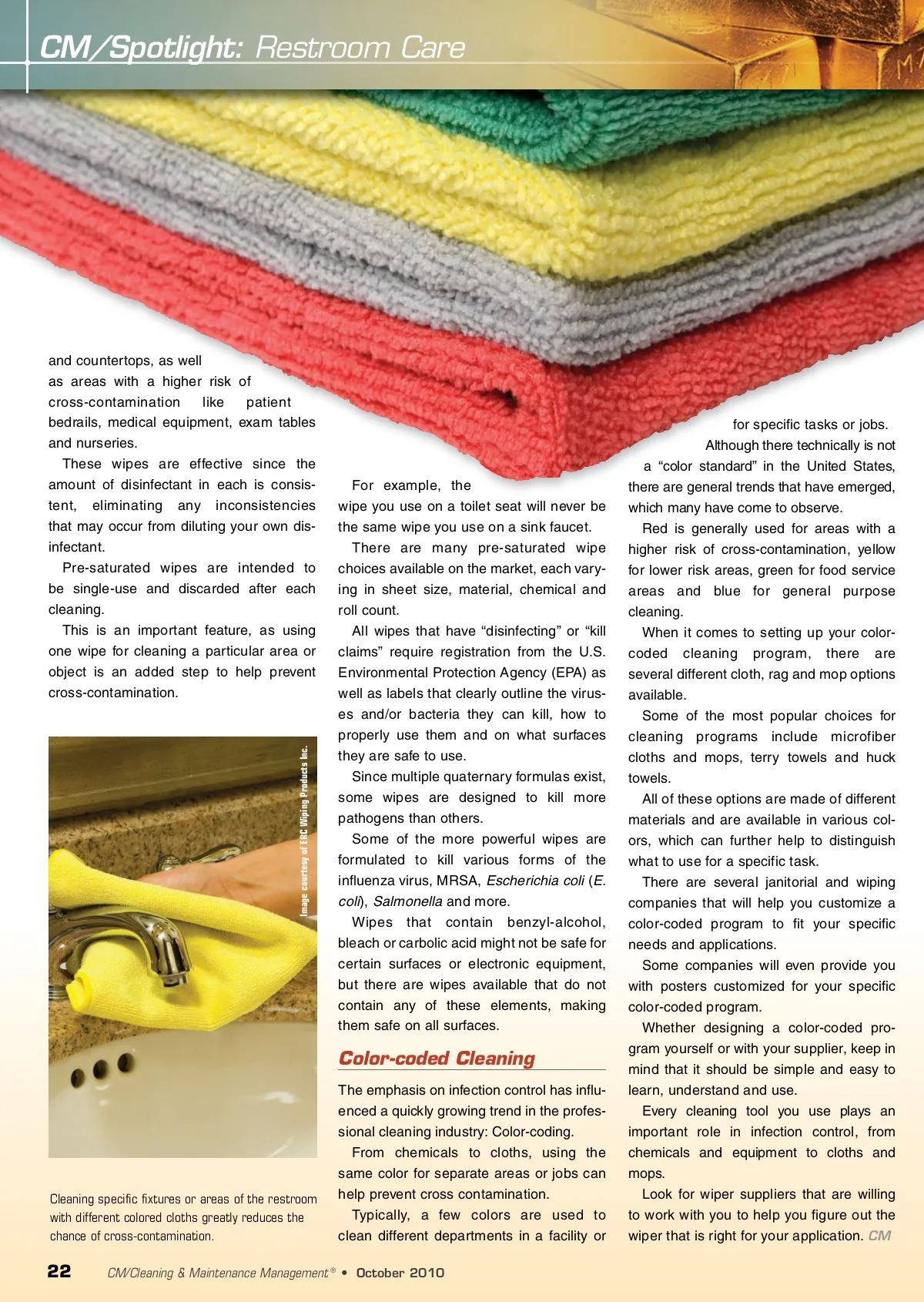
CM/Spotlight: Restroom Care and countertops, as well as areas with a higher risk of cross-contamination like patient bedrails, medical equipment, exam tables and nurseries. These wipes are effective since the amount of disinfectant in each is consis-tent, eliminating any inconsistencies that may occur from diluting your own dis-infectant. Pre-saturated wipes are intended to be single-use and discarded after each cleaning. This is an important feature, as using one wipe for cleaning a particular area or object is an added step to help prevent cross-contamination. For example, the wipe you use on a toilet seat will never be the same wipe you use on a sink faucet. There are many pre-saturated wipe choices available on the market, each vary-ing in sheet size, material, chemical and roll count. All wipes that have “disinfecting” or “kill claims” require registration from the U.S. Environmental Protection Agency (EPA) as well as labels that clearly outline the virus-es and/or bacteria they can kill, how to properly use them and on what surfaces they are safe to use. Since multiple quaternary formulas exist, some wipes are designed to kill more pathogens than others. Some of the more powerful wipes are formulated to kill various forms of the influenza virus, MRSA, Escherichia coli ( E. coli ), Salmonella and more. Wipes that contain benzyl-alcohol, bleach or carbolic acid might not be safe for certain surfaces or electronic equipment, but there are wipes available that do not contain any of these elements, making them safe on all surfaces. Color-coded Cleaning The emphasis on infection control has influ-enced a quickly growing trend in the profes-sional cleaning industry: Color-coding. From chemicals to cloths, using the same color for separate areas or jobs can help prevent cross contamination. Typically, a few colors are used to clean different departments in a facility or Cleaning specific fixtures or areas of the restroom with different colored cloths greatly reduces the chance of cross-contamination. for specific tasks or jobs. Although there technically is not a “color standard” in the United States, there are general trends that have emerged, which many have come to observe. Red is generally used for areas with a higher risk of cross-contamination, yellow for lower risk areas, green for food service areas and blue for general purpose cleaning. When it comes to setting up your color-coded cleaning program, there are several different cloth, rag and mop options available. Some of the most popular choices for cleaning programs include microfiber cloths and mops, terry towels and huck towels. All of these options are made of different materials and are available in various col-ors, which can further help to distinguish what to use for a specific task. There are several janitorial and wiping companies that will help you customize a color-coded program to fit your specific needs and applications. Some companies will even provide you with posters customized for your specific color-coded program. Whether designing a color-coded pro-gram yourself or with your supplier, keep in mind that it should be simple and easy to learn, understand and use. Every cleaning tool you use plays an important role in infection control, from chemicals and equipment to cloths and mops. Look for wiper suppliers that are willing to work with you to help you figure out the wiper that is right for your application. CM 22 CM/Cleaning & Maintenance Management ® • October 2010 Image courtesy of ERC Wiping Products Inc.
CMM – Archives Oct 2010: 22