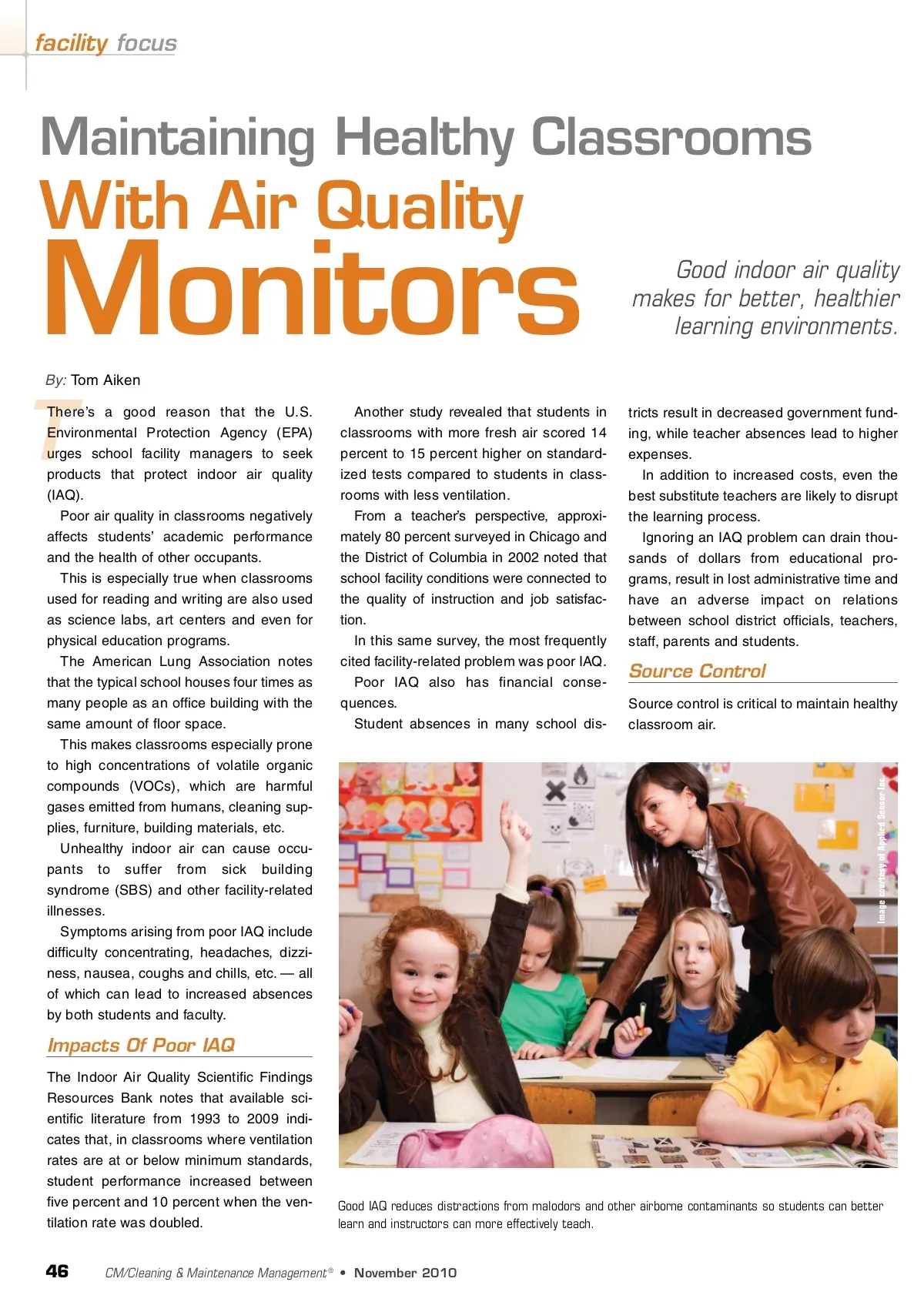
facility focus Maintaining Healthy Classrooms With Air Quality By: Tom Aiken Monitors T There’s a good reason that the U.S. Environmental Protection Agency (EPA) urges school facility managers to seek products that protect indoor air quality (IAQ). Poor air quality in classrooms negatively affects students’ academic performance and the health of other occupants. This is especially true when classrooms used for reading and writing are also used as science labs, art centers and even for physical education programs. The American Lung Association notes that the typical school houses four times as many people as an office building with the same amount of floor space. This makes classrooms especially prone to high concentrations of volatile organic compounds (VOCs), which are harmful gases emitted from humans, cleaning sup-plies, furniture, building materials, etc. Unhealthy indoor air can cause occu-pants to suffer from sick building syndrome (SBS) and other facility-related illnesses. Symptoms arising from poor IAQ include difficulty concentrating, headaches, dizzi-ness, nausea, coughs and chills, etc. — all of which can lead to increased absences by both students and faculty. Another study revealed that students in classrooms with more fresh air scored 14 percent to 15 percent higher on standard-ized tests compared to students in class-rooms with less ventilation. From a teacher’s perspective, approxi-mately 80 percent surveyed in Chicago and the District of Columbia in 2002 noted that school facility conditions were connected to the quality of instruction and job satisfac-tion. In this same survey, the most frequently cited facility-related problem was poor IAQ. Poor IAQ also has financial conse-quences. Student absences in many school dis-Good indoor air quality makes for better, healthier learning environments. tricts result in decreased government fund-ing, while teacher absences lead to higher expenses. In addition to increased costs, even the best substitute teachers are likely to disrupt the learning process. Ignoring an IAQ problem can drain thou-sands of dollars from educational pro-grams, result in lost administrative time and have an adverse impact on relations between school district officials, teachers, staff, parents and students. Source Control Source control is critical to maintain healthy classroom air. Impacts Of Poor IAQ The Indoor Air Quality Scientific Findings Resources Bank notes that available sci-entific literature from 1993 to 2009 indi-cates that, in classrooms where ventilation rates are at or below minimum standards, student performance increased between five percent and 10 percent when the ven-tilation rate was doubled. Good IAQ reduces distractions from malodors and other airborne contaminants so students can better learn and instructors can more effectively teach. 46 CM/Cleaning & Maintenance Management ® • November 2010 Image courtesy of Applied Sensor Inc.
CMM – Archives Nov 2010: 46