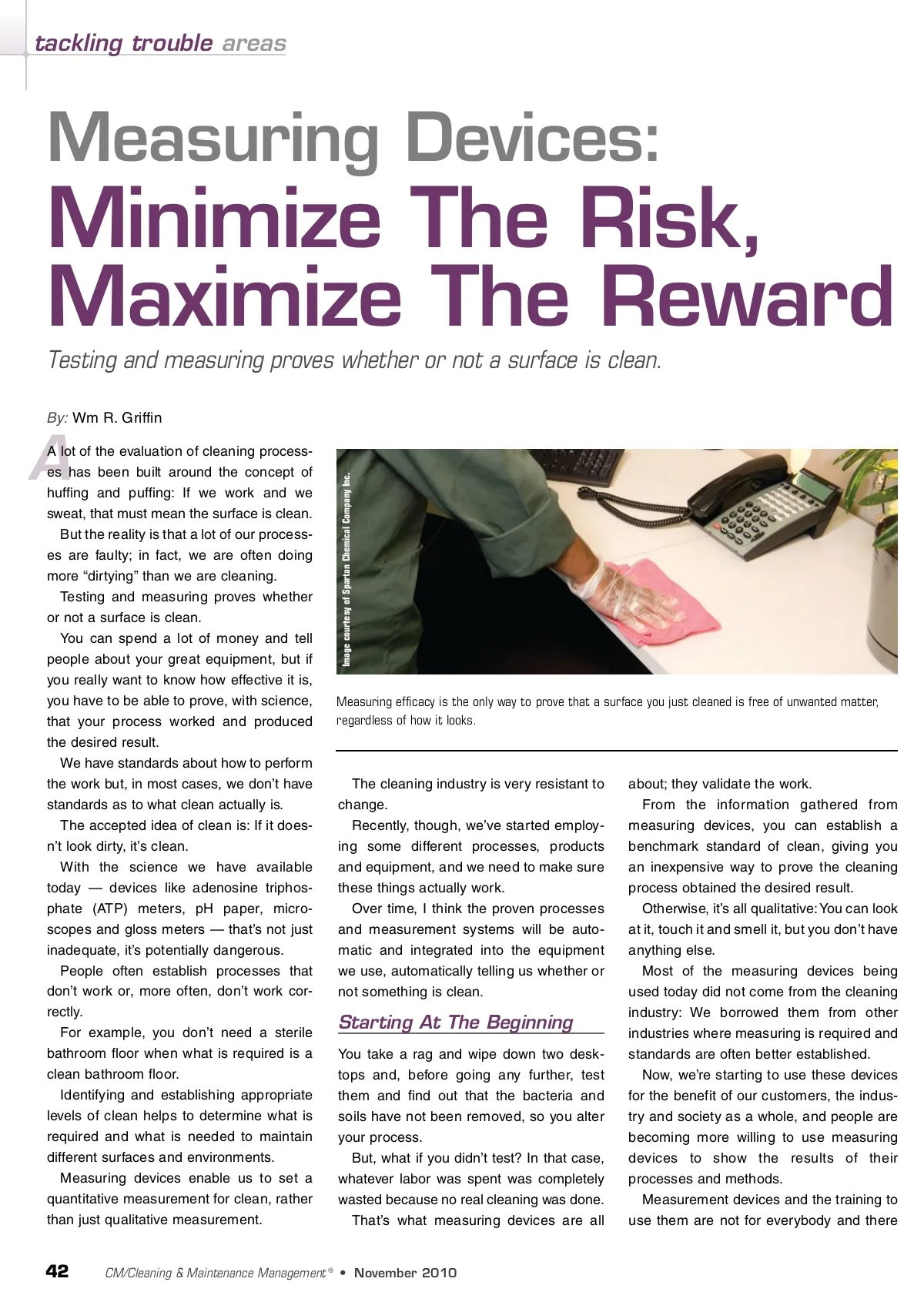
tackling trouble areas Measuring Devices: Minimize The Risk, Maximize The Reward Testing and measuring proves whether or not a surface is clean. By: Wm R. Griffin Image courtesy of Spartan Chemical Company Inc. A A lot of the evaluation of cleaning process-es has been built around the concept of huffing and puffing: If we work and we sweat, that must mean the surface is clean. But the reality is that a lot of our process-es are faulty; in fact, we are often doing more “dirtying” than we are cleaning. Testing and measuring proves whether or not a surface is clean. You can spend a lot of money and tell people about your great equipment, but if you really want to know how effective it is, you have to be able to prove, with science, that your process worked and produced the desired result. We have standards about how to perform the work but, in most cases, we don’t have standards as to what clean actually is. The accepted idea of clean is: If it does-n’t look dirty, it’s clean. With the science we have available today — devices like adenosine triphos-phate (ATP) meters, pH paper, micro-scopes and gloss meters — that’s not just inadequate, it’s potentially dangerous. People often establish processes that don’t work or, more often, don’t work cor-rectly. For example, you don’t need a sterile bathroom floor when what is required is a clean bathroom floor. Identifying and establishing appropriate levels of clean helps to determine what is required and what is needed to maintain different surfaces and environments. Measuring devices enable us to set a quantitative measurement for clean, rather than just qualitative measurement. Measuring efficacy is the only way to prove that a surface you just cleaned is free of unwanted matter, regardless of how it looks. The cleaning industry is very resistant to change. Recently, though, we’ve started employ-ing some different processes, products and equipment, and we need to make sure these things actually work. Over time, I think the proven processes and measurement systems will be auto-matic and integrated into the equipment we use, automatically telling us whether or not something is clean. Starting At The Beginning You take a rag and wipe down two desk-tops and, before going any further, test them and find out that the bacteria and soils have not been removed, so you alter your process. But, what if you didn’t test? In that case, whatever labor was spent was completely wasted because no real cleaning was done. That’s what measuring devices are all about; they validate the work. From the information gathered from measuring devices, you can establish a benchmark standard of clean, giving you an inexpensive way to prove the cleaning process obtained the desired result. Otherwise, it’s all qualitative: You can look at it, touch it and smell it, but you don’t have anything else. Most of the measuring devices being used today did not come from the cleaning industry: We borrowed them from other industries where measuring is required and standards are often better established. Now, we’re starting to use these devices for the benefit of our customers, the indus-try and society as a whole, and people are becoming more willing to use measuring devices to show the results of their processes and methods. Measurement devices and the training to use them are not for everybody and there 42 CM/Cleaning & Maintenance Management ® • November 2010
CMM – Archives Nov 2010: 42