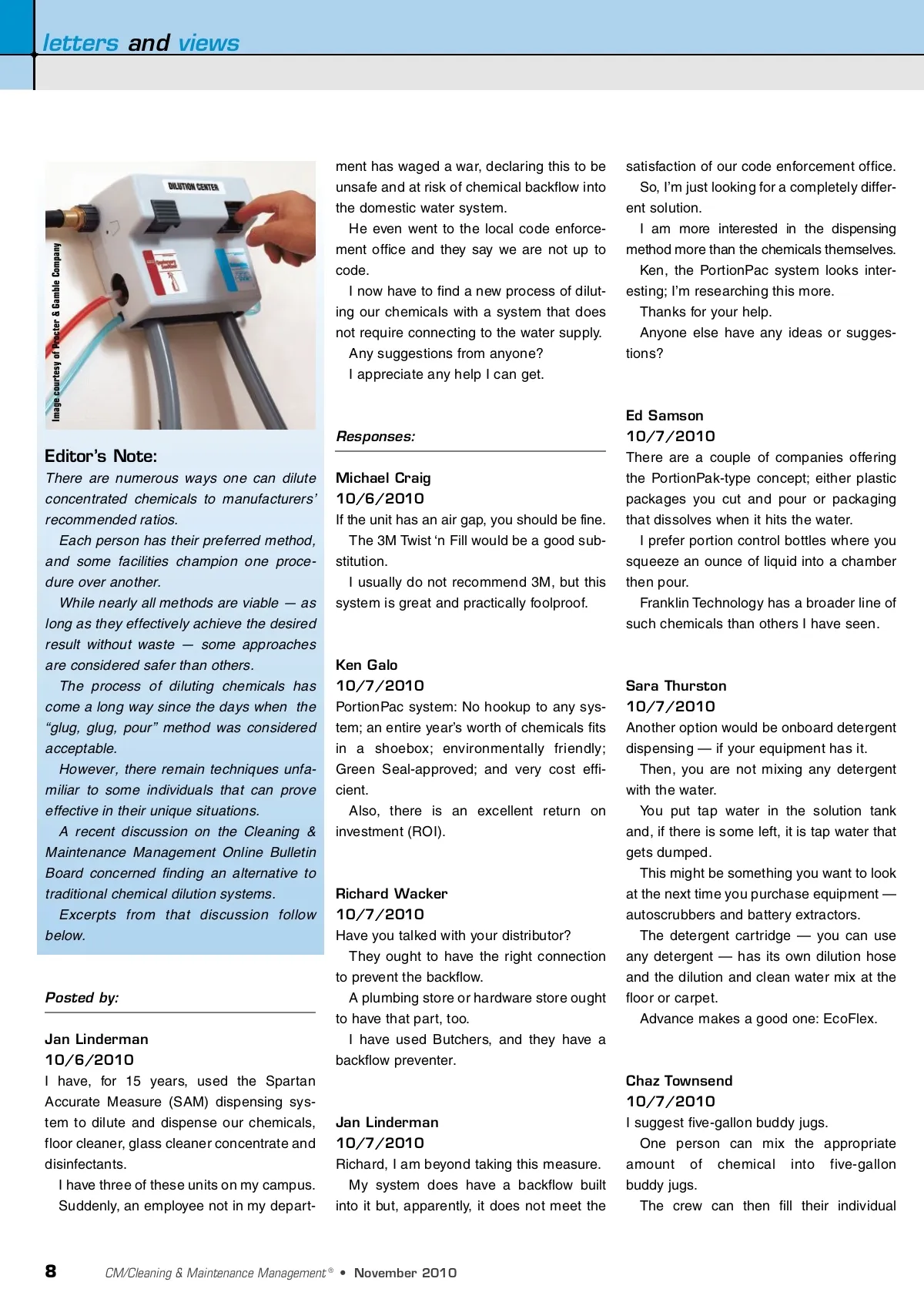
letters and views Image courtesy of Procter & Gamble Company ment has waged a war, declaring this to be unsafe and at risk of chemical backflow into the domestic water system. He even went to the local code enforce-ment office and they say we are not up to code. I now have to find a new process of dilut-ing our chemicals with a system that does not require connecting to the water supply. Any suggestions from anyone? I appreciate any help I can get. satisfaction of our code enforcement office. So, I’m just looking for a completely differ-ent solution. I am more interested in the dispensing method more than the chemicals themselves. Ken, the PortionPac system looks inter-esting; I’m researching this more. Thanks for your help. Anyone else have any ideas or sugges-tions? Responses: Editor’s Note: There are numerous ways one can dilute concentrated chemicals to manufacturersʼ recommended ratios. Each person has their preferred method, and some facilities champion one proce-dure over another. While nearly all methods are viable — as long as they effectively achieve the desired result without waste — some approaches are considered safer than others. The process of diluting chemicals has come a long way since the days when the “glug, glug, pour” method was considered acceptable. However, there remain techniques unfa-miliar to some individuals that can prove effective in their unique situations. A recent discussion on the Cleaning & Maintenance Management Online Bulletin Board concerned finding an alternative to traditional chemical dilution systems. Excerpts from that discussion follow below. Michael Craig 10/6/2010 If the unit has an air gap, you should be fine. The 3M Twist ‘n Fill would be a good sub-stitution. I usually do not recommend 3M, but this system is great and practically foolproof. Ed Samson 10/7/2010 There are a couple of companies offering the PortionPak-type concept; either plastic packages you cut and pour or packaging that dissolves when it hits the water. I prefer portion control bottles where you squeeze an ounce of liquid into a chamber then pour. Franklin Technology has a broader line of such chemicals than others I have seen. Ken Galo 10/7/2010 PortionPac system: No hookup to any sys-tem; an entire year’s worth of chemicals fits in a shoebox; environmentally friendly; Green Seal-approved; and very cost effi-cient. Also, there is an excellent return on investment (ROI). Posted by: Jan Linderman 10/6/2010 I have, for 15 years, used the Spartan Accurate Measure (SAM) dispensing sys-tem to dilute and dispense our chemicals, floor cleaner, glass cleaner concentrate and disinfectants. I have three of these units on my campus. Suddenly, an employee not in my depart-Richard Wacker 10/7/2010 Have you talked with your distributor? They ought to have the right connection to prevent the backflow. A plumbing store or hardware store ought to have that part, too. I have used Butchers, and they have a backflow preventer. Sara Thurston 10/7/2010 Another option would be onboard detergent dispensing — if your equipment has it. Then, you are not mixing any detergent with the water. You put tap water in the solution tank and, if there is some left, it is tap water that gets dumped. This might be something you want to look at the next time you purchase equipment — autoscrubbers and battery extractors. The detergent cartridge — you can use any detergent — has its own dilution hose and the dilution and clean water mix at the floor or carpet. Advance makes a good one: EcoFlex. Jan Linderman 10/7/2010 Richard, I am beyond taking this measure. My system does have a backflow built into it but, apparently, it does not meet the Chaz Townsend 10/7/2010 I suggest five-gallon buddy jugs. One person can mix the appropriate amount of chemical into five-gallon buddy jugs. The crew can then fill their individual 8 CM/Cleaning & Maintenance Management ® • November 2010
CMM – Archives Nov 2010: 8