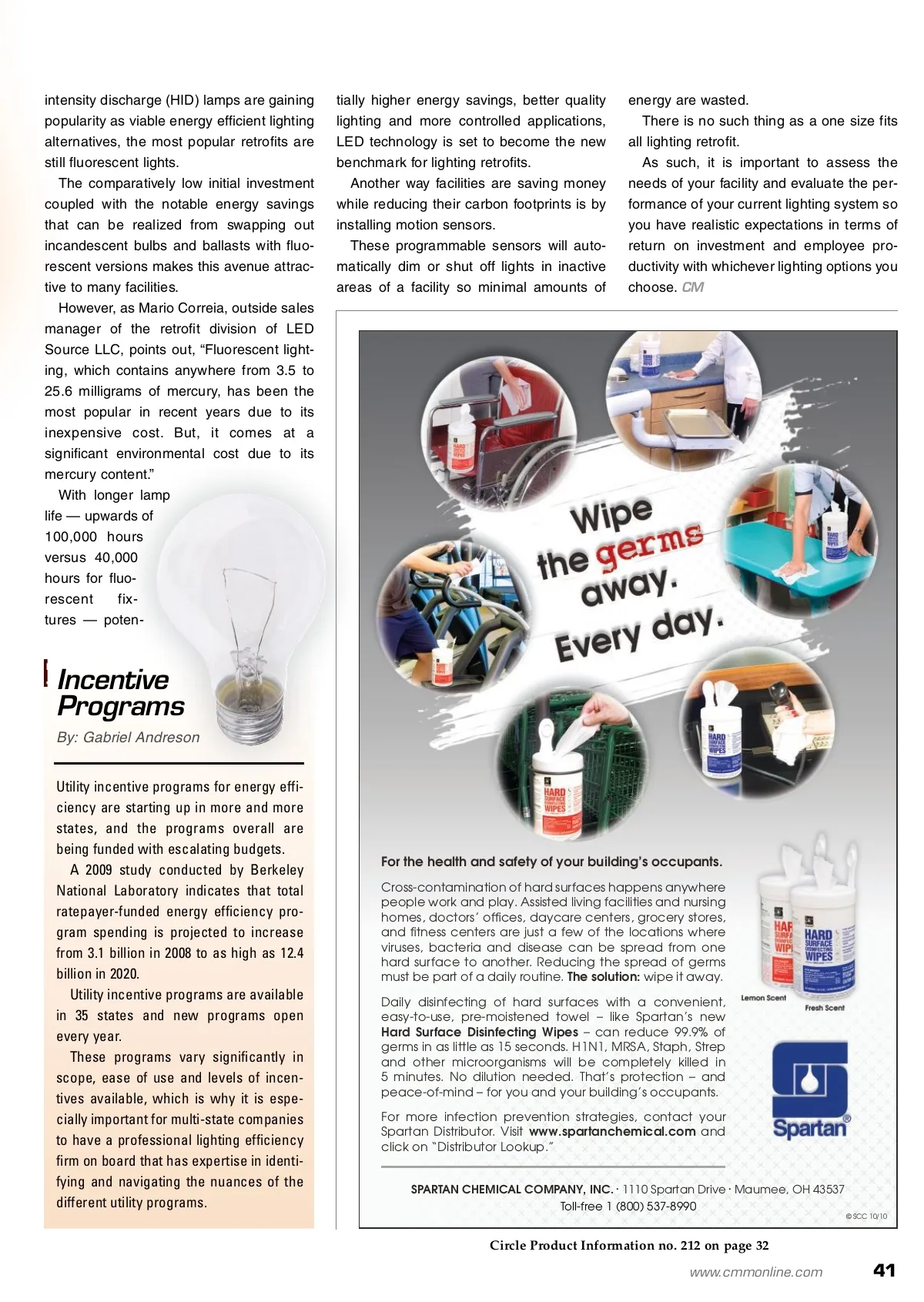
intensity discharge (HID) lamps are gaining popularity as viable energy efficient lighting alternatives, the most popular retrofits are still fluorescent lights. The comparatively low initial investment coupled with the notable energy savings that can be realized from swapping out incandescent bulbs and ballasts with fluo-rescent versions makes this avenue attrac-tive to many facilities. However, as Mario Correia, outside sales manager of the retrofit division of LED Source LLC, points out, “Fluorescent light-ing, which contains anywhere from 3.5 to 25.6 milligrams of mercury, has been the most popular in recent years due to its inexpensive cost. But, it comes at a significant environmental cost due to its mercury content.” With longer lamp life — upwards of 100,000 hours versus 40,000 hours for fluo-rescent fix-tures — poten-tially higher energy savings, better quality lighting and more controlled applications, LED technology is set to become the new benchmark for lighting retrofits. Another way facilities are saving money while reducing their carbon footprints is by installing motion sensors. These programmable sensors will auto-matically dim or shut off lights in inactive areas of a facility so minimal amounts of energy are wasted. There is no such thing as a one size fits all lighting retrofit. As such, it is important to assess the needs of your facility and evaluate the per-formance of your current lighting system so you have realistic expectations in terms of return on investment and employee pro-ductivity with whichever lighting options you choose. CM Incentive Programs By: Gabriel Andreson Utility incentive programs for energy effi-ciency are starting up in more and more states, and the programs overall are being funded with escalating budgets. A 2009 study conducted by Berkeley National Laboratory indicates that total ratepayer-funded energy efficiency pro-gram spending is projected to increase from 3.1 billion in 2008 to as high as 12.4 billion in 2020. Utility incentive programs are available in 35 states and new programs open every year. These programs vary significantly in scope, ease of use and levels of incen-tives available, which is why it is espe-cially important for multi-state companies to have a professional lighting efficiency firm on board that has expertise in identi-fying and navigating the nuances of the different utility programs. For the health and safety of your building’s occupants. Cross-contamination of hard surfaces happens anywhere people work and play. Assisted living facilities and nursing homes, doctors’ offices, daycare centers, grocery stores, and fitness centers are just a few of the locations where viruses, bacteria and disease can be spread from one hard surface to another. Reducing the spread of germs must be part of a daily routine. The solution: wipe it away. Daily disinfecting of hard surfaces with a convenient, easy-to-use, pre-moistened towel – like Spartan’s new Hard Surface Disinfecting Wipes – can reduce 99.9% of germs in as little as 15 seconds. H1N1, MRSA, Staph, Strep and other microorganisms will be completely killed in 5 minutes. No dilution needed. That’s protection – and peace-of-mind – for you and your building’s occupants. For more infection prevention strategies, contact your Spartan Distributor. Visit www.spartanchemical.com and click on “Distributor Lookup.” SPARTAN CHEMICAL COMPANY, INC. U 1110 Spartan Drive U Maumee, OH 43537 Toll-free 1 (800) 537-8990 © SCC 10/10 Circle Product Information no. 212 on page 32 www.cmmonline.com 41
CMM – Archives Jan 2011: 41