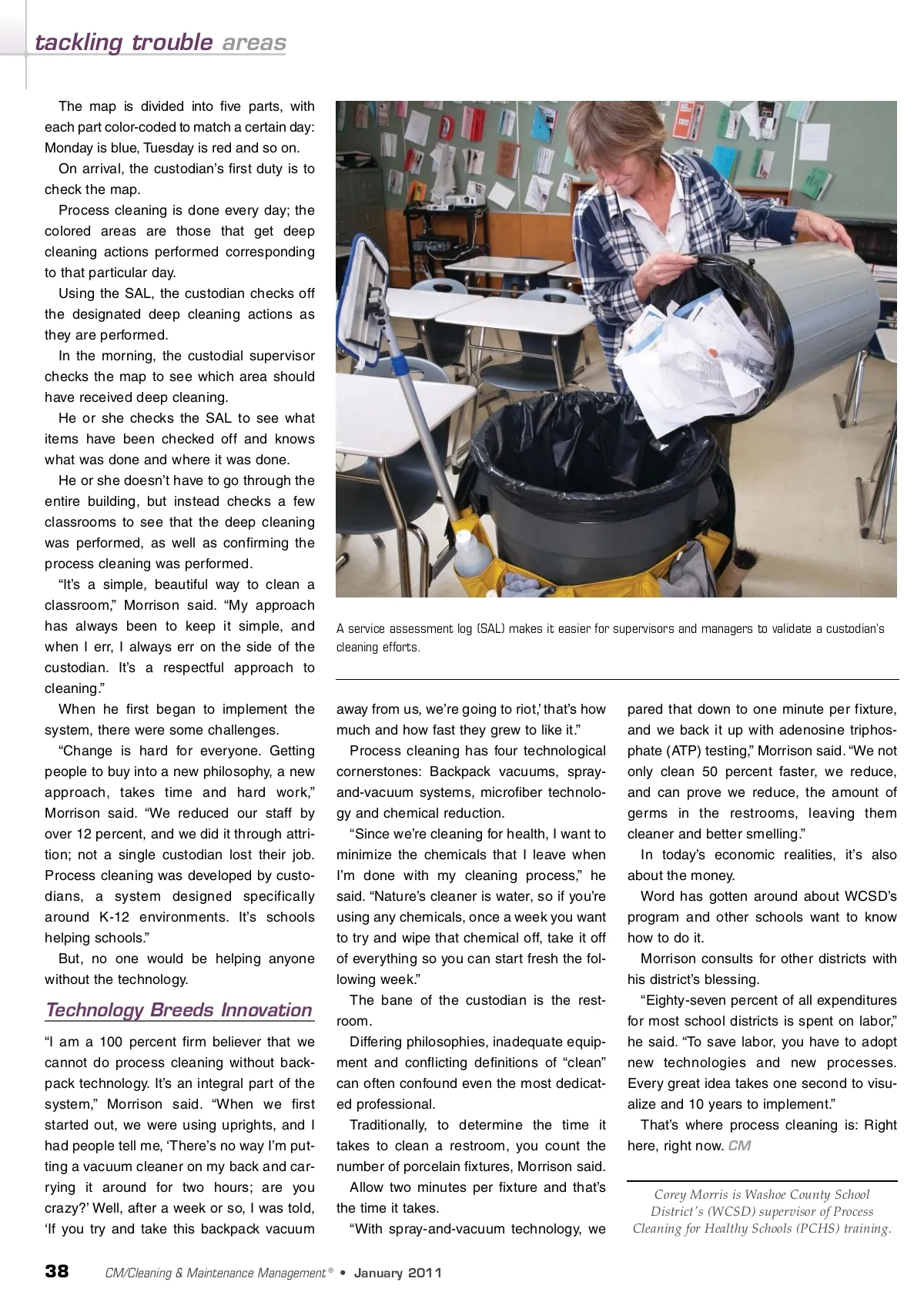
tackling trouble areas The map is divided into five parts, with each part color-coded to match a certain day: Monday is blue, Tuesday is red and so on. On arrival, the custodian’s first duty is to check the map. Process cleaning is done every day; the colored areas are those that get deep cleaning actions performed corresponding to that particular day. Using the SAL, the custodian checks off the designated deep cleaning actions as they are performed. In the morning, the custodial supervisor checks the map to see which area should have received deep cleaning. He or she checks the SAL to see what items have been checked off and knows what was done and where it was done. He or she doesn’t have to go through the entire building, but instead checks a few classrooms to see that the deep cleaning was performed, as well as confirming the process cleaning was performed. “It’s a simple, beautiful way to clean a classroom,” Morrison said. “My approach has always been to keep it simple, and when I err, I always err on the side of the custodian. It’s a respectful approach to cleaning.” When he first began to implement the system, there were some challenges. “Change is hard for everyone. Getting people to buy into a new philosophy, a new approach, takes time and hard work,” Morrison said. “We reduced our staff by over 12 percent, and we did it through attri-tion; not a single custodian lost their job. Process cleaning was developed by custo-dians, a system designed specifically around K-12 environments. It’s schools helping schools.” But, no one would be helping anyone without the technology. A service assessment log (SAL) makes it easier for supervisors and managers to validate a custodian's cleaning efforts. Technology Breeds Innovation “I am a 100 percent firm believer that we cannot do process cleaning without back-pack technology. It’s an integral part of the system,” Morrison said. “When we first started out, we were using uprights, and I had people tell me, ‘There’s no way I’m put-ting a vacuum cleaner on my back and car-rying it around for two hours; are you crazy?’ Well, after a week or so, I was told, ‘If you try and take this backpack vacuum away from us, we’re going to riot,’ that’s how much and how fast they grew to like it.” Process cleaning has four technological cornerstones: Backpack vacuums, spray-and-vacuum systems, microfiber technolo-gy and chemical reduction. “Since we’re cleaning for health, I want to minimize the chemicals that I leave when I’m done with my cleaning process,” he said. “Nature’s cleaner is water, so if you’re using any chemicals, once a week you want to try and wipe that chemical off, take it off of everything so you can start fresh the fol-lowing week.” The bane of the custodian is the rest-room. Differing philosophies, inadequate equip-ment and conflicting definitions of “clean” can often confound even the most dedicat-ed professional. Traditionally, to determine the time it takes to clean a restroom, you count the number of porcelain fixtures, Morrison said. Allow two minutes per fixture and that’s the time it takes. “With spray-and-vacuum technology, we pared that down to one minute per fixture, and we back it up with adenosine triphos-phate (ATP) testing,” Morrison said. “We not only clean 50 percent faster, we reduce, and can prove we reduce, the amount of germs in the restrooms, leaving them cleaner and better smelling.” In today’s economic realities, it’s also about the money. Word has gotten around about WCSD’s program and other schools want to know how to do it. Morrison consults for other districts with his district’s blessing. “Eighty-seven percent of all expenditures for most school districts is spent on labor,” he said. “To save labor, you have to adopt new technologies and new processes. Every great idea takes one second to visu-alize and 10 years to implement.” That’s where process cleaning is: Right here, right now. CM Corey Morris is Washoe County School District's (WCSD) supervisor of Process Cleaning for Healthy Schools (PCHS) training. 38 CM/Cleaning & Maintenance Management ® • January 2011
CMM – Archives Jan 2011: 38