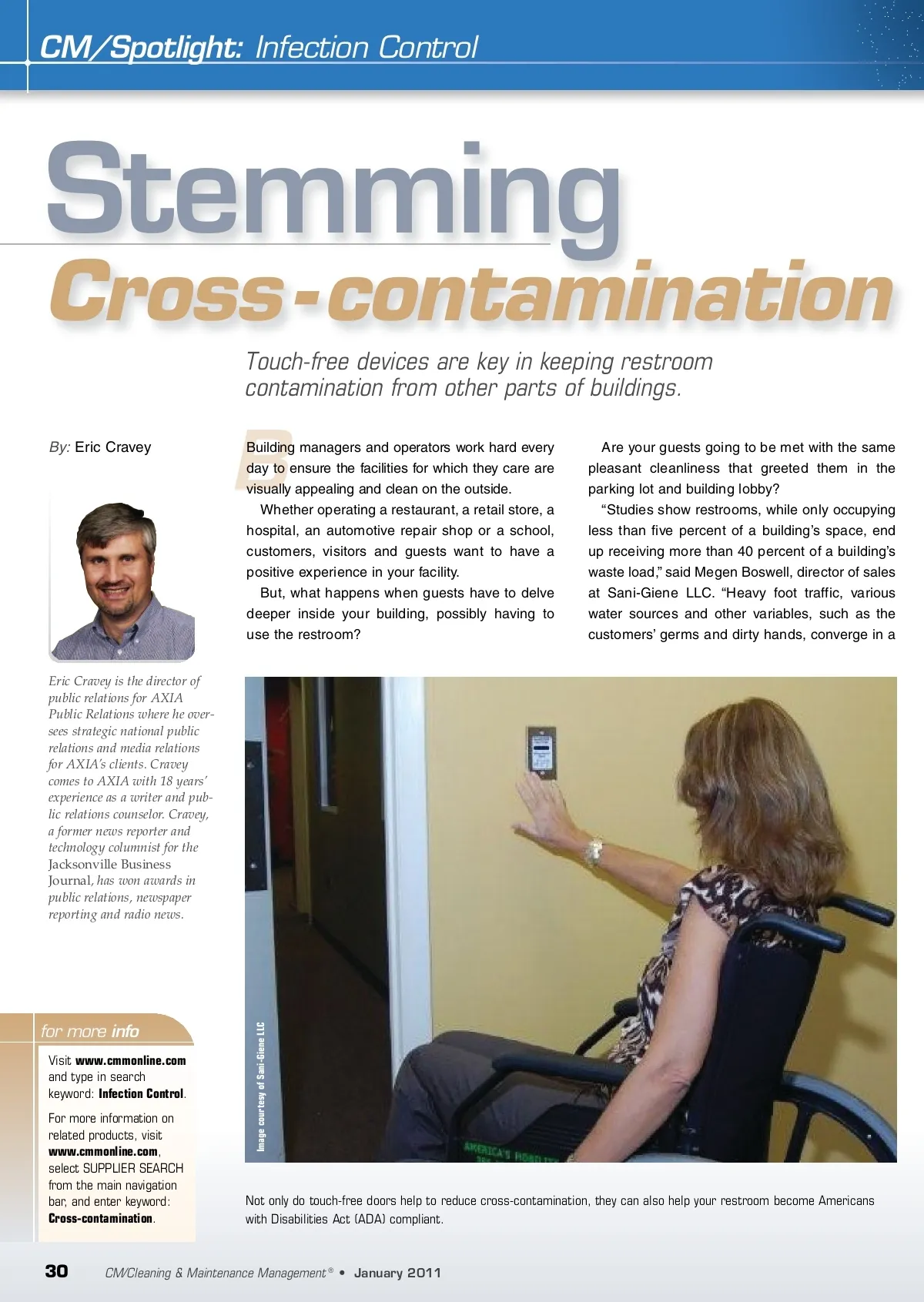
building’s restroom to create an uninten-tional lab that breeds germs and bacteria.” Inadequate restroom cleaning harms human health and reaps negative customer impressions, which can result in lost busi-ness. No one likes frequenting an establish-ment with restrooms that are dirty or per-ceived as dirty and could potentially lead to the spread of germs through cross-contam-ination. One thing business owners can do to win the war on germs is to establish a cultural practice that promotes safety and aware-ness about how germs are spread. According to the U.S. Centers for Disease Control and Prevention (CDC), hand washing is the most important procedure for preventing the spread of infection. However, numerous studies show that as many as 25 percent of all restroom users will leave the facility with some form of bacteria on their hands. of modern touch-free devices will not only increase the likelihood that guests will use the restroom, touch-free devices also improve public perception of your facility and your business overall. Health In Your Hands Touch-free toilets and touch-free seat cov-ers give restroom users peace of mind while in the stall, yet they end up having to touch the stall door upon exit. After exiting the stall, the restroom guest may be greeted by a touch-free soap dis-penser and a touch-free water source to cre-ate the ultimate hand washing experience. The next part of the touch-free experi-ence should include a touch-free hand dryer or touch-free paper towel dispenser. “The best way that building managers can provide a complete restroom experi-ence for their guests is to install touch-free door systems,” Boswell said. “A touch-free door exiting system will complement all of the restroom’s other touch-free devices and provide the strongest amount of user peace of mind that the spread of germs through cross-contamination has been minimized.” With the addition of a touch-free door opening system, your pristinely maintained restroom will further promote proper hand washing practices and force building maintenance crews to pay closer attention to routine cleanliness of the restroom. Building operators can implement touch-free devices without breaking the bank. Most touch-free products can be retrofit-ted in every facility and result in improved worker and guest morale. “When touch-free products are put in place, the cost of maintenance also decreases, while building occupants become more willing to use the restroom,” Boswell said. Facility managers are on the cusp of a complete touch-free restroom experience, a time that can only create excitement for an industry that is often overlooked. As more and more touch-free restroom systems become available, the less time our culture will have to worry about the spread of germs, which makes for a bright future for the industry. CM Circle Product Information no. 208 on page 32 www.cmmonline.com The Criticality Of Cleaning To improve restroom cleanliness, building operators should identify the critical areas of the restroom and establish strategic cleaning systems that work best for their specific needs. One such solution may include the deployment of all-in-one spray and vacuum systems that apply high-pressure mixtures of chemicals and water and, therefore, lower labor costs. Building managers can also adopt the use of microfiber mops and cloths that allow for greater absorbency and scrubbing capability. Dual-compartment buckets that have separate basins for clean and soiled water have also proven effective in the battle for clean restrooms. In the past decade, there has been an increase in the number of touch-free devices that are available to ensure germs are not spread in and out of restrooms. Modern society is more aware of the dangers of cross-contamination to such a point that one study found that almost 30 percent of people avoid using public rest-rooms due to the awareness of the pres-ence of germs. But, another study showed that the use 31
CMM – Archives Jan 2011: 31