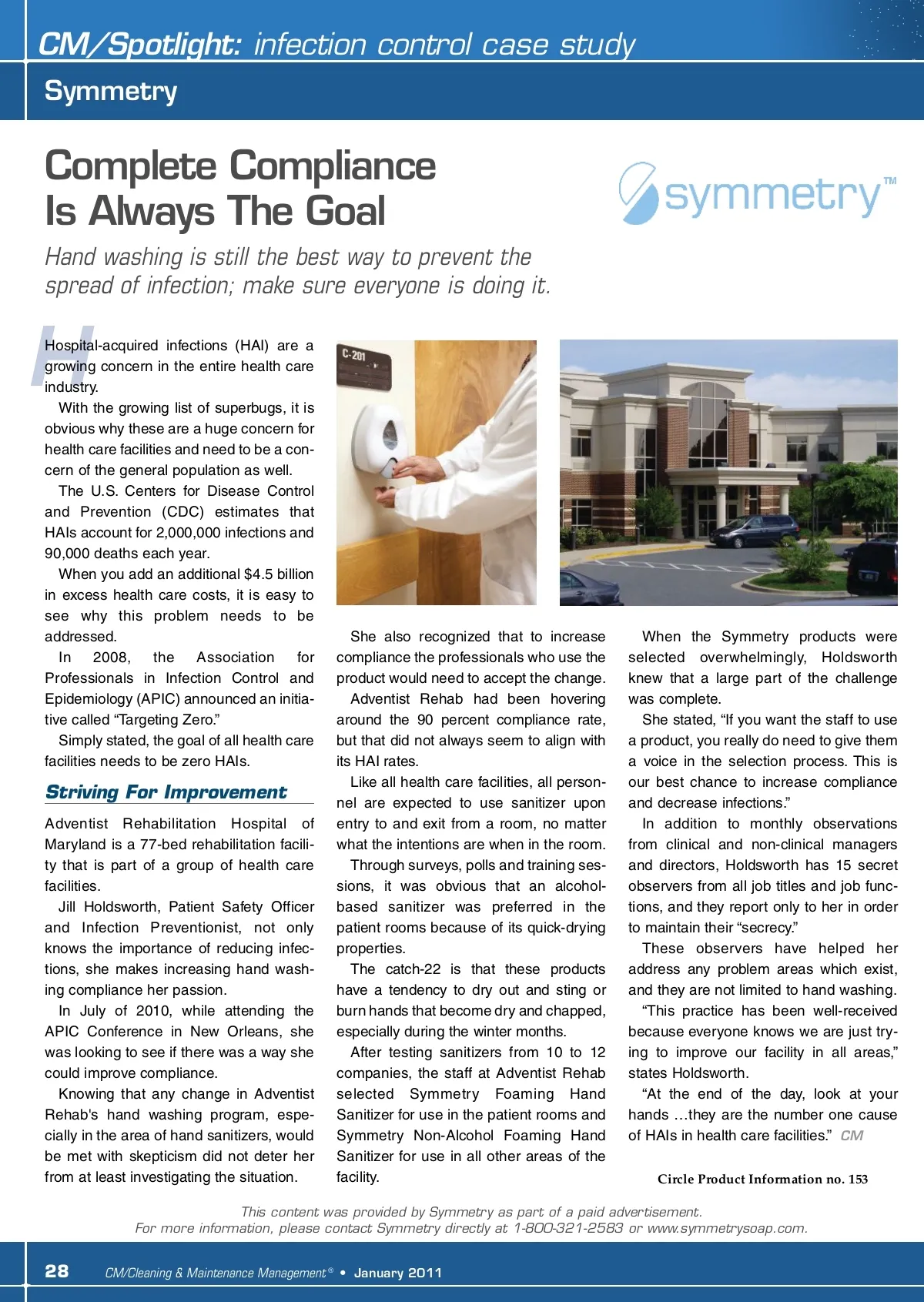
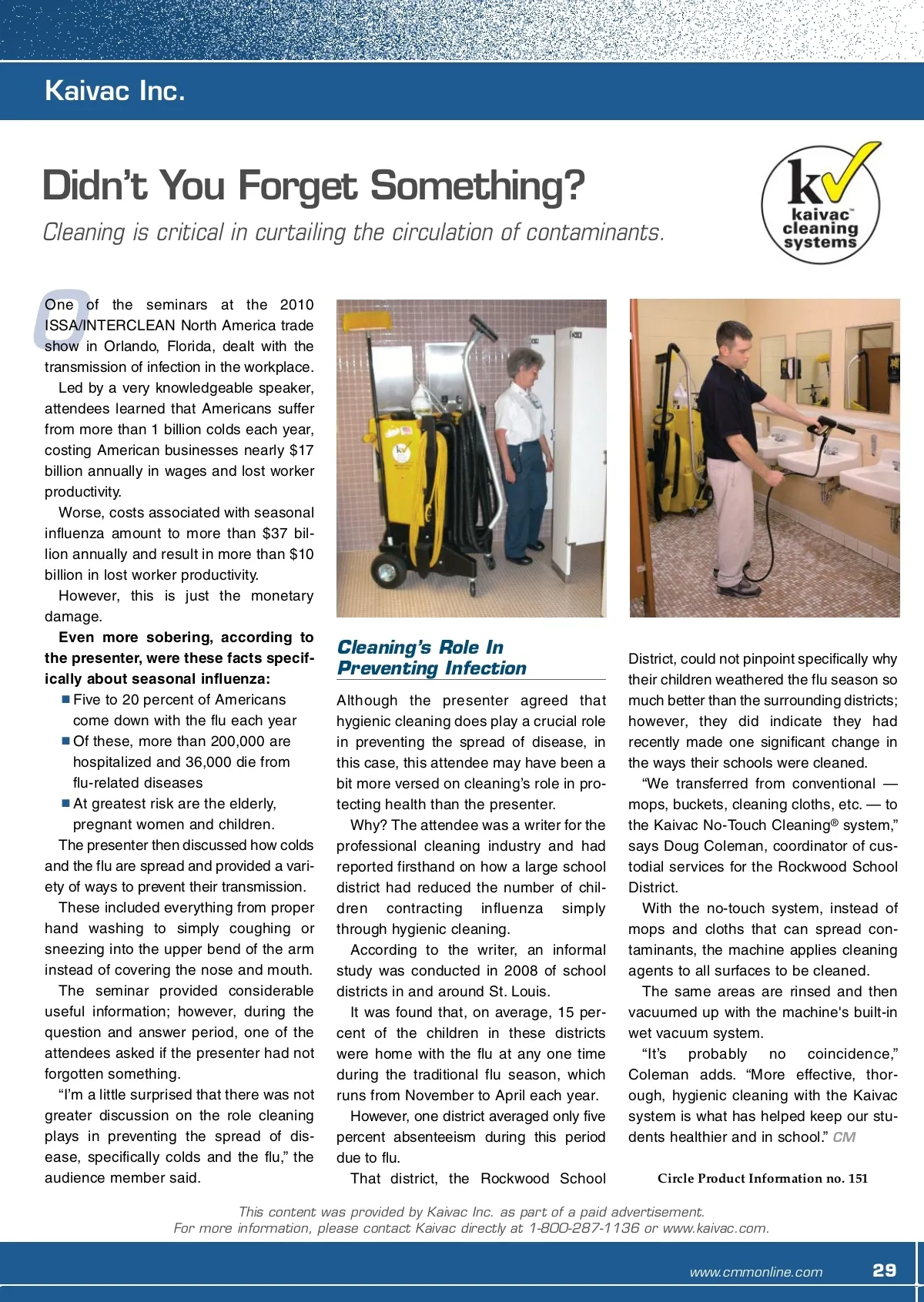
Kaivac Inc. Didn’t You Forget Something? Cleaning is critical in curtailing the circulation of contaminants. O One of the seminars at the 2010 ISSA/INTERCLEAN North America trade show in Orlando, Florida, dealt with the transmission of infection in the workplace. Led by a very knowledgeable speaker, attendees learned that Americans suffer from more than 1 billion colds each year, costing American businesses nearly $17 billion annually in wages and lost worker productivity. Worse, costs associated with seasonal influenza amount to more than $37 bil-lion annually and result in more than $10 billion in lost worker productivity. However, this is just the monetary damage. Even more sobering, according to the presenter, were these facts specif-ically about seasonal influenza: Five to 20 percent of Americans come down with the flu each year Of these, more than 200,000 are hospitalized and 36,000 die from flu-related diseases At greatest risk are the elderly, pregnant women and children. The presenter then discussed how colds and the flu are spread and provided a vari-ety of ways to prevent their transmission. These included everything from proper hand washing to simply coughing or sneezing into the upper bend of the arm instead of covering the nose and mouth. The seminar provided considerable useful information; however, during the question and answer period, one of the attendees asked if the presenter had not forgotten something. “I’m a little surprised that there was not greater discussion on the role cleaning plays in preventing the spread of dis-ease, specifically colds and the flu,” the audience member said. Cleaning’s Role In Preventing Infection Although the presenter agreed that hygienic cleaning does play a crucial role in preventing the spread of disease, in this case, this attendee may have been a bit more versed on cleaning’s role in pro-tecting health than the presenter. Why? The attendee was a writer for the professional cleaning industry and had reported firsthand on how a large school district had reduced the number of chil-dren contracting influenza simply through hygienic cleaning. According to the writer, an informal study was conducted in 2008 of school districts in and around St. Louis. It was found that, on average, 15 per-cent of the children in these districts were home with the flu at any one time during the traditional flu season, which runs from November to April each year. However, one district averaged only five percent absenteeism during this period due to flu. That district, the Rockwood School District, could not pinpoint specifically why their children weathered the flu season so much better than the surrounding districts; however, they did indicate they had recently made one significant change in the ways their schools were cleaned. “We transferred from conventional — mops, buckets, cleaning cloths, etc. — to the Kaivac No-Touch Cleaning ® system,” says Doug Coleman, coordinator of cus-todial services for the Rockwood School District. With the no-touch system, instead of mops and cloths that can spread con-taminants, the machine applies cleaning agents to all surfaces to be cleaned. The same areas are rinsed and then vacuumed up with the machine's built-in wet vacuum system. “It’s probably no coincidence,” Coleman adds. “More effective, thor-ough, hygienic cleaning with the Kaivac system is what has helped keep our stu-dents healthier and in school.” CM Circle Product Information no. 151 This content was provided by Kaivac Inc. as part of a paid advertisement. For more information, please contact Kaivac directly at 1-800-287-1136 or www.kaivac.com. www.cmmonline.com 29
CMM – Archives Jan 2011: 29