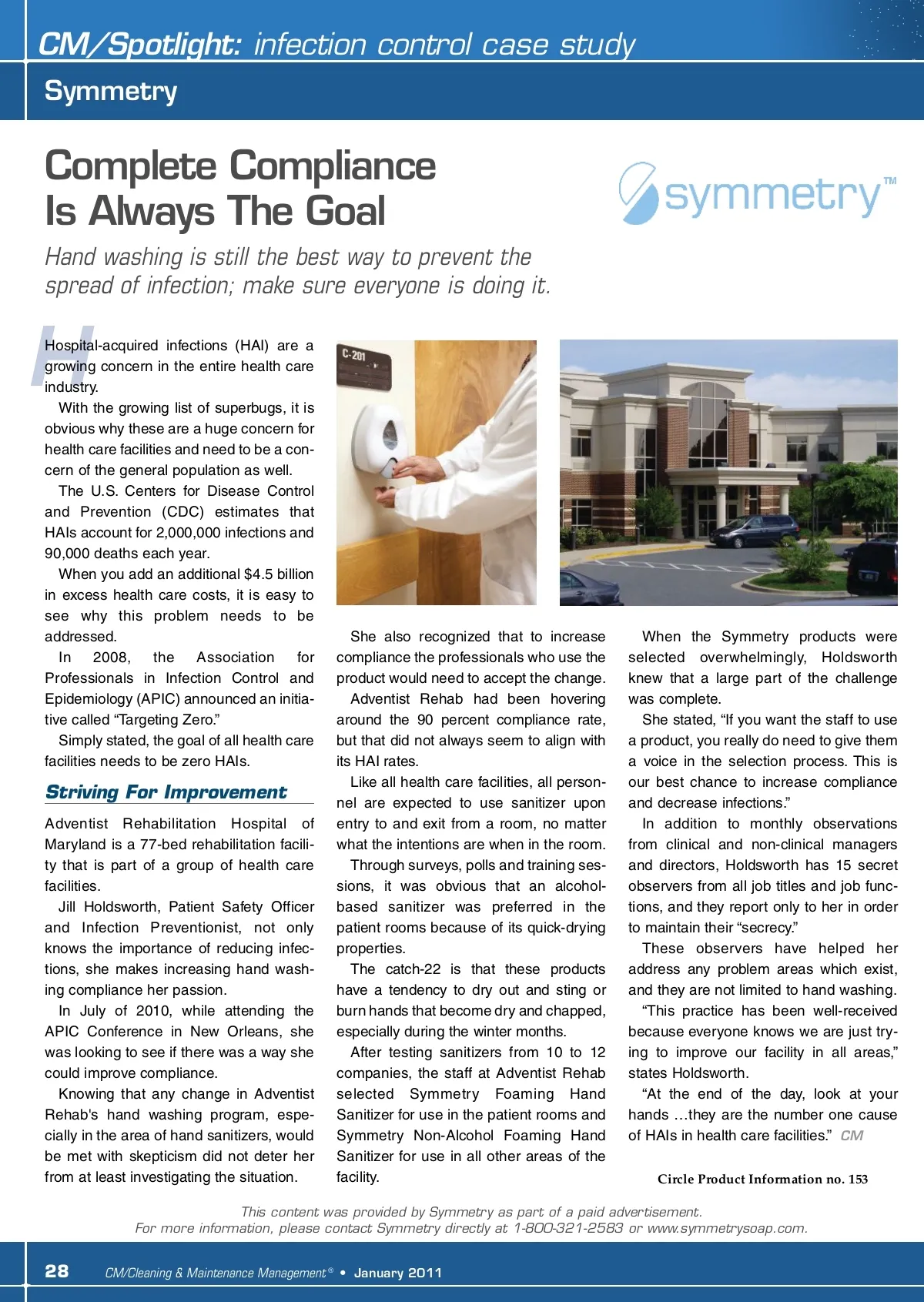
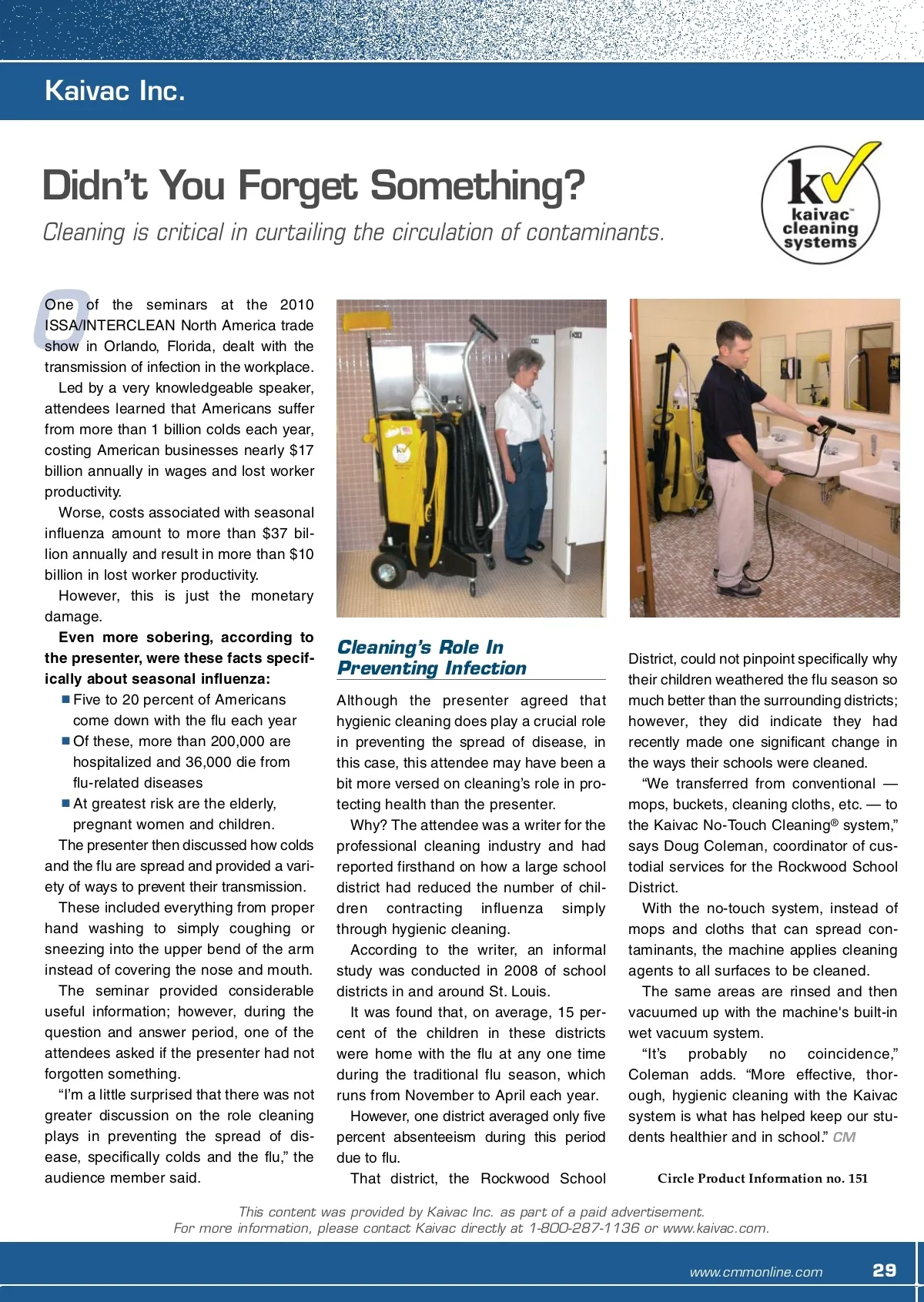
CM/Spotlight: infection control case study Symmetry Complete Compliance Is Always The Goal Hand washing is still the best way to prevent the spread of infection; make sure everyone is doing it. H Hospital-acquired infections (HAI) are a growing concern in the entire health care industry. With the growing list of superbugs, it is obvious why these are a huge concern for health care facilities and need to be a con-cern of the general population as well. The U.S. Centers for Disease Control and Prevention (CDC) estimates that HAIs account for 2,000,000 infections and 90,000 deaths each year. When you add an additional $4.5 billion in excess health care costs, it is easy to see why this problem needs to be addressed. In 2008, the Association for Professionals in Infection Control and Epidemiology (APIC) announced an initia-tive called “Targeting Zero.” Simply stated, the goal of all health care facilities needs to be zero HAIs. Striving For Improvement Adventist Rehabilitation Hospital of Maryland is a 77-bed rehabilitation facili-ty that is part of a group of health care facilities. Jill Holdsworth, Patient Safety Officer and Infection Preventionist, not only knows the importance of reducing infec-tions, she makes increasing hand wash-ing compliance her passion. In July of 2010, while attending the APIC Conference in New Orleans, she was looking to see if there was a way she could improve compliance. Knowing that any change in Adventist Rehab's hand washing program, espe-cially in the area of hand sanitizers, would be met with skepticism did not deter her from at least investigating the situation. She also recognized that to increase compliance the professionals who use the product would need to accept the change. Adventist Rehab had been hovering around the 90 percent compliance rate, but that did not always seem to align with its HAI rates. Like all health care facilities, all person-nel are expected to use sanitizer upon entry to and exit from a room, no matter what the intentions are when in the room. Through surveys, polls and training ses-sions, it was obvious that an alcohol-based sanitizer was preferred in the patient rooms because of its quick-drying properties. The catch-22 is that these products have a tendency to dry out and sting or burn hands that become dry and chapped, especially during the winter months. After testing sanitizers from 10 to 12 companies, the staff at Adventist Rehab selected Symmetry Foaming Hand Sanitizer for use in the patient rooms and Symmetry Non-Alcohol Foaming Hand Sanitizer for use in all other areas of the facility. When the Symmetry products were selected overwhelmingly, Holdsworth knew that a large part of the challenge was complete. She stated, “If you want the staff to use a product, you really do need to give them a voice in the selection process. This is our best chance to increase compliance and decrease infections.” In addition to monthly observations from clinical and non-clinical managers and directors, Holdsworth has 15 secret observers from all job titles and job func-tions, and they report only to her in order to maintain their “secrecy.” These observers have helped her address any problem areas which exist, and they are not limited to hand washing. “This practice has been well-received because everyone knows we are just try-ing to improve our facility in all areas,” states Holdsworth. “At the end of the day, look at your hands …they are the number one cause of HAIs in health care facilities.” CM Circle Product Information no. 153 This content was provided by Symmetry as part of a paid advertisement. For more information, please contact Symmetry directly at 1-800-321-2583 or www.symmetrysoap.com. 28 CM/Cleaning & Maintenance Management ® • January 2011
CMM – Archives Jan 2011: 28