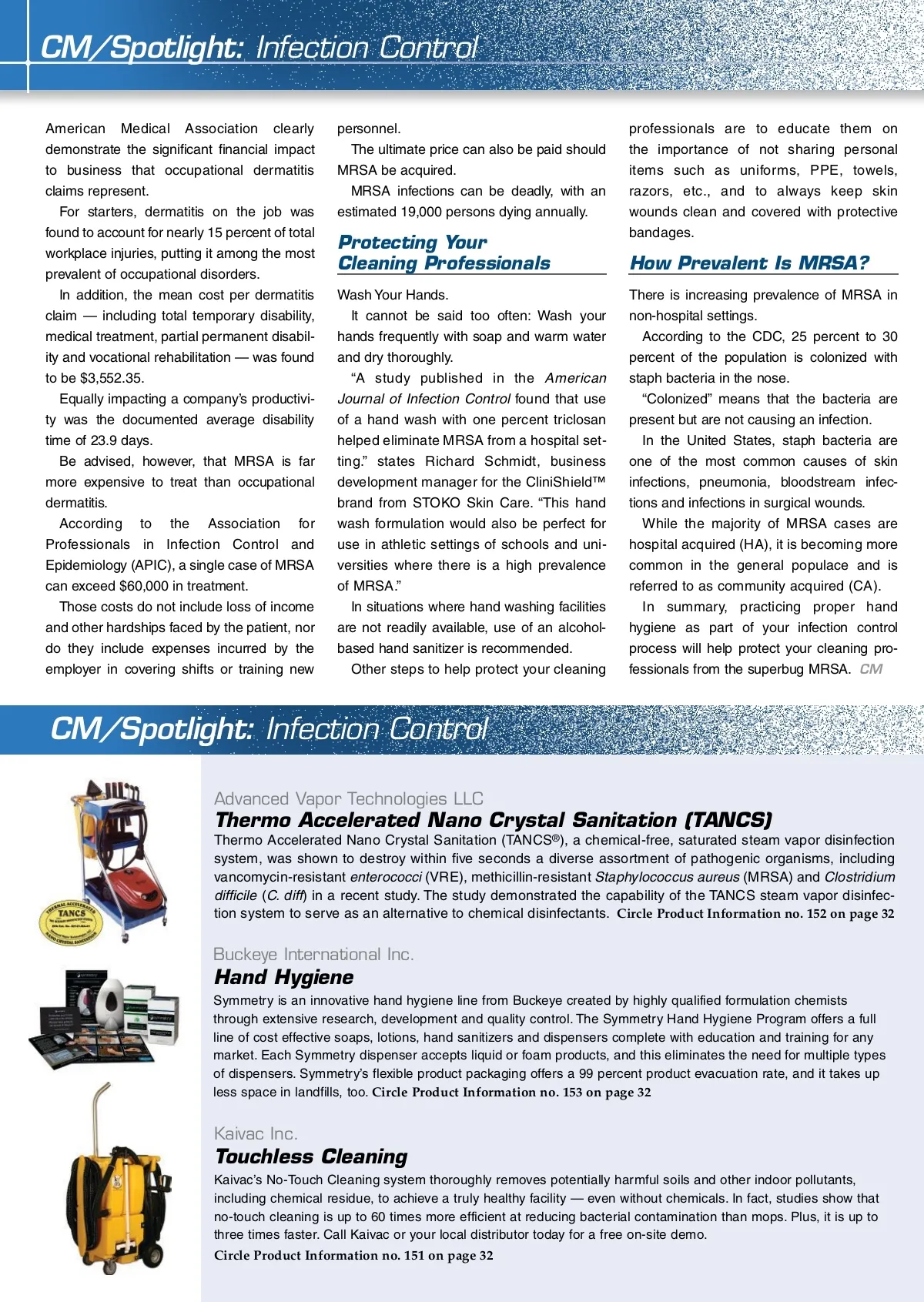
CM/Spotlight: Infection Control American Medical Association clearly demonstrate the significant financial impact to business that occupational dermatitis claims represent. For starters, dermatitis on the job was found to account for nearly 15 percent of total workplace injuries, putting it among the most prevalent of occupational disorders. In addition, the mean cost per dermatitis claim — including total temporary disability, medical treatment, partial permanent disabil-ity and vocational rehabilitation — was found to be $3,552.35. Equally impacting a company’s productivi-ty was the documented average disability time of 23.9 days. Be advised, however, that MRSA is far more expensive to treat than occupational dermatitis. According to the Association for Professionals in Infection Control and Epidemiology (APIC), a single case of MRSA can exceed $60,000 in treatment. Those costs do not include loss of income and other hardships faced by the patient, nor do they include expenses incurred by the employer in covering shifts or training new personnel. The ultimate price can also be paid should MRSA be acquired. MRSA infections can be deadly, with an estimated 19,000 persons dying annually. professionals are to educate them on the importance of not sharing personal items such as uniforms, PPE, towels, razors, etc., and to always keep skin wounds clean and covered with protective bandages. Protecting Your Cleaning Professionals Wash Your Hands. It cannot be said too often: Wash your hands frequently with soap and warm water and dry thoroughly. “A study published in the American Journal of Infection Control found that use of a hand wash with one percent triclosan helped eliminate MRSA from a hospital set-ting.” states Richard Schmidt, business development manager for the CliniShield™ brand from STOKO Skin Care. “This hand wash formulation would also be perfect for use in athletic settings of schools and uni-versities where there is a high prevalence of MRSA.” In situations where hand washing facilities are not readily available, use of an alcohol-based hand sanitizer is recommended. Other steps to help protect your cleaning How Prevalent Is MRSA? There is increasing prevalence of MRSA in non-hospital settings. According to the CDC, 25 percent to 30 percent of the population is colonized with staph bacteria in the nose. “Colonized” means that the bacteria are present but are not causing an infection. In the United States, staph bacteria are one of the most common causes of skin infections, pneumonia, bloodstream infec-tions and infections in surgical wounds. While the majority of MRSA cases are hospital acquired (HA), it is becoming more common in the general populace and is referred to as community acquired (CA). In summary, practicing proper hand hygiene as part of your infection control process will help protect your cleaning pro-fessionals from the superbug MRSA. CM CM/Spotlight: Infection Control Advanced Vapor Technologies LLC Thermo Accelerated Nano Crystal Sanitation (TANCS) Thermo Accelerated Nano Crystal Sanitation (TANCS ® ), a chemical-free, saturated steam vapor disinfection system, was shown to destroy within five seconds a diverse assortment of pathogenic organisms, including vancomycin-resistant enterococci (VRE), methicillin-resistant Staphylococcus aureus (MRSA) and Clostridium difficile ( C. diff ) in a recent study. The study demonstrated the capability of the TANCS steam vapor disinfec-tion system to serve as an alternative to chemical disinfectants. Circle Product Information no. 152 on page 32 Buckeye International Inc. Hand Hygiene Symmetry is an innovative hand hygiene line from Buckeye created by highly qualified formulation chemists through extensive research, development and quality control. The Symmetry Hand Hygiene Program offers a full line of cost effective soaps, lotions, hand sanitizers and dispensers complete with education and training for any market. Each Symmetry dispenser accepts liquid or foam products, and this eliminates the need for multiple types of dispensers. Symmetry’s flexible product packaging offers a 99 percent product evacuation rate, and it takes up less space in landfills, too. Circle Product Information no. 153 on page 32 Kaivac Inc. Touchless Cleaning Kaivac’s No-Touch Cleaning system thoroughly removes potentially harmful soils and other indoor pollutants, including chemical residue, to achieve a truly healthy facility — even without chemicals. In fact, studies show that no-touch cleaning is up to 60 times more efficient at reducing bacterial contamination than mops. Plus, it is up to three times faster. Call Kaivac or your local distributor today for a free on-site demo. Circle Product Information no. 151 on page 32
CMM – Archives Jan 2011: 22