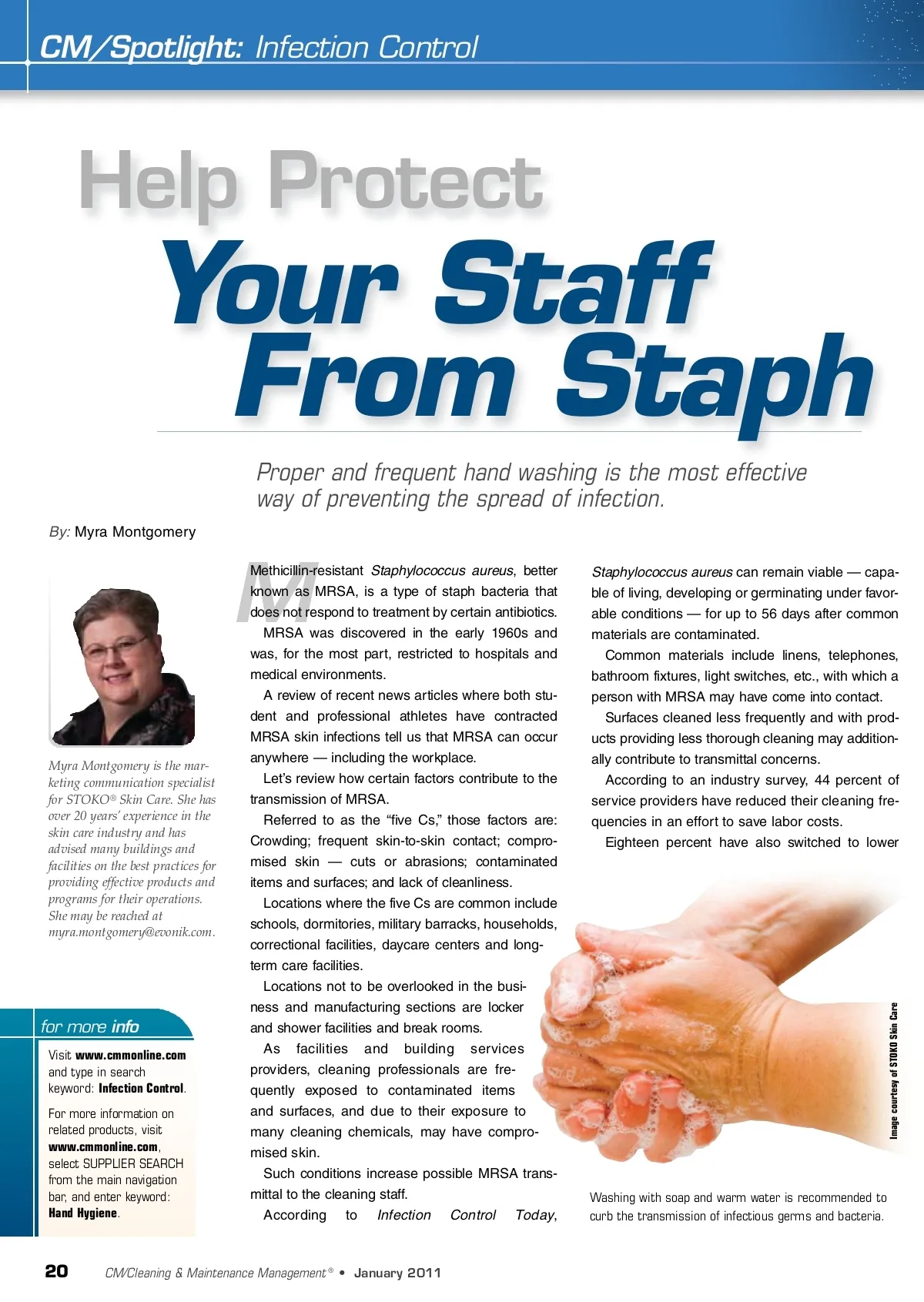
grade or off-brand consumables such as hand soaps and cleaning chemicals. Lower grade products may not offer the same level of disinfectant and, as a result, leave higher levels of bacteria on hands and work surfaces. Cleaning efficacy of hand soaps and cleaning chemicals is also compromised if diluted with water to “stretch” the number of uses of the product. Proper handling and washing of uniforms and towels, thorough cleansing of surfaces and limiting skin-to-skin contact by use of personal protective equipment (PPE) all assist the cleaning professional in protecting themselves from MRSA. However, a critical factor in infection control is perhaps the most simple and most eco-nomical: Hand washing. The U.S. Centers for Disease Control and Prevention (CDC) tell us that proper hand washing is the single most important action each of us can perform to help stop the spread of diseases. Hand washing instructions populate many websites, and even puppet characters on children’s television programming deliver the hand washing message. After countless stories from local, state and national press reminding us to wash our hands, one might assume that the public has become better educated in the importance of proper hand hygiene in the fight against the transmission of diseases, particularly after last year’s H1N1 pandemic. Apparently not, according to a hand wash-ing survey conducted by the Bradley Corporation. In that recent survey, participants were asked if the threat of H1N1 had changed the frequency of their hand washing. Surprisingly, the majority of those surveyed had not altered their hand washing habits, even during the time of H1N1 pandemic. In fact, 54 percent of the 1,020 participants indicated they did not wash their hands more frequently, nor did they wash less frequently, in public restroom facilities as a result of the virus threat. This lack of attention to proper hand hygiene puts each of us at risk for transmit-ting and acquiring potentially fatal infections like MRSA. It also increases the possibility of getting intestinal and respiratory infections — and even occupational dermatitis. These illnesses contribute to workplace absenteeism, increased demands upon the time of health care providers and escalation of the costs of health care with insurance companies. The Costs Of Poor Hand Hygiene Employers who do not consider the possibil-ity that dermatitis from a lack of hand hygiene practices may occur at their workplace could be making a very costly mistake. Results provided in a recent study pub-lished in the Archives of Dermatology of the Circle Product Information no. 207 on page 32 www.cmmonline.com 21
CMM – Archives Jan 2011: 21