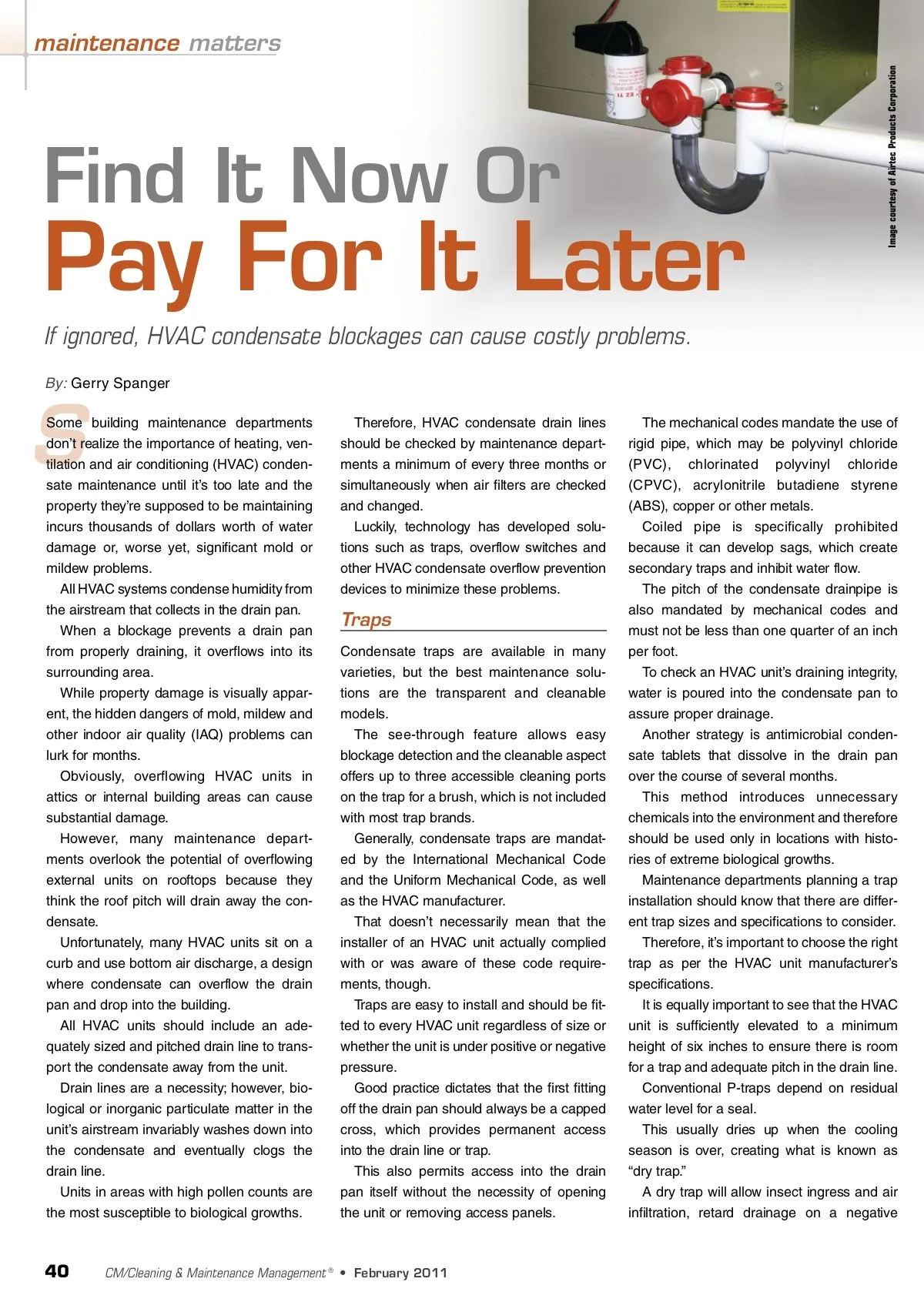
pressure system and increase energy costs on a positive pressure system. A good solution to these problems is a waterless trap, which relies on a float to act as a check valve and create a seal. Waterless traps are freeze-resistant, require no priming, don’t allow air to flow in both directions and permit the free flow of water at all times. Waterless traps are available in ¾-inch, 1-inch and 1-¼-inch diameters. Traps, overflow switches and switches with integral pumps are inexpensive to purchase and install in-house when com-pared to the costs of replacing damaged property. These devices are invaluable when applied along with a periodic maintenance schedule. A maintenance staff that’s well-versed in controlling condensate from HVAC units will save its employer a significant amount of money in the long run while also improving building IAQ. CM Gerry Spanger is a 46-year veteran of the HV AC indus-try. Founder of Marketair, EZ Trap and Slimduct, Spanger is now vice president of Airtec Products, Corporation a leading importer/manufacturer and dis-tributor of components for the HV AC industry. Airtec is the exclusive U.S. distributor for Aspen condensate pumps, manufacturer of Airtec diffusers, EZ Trap con-densate control products, Fortress lineset protection covers and fittings and global marketer of NOVENT locking refrigerant caps. Overflow Switches An overflow float switch is useful because it deactivates the HVAC unit during an overflow event. During a trap blockage, water rises up into the cross and lifts the switch’s mechanical float, which cuts power to the 24-volt circuit that’s wired inline with the HVAC unit. While there are many overflow switches on the market, it’s important to note that switches with a capacity of less than four amps may not perform properly on many HVAC units because they may not be able to handle the higher currents associated with modern systems. Overflow switches are invaluable, but are not a cure; they should not be used as a sub-stitute for the regular maintenance of traps and/or drain lines. An overflow switch is a second line of defense that only treats the symptoms of a blockage by cutting power to the unit. Once the water recedes, as in the case of a partial blockage, the unit activates and the cycle perpetuates until the drain line block-age is physically removed. While an overflow cut-off switch prevents the unit from operating during blockages, there is one disadvantage: Iced evaporator coils will continue to thaw and feed the slow receding or blocked drain pan even though the unit is deactivated. For up to five-ton capacity units, the ulti-mate in overflow protection is an overflow switch with a self-evacuating pump. Regardless of thawing ice, which may form on evaporator coils, the pump will continue to pump out the drain pan and prevent an over-flow even though the switch has deactivated the unit. The pump remains live while the unit stays deactivated until a maintenance staffer removes the blockage and manually presses the integral pump’s reset button. The Voice of the IAQ Industry A Training com IAQ Training Institute LLC Circle Product Information no. 208 on page 32 www.cmmonline.com 41
CMM – Archives Feb 2011: 41