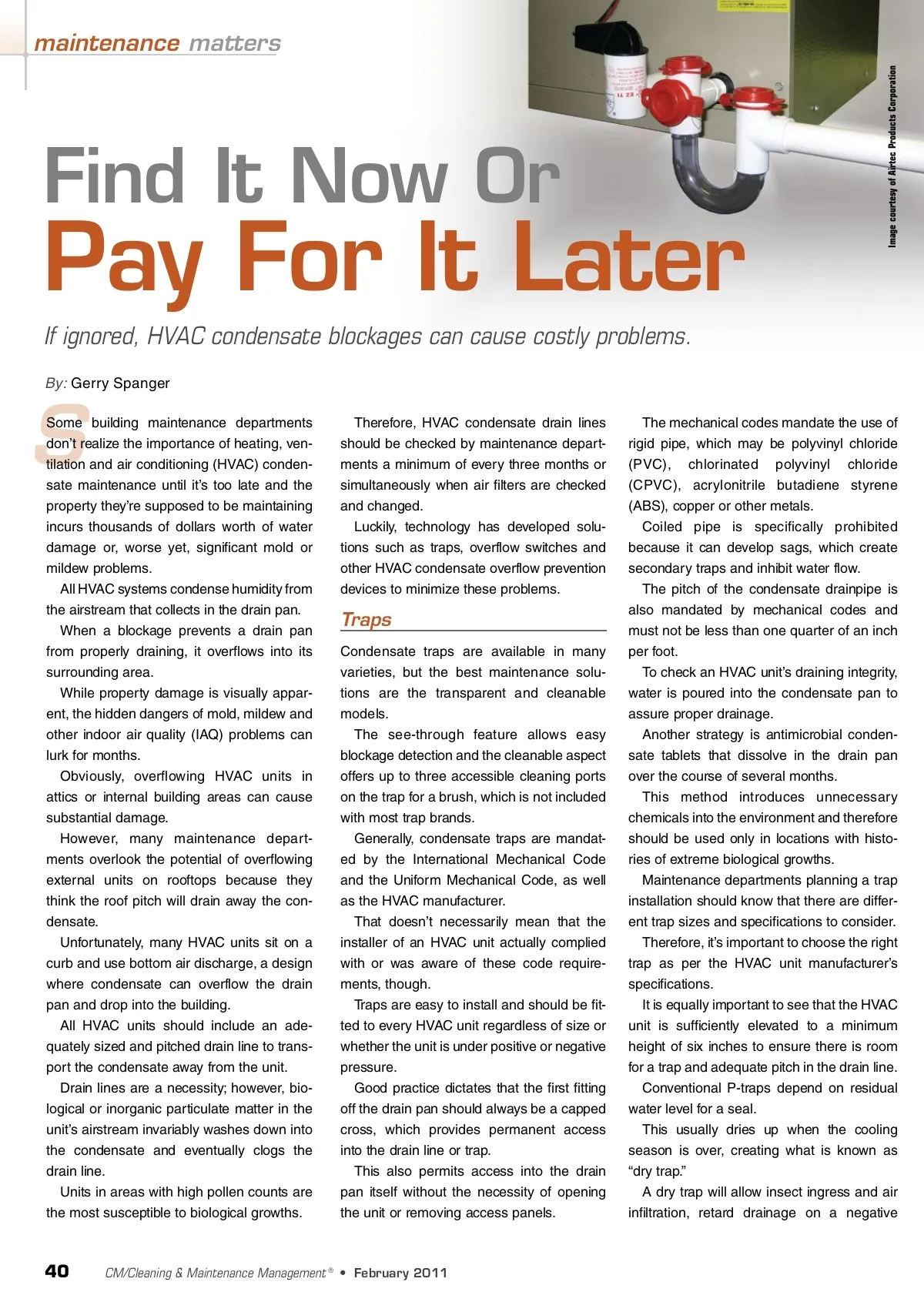
maintenance matters Image courtesy of Airtec Products Corporation Find It Now Or By: Gerry Spanger Pay For It Later If ignored, HVAC condensate blockages can cause costly problems. S Some building maintenance departments don’t realize the importance of heating, ven-tilation and air conditioning (HVAC) conden-sate maintenance until it’s too late and the property they’re supposed to be maintaining incurs thousands of dollars worth of water damage or, worse yet, significant mold or mildew problems. All HVAC systems condense humidity from the airstream that collects in the drain pan. When a blockage prevents a drain pan from properly draining, it overflows into its surrounding area. While property damage is visually appar-ent, the hidden dangers of mold, mildew and other indoor air quality (IAQ) problems can lurk for months. Obviously, overflowing HVAC units in attics or internal building areas can cause substantial damage. However, many maintenance depart-ments overlook the potential of overflowing external units on rooftops because they think the roof pitch will drain away the con-densate. Unfortunately, many HVAC units sit on a curb and use bottom air discharge, a design where condensate can overflow the drain pan and drop into the building. All HVAC units should include an ade-quately sized and pitched drain line to trans-port the condensate away from the unit. Drain lines are a necessity; however, bio-logical or inorganic particulate matter in the unit’s airstream invariably washes down into the condensate and eventually clogs the drain line. Units in areas with high pollen counts are the most susceptible to biological growths. Therefore, HVAC condensate drain lines should be checked by maintenance depart-ments a minimum of every three months or simultaneously when air filters are checked and changed. Luckily, technology has developed solu-tions such as traps, overflow switches and other HVAC condensate overflow prevention devices to minimize these problems. Traps Condensate traps are available in many varieties, but the best maintenance solu-tions are the transparent and cleanable models. The see-through feature allows easy blockage detection and the cleanable aspect offers up to three accessible cleaning ports on the trap for a brush, which is not included with most trap brands. Generally, condensate traps are mandat-ed by the International Mechanical Code and the Uniform Mechanical Code, as well as the HVAC manufacturer. That doesn’t necessarily mean that the installer of an HVAC unit actually complied with or was aware of these code require-ments, though. Traps are easy to install and should be fit-ted to every HVAC unit regardless of size or whether the unit is under positive or negative pressure. Good practice dictates that the first fitting off the drain pan should always be a capped cross, which provides permanent access into the drain line or trap. This also permits access into the drain pan itself without the necessity of opening the unit or removing access panels. The mechanical codes mandate the use of rigid pipe, which may be polyvinyl chloride (PVC), chlorinated polyvinyl chloride (CPVC), acrylonitrile butadiene styrene (ABS), copper or other metals. Coiled pipe is specifically prohibited because it can develop sags, which create secondary traps and inhibit water flow. The pitch of the condensate drainpipe is also mandated by mechanical codes and must not be less than one quarter of an inch per foot. To check an HVAC unit’s draining integrity, water is poured into the condensate pan to assure proper drainage. Another strategy is antimicrobial conden-sate tablets that dissolve in the drain pan over the course of several months. This method introduces unnecessary chemicals into the environment and therefore should be used only in locations with histo-ries of extreme biological growths. Maintenance departments planning a trap installation should know that there are differ-ent trap sizes and specifications to consider. Therefore, it’s important to choose the right trap as per the HVAC unit manufacturer’s specifications. It is equally important to see that the HVAC unit is sufficiently elevated to a minimum height of six inches to ensure there is room for a trap and adequate pitch in the drain line. Conventional P-traps depend on residual water level for a seal. This usually dries up when the cooling season is over, creating what is known as “dry trap.” A dry trap will allow insect ingress and air infiltration, retard drainage on a negative 40 CM/Cleaning & Maintenance Management ® • February 2011
CMM – Archives Feb 2011: 40