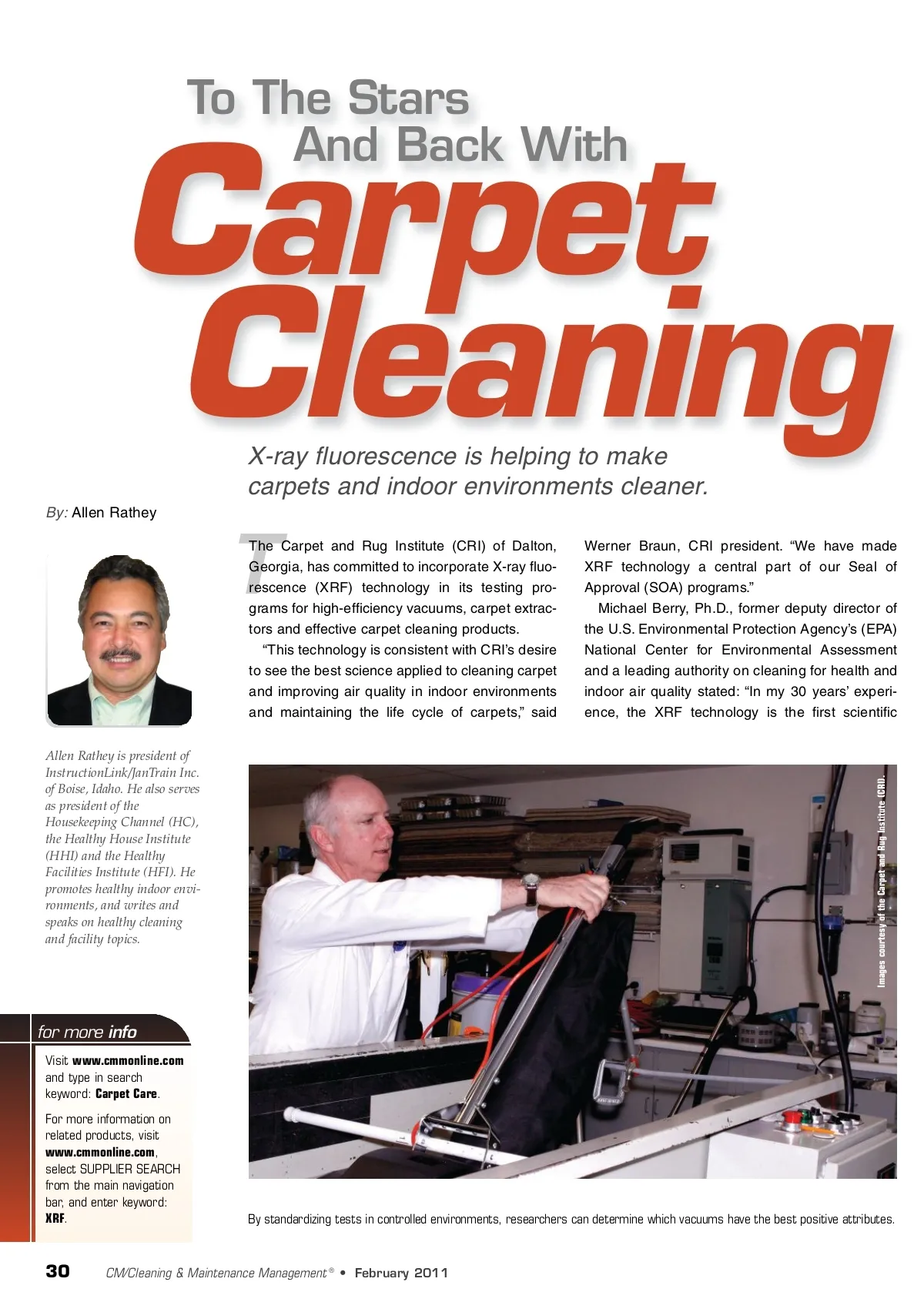
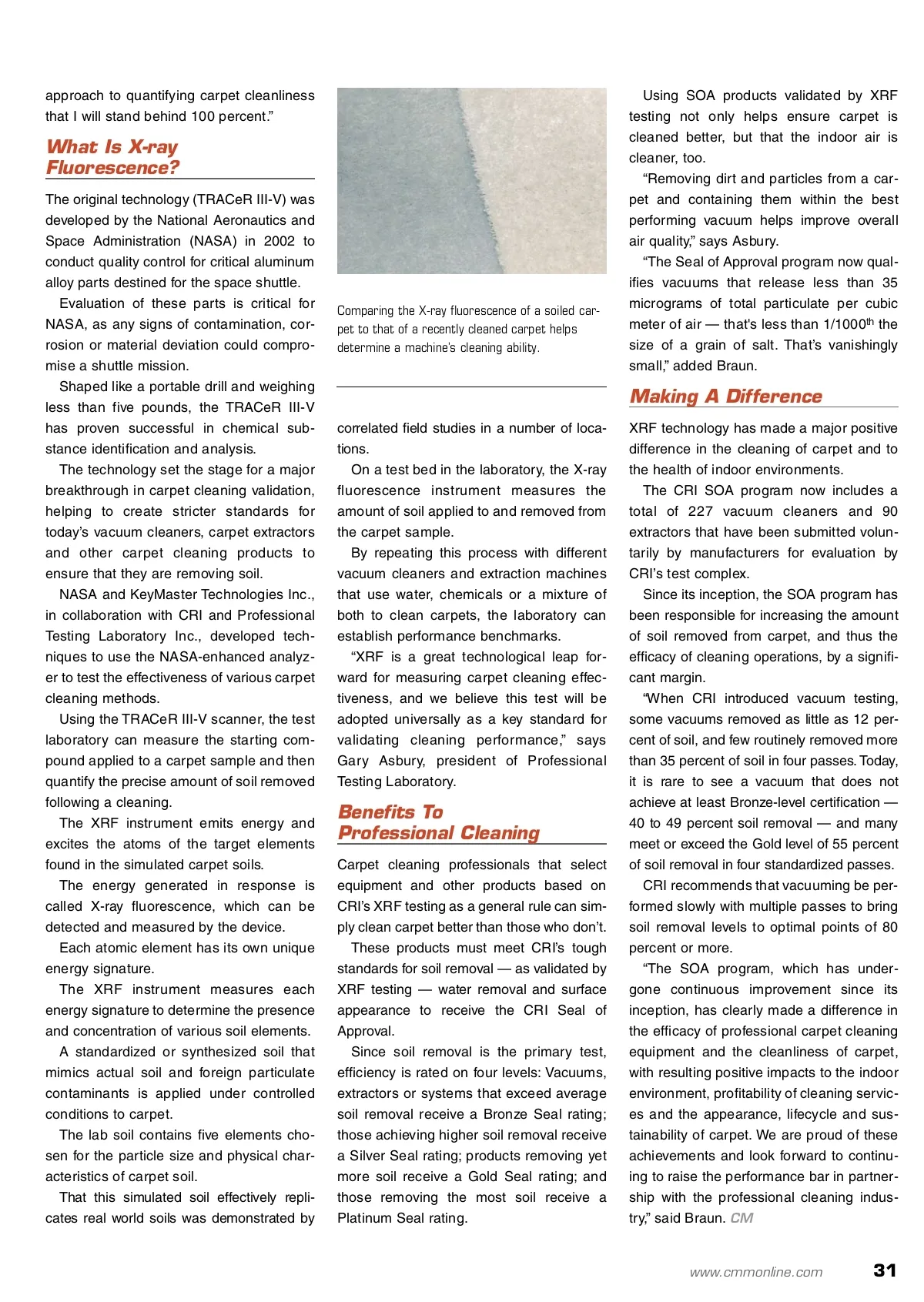
approach to quantifying carpet cleanliness that I will stand behind 100 percent.” What Is X-ray Fluorescence? The original technology (TRACeR III-V) was developed by the National Aeronautics and Space Administration (NASA) in 2002 to conduct quality control for critical aluminum alloy parts destined for the space shuttle. Evaluation of these parts is critical for NASA, as any signs of contamination, cor-rosion or material deviation could compro-mise a shuttle mission. Shaped like a portable drill and weighing less than five pounds, the TRACeR III-V has proven successful in chemical sub-stance identification and analysis. The technology set the stage for a major breakthrough in carpet cleaning validation, helping to create stricter standards for today’s vacuum cleaners, carpet extractors and other carpet cleaning products to ensure that they are removing soil. NASA and KeyMaster Technologies Inc., in collaboration with CRI and Professional Testing Laboratory Inc., developed tech-niques to use the NASA-enhanced analyz-er to test the effectiveness of various carpet cleaning methods. Using the TRACeR III-V scanner, the test laboratory can measure the starting com-pound applied to a carpet sample and then quantify the precise amount of soil removed following a cleaning. The XRF instrument emits energy and excites the atoms of the target elements found in the simulated carpet soils. The energy generated in response is called X-ray fluorescence, which can be detected and measured by the device. Each atomic element has its own unique energy signature. The XRF instrument measures each energy signature to determine the presence and concentration of various soil elements. A standardized or synthesized soil that mimics actual soil and foreign particulate contaminants is applied under controlled conditions to carpet. The lab soil contains five elements cho-sen for the particle size and physical char-acteristics of carpet soil. That this simulated soil effectively repli-cates real world soils was demonstrated by Comparing the X-ray fluorescence of a soiled car-pet to that of a recently cleaned carpet helps determine a machine’s cleaning ability. Using SOA products validated by XRF testing not only helps ensure carpet is cleaned better, but that the indoor air is cleaner, too. “Removing dirt and particles from a car-pet and containing them within the best performing vacuum helps improve overall air quality,” says Asbury. “The Seal of Approval program now qual-ifies vacuums that release less than 35 micrograms of total particulate per cubic meter of air — that's less than 1/1000 th the size of a grain of salt. That’s vanishingly small,” added Braun. Making A Difference correlated field studies in a number of loca-tions. On a test bed in the laboratory, the X-ray fluorescence instrument measures the amount of soil applied to and removed from the carpet sample. By repeating this process with different vacuum cleaners and extraction machines that use water, chemicals or a mixture of both to clean carpets, the laboratory can establish performance benchmarks. “XRF is a great technological leap for-ward for measuring carpet cleaning effec-tiveness, and we believe this test will be adopted universally as a key standard for validating cleaning performance,” says Gary Asbury, president of Professional Testing Laboratory. XRF technology has made a major positive difference in the cleaning of carpet and to the health of indoor environments. The CRI SOA program now includes a total of 227 vacuum cleaners and 90 extractors that have been submitted volun-tarily by manufacturers for evaluation by CRI’s test complex. Since its inception, the SOA program has been responsible for increasing the amount of soil removed from carpet, and thus the efficacy of cleaning operations, by a signifi-cant margin. “When CRI introduced vacuum testing, some vacuums removed as little as 12 per-cent of soil, and few routinely removed more than 35 percent of soil in four passes. Today, it is rare to see a vacuum that does not achieve at least Bronze-level certification — 40 to 49 percent soil removal — and many meet or exceed the Gold level of 55 percent of soil removal in four standardized passes. CRI recommends that vacuuming be per-formed slowly with multiple passes to bring soil removal levels to optimal points of 80 percent or more. “The SOA program, which has under-gone continuous improvement since its inception, has clearly made a difference in the efficacy of professional carpet cleaning equipment and the cleanliness of carpet, with resulting positive impacts to the indoor environment, profitability of cleaning servic-es and the appearance, lifecycle and sus-tainability of carpet. We are proud of these achievements and look forward to continu-ing to raise the performance bar in partner-ship with the professional cleaning indus-try,” said Braun. CM Benefits To Professional Cleaning Carpet cleaning professionals that select equipment and other products based on CRI’s XRF testing as a general rule can sim-ply clean carpet better than those who don’t. These products must meet CRI’s tough standards for soil removal — as validated by XRF testing — water removal and surface appearance to receive the CRI Seal of Approval. Since soil removal is the primary test, efficiency is rated on four levels: Vacuums, extractors or systems that exceed average soil removal receive a Bronze Seal rating; those achieving higher soil removal receive a Silver Seal rating; products removing yet more soil receive a Gold Seal rating; and those removing the most soil receive a Platinum Seal rating. www.cmmonline.com 31
CMM – Archives Feb 2011: 31