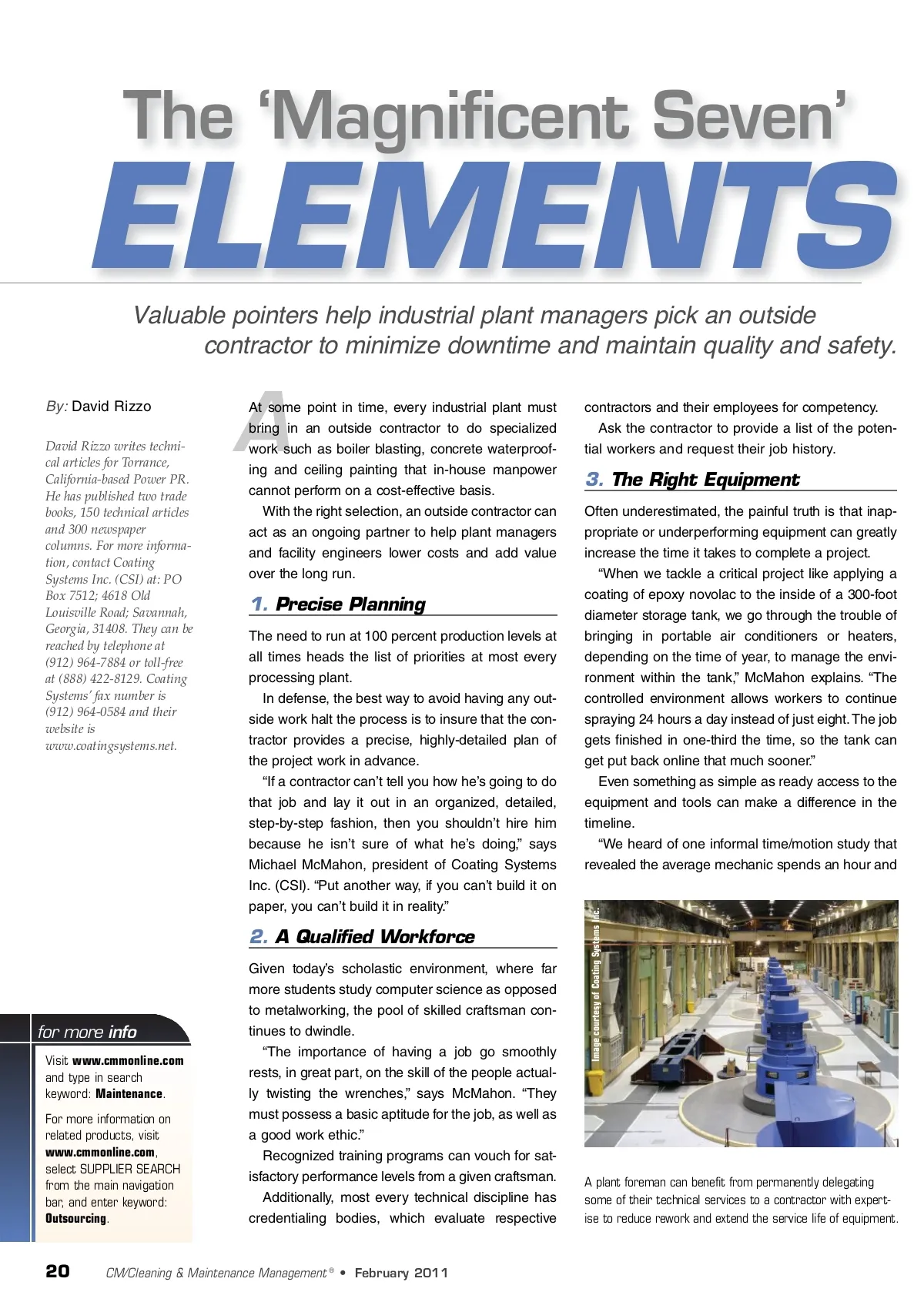
five minutes each day looking for tools,” recounts McMahon. 4. Safe Work Practices Safety can never be compromised for the sake of speed. If anything, a serious accident can stop a project in its tracks and immediately place a project budget in peril. Checking a contractor’s commitment to safety begins at the top. “The mechanics will do whatever the supervisor lets them do,” notes McMahon. “If the foreman allows the workers to stand on a ladder without a safety belt, they will do it. So, supervisors should attend ‘process safety management training’ classes so they will set the right tone.” A contractor’s membership in the American Society of Safety Engineers (ASSE) also indi-cates a commitment to reducing injuries. Additionally, the prospective contractor should be able to demonstrate site-specific training of its employees. Some eventually declare bankruptcy, leav-ing plant management with no recourse if anything goes wrong. Look for a contractor who is willing to main-tain an on-site presence well after completion of the scheduled work. Even beyond that, added value stems from a contractor who is willing to act as a resource for long-term maintenance planning. “Plant foreman can benefit from permanent-ly delegating some of their technical services to a contractor with expertise in their respective fields,” explains McMahon. “Many of our fore-men stay on at a given site to provide various cleaning and maintenance services.” Ultimately, enlisting the help of a proven contractor on a year-round basis allows processors and manufacturers to keep their own staff focused on the core competency of the organization. CM 5. Access To Spare Parts Every product manufacturer understands the need for a “second source” supplier; it should be no different for contractors who show up to do critical work at a plant. “With the experience of coating over 400 tanks behind us, I can assure you that you have to have ‘Plan B’ as well as ‘Plan C,’” advises McMahon. “To be really on the safe side, the contractor should have duplicate pieces of machinery at the ready so, if a part breaks, it won’t halt the work.” 6. Constant Communication Upon completion of a project, few plant man-agers like surprises such as unexpected, expensive change orders or up-scoping. A conscientious contractor must be will-ing to provide project reports up-front, on a daily basis. “Clarity with the customer is crucial,” McMahon stresses. “I recommend that the customer receives three separate reports at the end of each day; each one covering con-struction overview, safety and quality.” 7. A Long-term Partnership An index of suspicion should rise when a contractor appears anxious to take the money and run. Circle Product Information no. 207 on page 32 www.cmmonline.com 21
CMM – Archives Feb 2011: 21