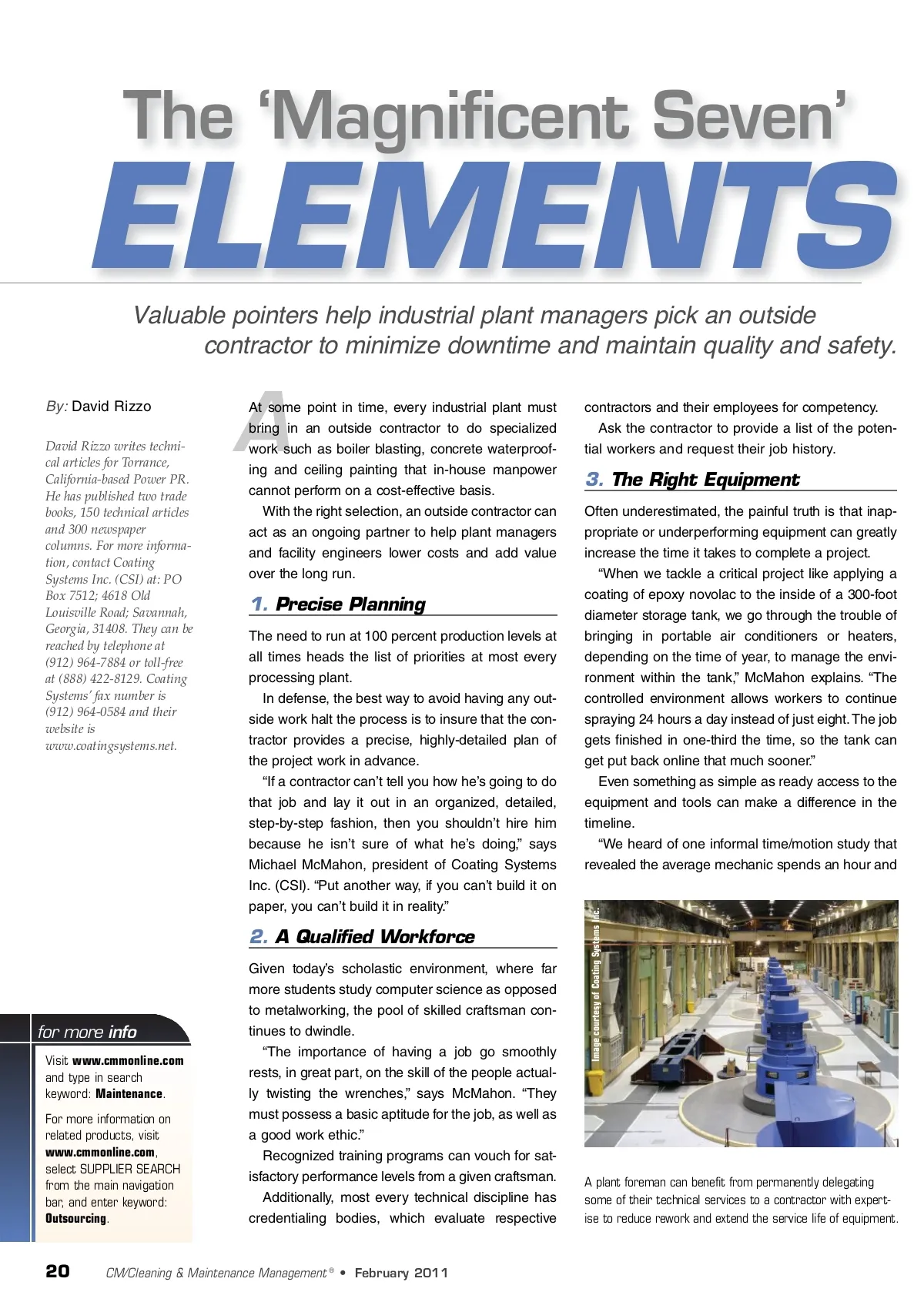
The ‘Magnificent Seven’ ELEMENTS Valuable pointers help industrial plant managers pick an outside contractor to minimize downtime and maintain quality and safety. By: David Rizzo David Rizzo writes techni-cal articles for Torrance, California-based Power PR. He has published two trade books, 150 technical articles and 300 newspaper columns. For more informa-tion, contact Coating Systems Inc. (CSI) at: PO Box 7512; 4618 Old Louisville Road; Savannah, Georgia, 31408. They can be reached by telephone at (912) 964-7884 or toll-free at (888) 422-8129. Coating Systems’ fax number is (912) 964-0584 and their website is www.coatingsystems.net. A At some point in time, every industrial plant must bring in an outside contractor to do specialized work such as boiler blasting, concrete waterproof-ing and ceiling painting that in-house manpower cannot perform on a cost-effective basis. With the right selection, an outside contractor can act as an ongoing partner to help plant managers and facility engineers lower costs and add value over the long run. contractors and their employees for competency. Ask the contractor to provide a list of the poten-tial workers and request their job history. 3. The Right Equipment Often underestimated, the painful truth is that inap-propriate or underperforming equipment can greatly increase the time it takes to complete a project. “When we tackle a critical project like applying a coating of epoxy novolac to the inside of a 300-foot diameter storage tank, we go through the trouble of bringing in portable air conditioners or heaters, depending on the time of year, to manage the envi-ronment within the tank,” McMahon explains. “The controlled environment allows workers to continue spraying 24 hours a day instead of just eight. The job gets finished in one-third the time, so the tank can get put back online that much sooner.” Even something as simple as ready access to the equipment and tools can make a difference in the timeline. “We heard of one informal time/motion study that revealed the average mechanic spends an hour and 1. Precise Planning The need to run at 100 percent production levels at all times heads the list of priorities at most every processing plant. In defense, the best way to avoid having any out-side work halt the process is to insure that the con-tractor provides a precise, highly-detailed plan of the project work in advance. “If a contractor can’t tell you how he’s going to do that job and lay it out in an organized, detailed, step-by-step fashion, then you shouldn’t hire him because he isn’t sure of what he’s doing,” says Michael McMahon, president of Coating Systems Inc. (CSI). “Put another way, if you can’t build it on paper, you can’t build it in reality.” 2. A Qualified Workforce Given today’s scholastic environment, where far more students study computer science as opposed to metalworking, the pool of skilled craftsman con-tinues to dwindle. “The importance of having a job go smoothly rests, in great part, on the skill of the people actual-ly twisting the wrenches,” says McMahon. “They must possess a basic aptitude for the job, as well as a good work ethic.” Recognized training programs can vouch for sat-isfactory performance levels from a given craftsman. Additionally, most every technical discipline has credentialing bodies, which evaluate respective for more info Visit www.cmmonline.com and type in search keyword: Maintenance . For more information on related products, visit www.cmmonline.com , select SUPPLIER SEARCH from the main navigation bar, and enter keyword: Outsourcing . A plant foreman can benefit from permanently delegating some of their technical services to a contractor with expert-ise to reduce rework and extend the service life of equipment. 20 CM/Cleaning & Maintenance Management ® • February 2011 Image courtesy of Coating Systems Inc.
CMM – Archives Feb 2011: 20