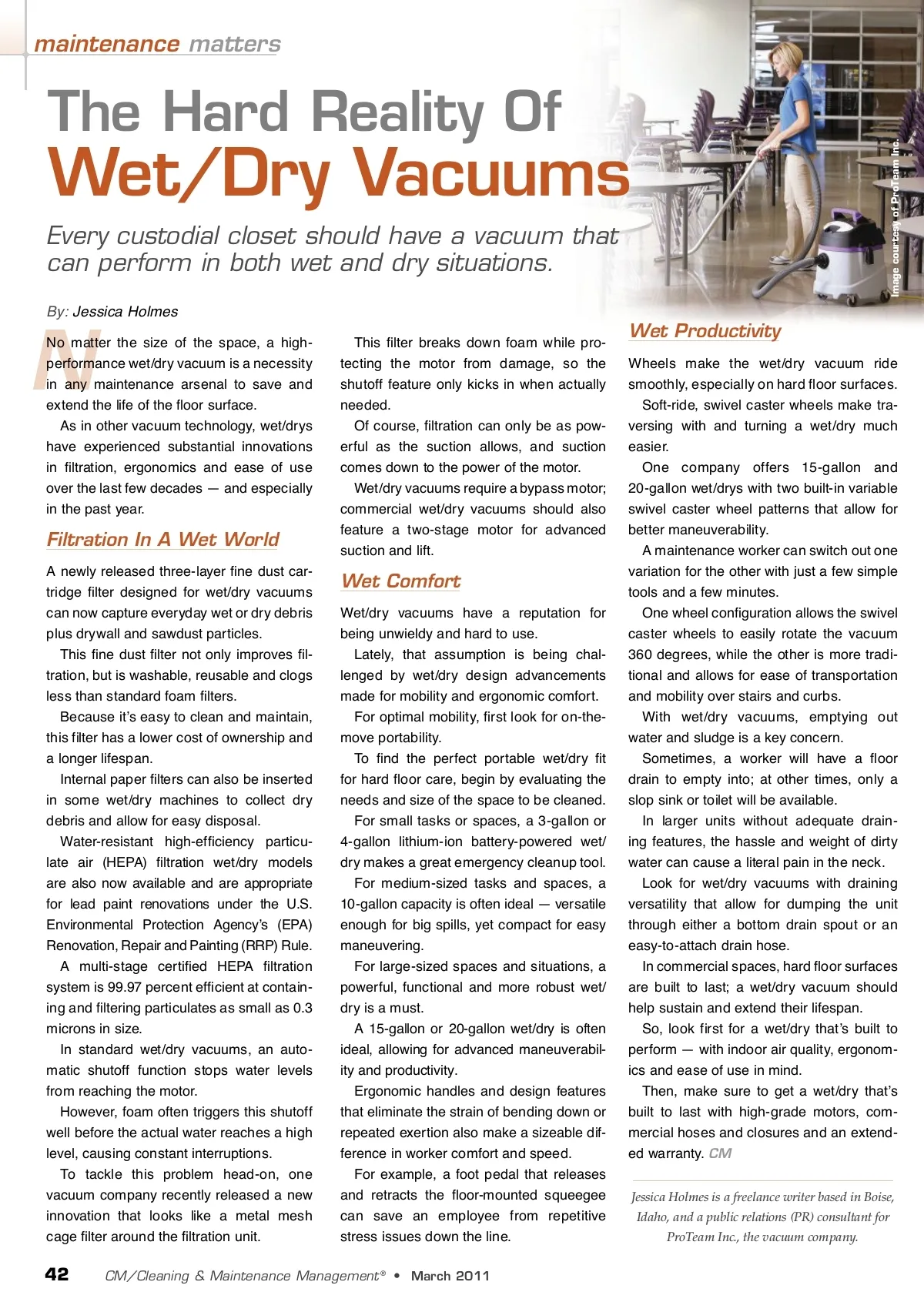
maintenance matters Wet/Dry Vacuums Every custodial closet should have a vacuum that can perform in both wet and dry situations. By: Jessica Holmes N No matter the size of the space, a high-performance wet/dry vacuum is a necessity in any maintenance arsenal to save and extend the life of the floor surface. As in other vacuum technology, wet/drys have experienced substantial innovations in filtration, ergonomics and ease of use over the last few decades — and especially in the past year. Filtration In A Wet World A newly released three-layer fine dust car-tridge filter designed for wet/dry vacuums can now capture everyday wet or dry debris plus drywall and sawdust particles. This fine dust filter not only improves fil-tration, but is washable, reusable and clogs less than standard foam filters. Because it’s easy to clean and maintain, this filter has a lower cost of ownership and a longer lifespan. Internal paper filters can also be inserted in some wet/dry machines to collect dry debris and allow for easy disposal. Water-resistant high-efficiency particu-late air (HEPA) filtration wet/dry models are also now available and are appropriate for lead paint renovations under the U.S. Environmental Protection Agency’s (EPA) Renovation, Repair and Painting (RRP) Rule. A multi-stage certified HEPA filtration system is 99.97 percent efficient at contain-ing and filtering particulates as small as 0.3 microns in size. In standard wet/dry vacuums, an auto-matic shutoff function stops water levels from reaching the motor. However, foam often triggers this shutoff well before the actual water reaches a high level, causing constant interruptions. To tackle this problem head-on, one vacuum company recently released a new innovation that looks like a metal mesh cage filter around the filtration unit. This filter breaks down foam while pro-tecting the motor from damage, so the shutoff feature only kicks in when actually needed. Of course, filtration can only be as pow-erful as the suction allows, and suction comes down to the power of the motor. Wet/dry vacuums require a bypass motor; commercial wet/dry vacuums should also feature a two-stage motor for advanced suction and lift. Wet Productivity Wheels make the wet/dry vacuum ride smoothly, especially on hard floor surfaces. Soft-ride, swivel caster wheels make tra-versing with and turning a wet/dry much easier. One company offers 15-gallon and 20-gallon wet/drys with two built-in variable swivel caster wheel patterns that allow for better maneuverability. A maintenance worker can switch out one variation for the other with just a few simple tools and a few minutes. One wheel configuration allows the swivel caster wheels to easily rotate the vacuum 360 degrees, while the other is more tradi-tional and allows for ease of transportation and mobility over stairs and curbs. With wet/dry vacuums, emptying out water and sludge is a key concern. Sometimes, a worker will have a floor drain to empty into; at other times, only a slop sink or toilet will be available. In larger units without adequate drain-ing features, the hassle and weight of dirty water can cause a literal pain in the neck. Look for wet/dry vacuums with draining versatility that allow for dumping the unit through either a bottom drain spout or an easy-to-attach drain hose. In commercial spaces, hard floor surfaces are built to last; a wet/dry vacuum should help sustain and extend their lifespan. So, look first for a wet/dry that’s built to perform — with indoor air quality, ergonom-ics and ease of use in mind. Then, make sure to get a wet/dry that’s built to last with high-grade motors, com-mercial hoses and closures and an extend-ed warranty. CM Jessica Holmes is a freelance writer based in Boise, Idaho, and a public relations (PR) consultant for ProTeam Inc., the vacuum company. Wet Comfort Wet/dry vacuums have a reputation for being unwieldy and hard to use. Lately, that assumption is being chal-lenged by wet/dry design advancements made for mobility and ergonomic comfort. For optimal mobility, first look for on-the-move portability. To find the perfect portable wet/dry fit for hard floor care, begin by evaluating the needs and size of the space to be cleaned. For small tasks or spaces, a 3-gallon or 4-gallon lithium-ion battery-powered wet/ dry makes a great emergency cleanup tool. For medium-sized tasks and spaces, a 10-gallon capacity is often ideal — versatile enough for big spills, yet compact for easy maneuvering. For large-sized spaces and situations, a powerful, functional and more robust wet/ dry is a must. A 15-gallon or 20-gallon wet/dry is often ideal, allowing for advanced maneuverabil-ity and productivity. Ergonomic handles and design features that eliminate the strain of bending down or repeated exertion also make a sizeable dif-ference in worker comfort and speed. For example, a foot pedal that releases and retracts the floor-mounted squeegee can save an employee from repetitive stress issues down the line. 42 CM/Cleaning & Maintenance Management ® • March 2011 Image courtesy of ProTeam Inc. The Hard Reality Of
CMM – Archives Mar 2011: 42