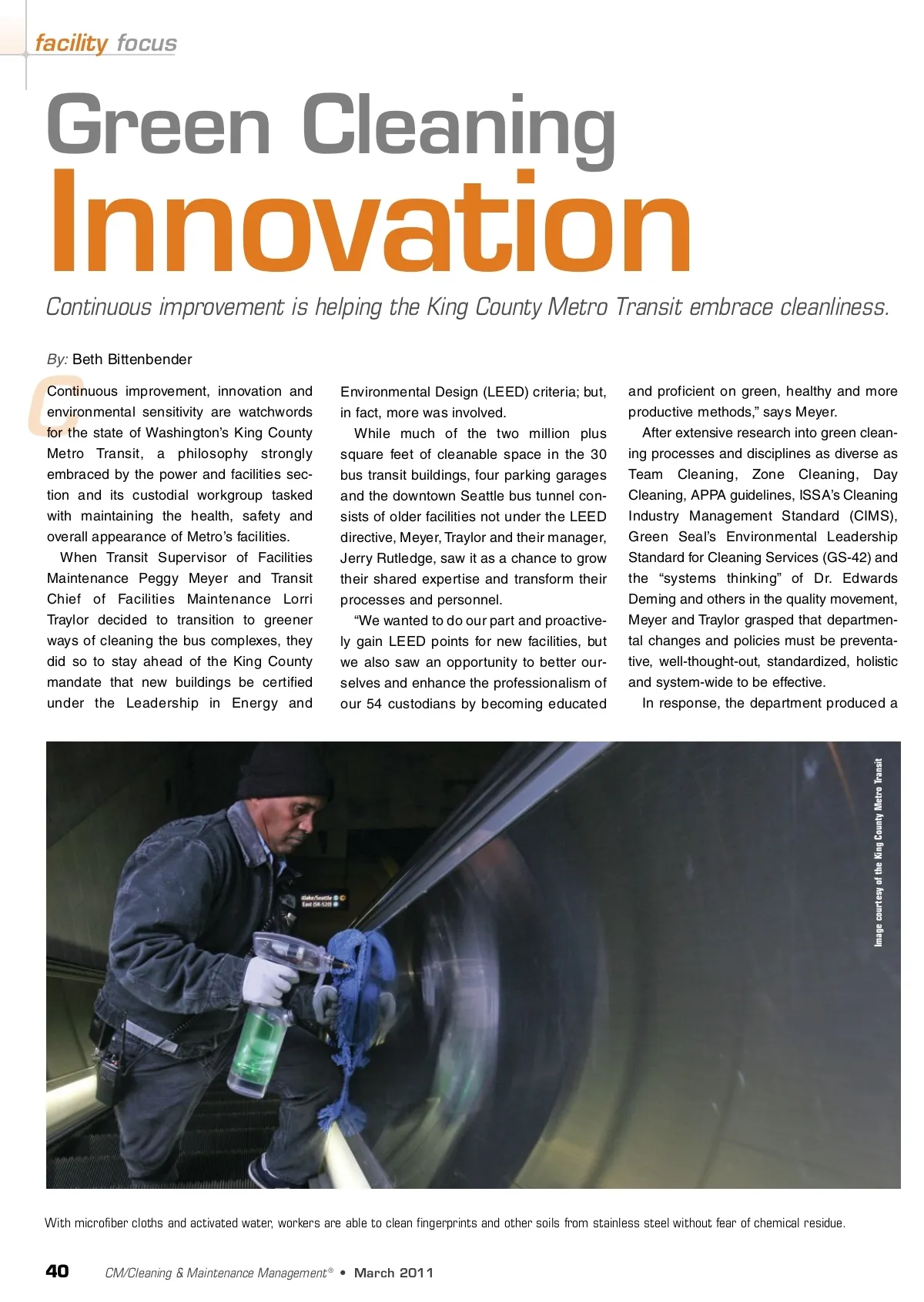
new custodial maintenance policy that states their mission, in part as: “To ensure clean facilities by using products responsi-bly, encompassing not only environmental-ly preferred cleaning products but equip-ment, tools, processes, standards, task schedules and frequencies that contribute toward implementation of a total green cleaning program.” The custodial workgroup also updat-ed their operating manual to reflect new standards and product and process changes, such as: Reducing cleaning products from 30 traditional formulations to two or three Green Seal-certified cleaners Eliminating aerosols Using green concentrates and chemi-cal proportioning and dispensing sys-tems to ensure accurate dilutions and minimize chemical waste and transport Using color-coded microfiber cloths and mops that clean better with less water or chemical and less ergonomic stress Ensuring consistent entrance matting and mat maintenance Increasing use of post-consumer recycled paper products. In addition, as part of its continuous improvement mission, the department has successfully tested and increasing-ly applied water-only cleaning process-es including the use of: Activated water throughout facilities Dry steam vapor in lunchrooms, offices and on touch points through-out facilities Chemical-free pressure washing in the bus shop areas Chemical-free autoscrubbing of tile floors. Meeting Challenges The transportation facilities present unique challenges that the department has risen to meet. “We maintain the transit operating and maintenance buildings, including industrial shops and offices, and the downtown Seattle bus tunnel. The bus buildings serve the bus drivers and mechanics, our employees and the public, 24/7. The bus tunnel hosts a constant flow of public com-muters and others. We need to be sensitive about products we use,” Traylor added. Modified Team Cleaning — groups of specialists that rotate specialties can com-plete tasks quickly and safely while working around others — helps crews get in and out of busy areas with minimum disruption. Training has been a big part of their suc-cess and includes a focus on restrooms in-use 24/7, the correct use of cleaners, dis-pensing equipment, new tools and repetition to instill standardized operating procedures. “Leads and chiefs spend a lot of time training new hires, and we also do refresh-er training,” Traylor says. “When we get new products, we train one-on-one. Documented monthly safety meetings are also required attendance.” While early changes involved switching to Green Seal-certified chemicals, a more recent transition was to non-chemical inter-ventions such as activated water, steam vapor, pressure washing without chemicals in bus shops and scrubbing floors using just water. Part of the program capitalizes on the availability of local vendors to provide expert knowledge and educational support, including demonstrating equipment and training to both staff and employees on the use of products. “Our job requires us to clean while the facilities are in use by occupants, so what we use makes a difference. The acti-vated water is just modified water, but also has sanitizing properties; this is important to us. Steam vapor has also been a great fit for many of the same reasons. We started using dry steam vapor in the restrooms along with activated water, and some work-ers have gotten to where they can use just the steam vapor for everything. And, as with activated water, you can work around people without concerns of causing chemi-cal reactions or sensitivities,” adds Traylor. In the bus maintenance areas, team spe-cialists pressure wash heavily soiled sur-faces using both cold water and heated units without additional chemicals. Many tile floors in Metro facilities are cleaned regularly with autoscrubbers that apply only water, scrub, rinse and vacuum away the soiled solution. enabled the purchase of new capital equipment. Moreover, buildings are actually cleaner and occupants and workers seem happier. “The bus bases or buildings are cleaner. The use of green processes has removed the buildup of old cleaning products and residue on many floors, and they have never been cleaner. The employees are amazed at the difference in the building — no smells,” says Traylor. In addition, Meyer says that with their success and newfound knowledge, they have become more proactive in offering input on the design of new buildings. “We are now more involved where possible to lobby for features that help rather than hurt the cleaning process,” Meyer says. Importantly, the new tools and processes have raised the profile of facility services. “There is always a crowd around when the steamer is out,” says Meyer. “The new tools help us communicate the change we have created.” As a result of their ongoing efforts, in 2008, the custodial workgroup won an award for green cleaning excellence from King County. “We have higher morale — the employ-ees value themselves and what they do more. I really want the employees to under-stand the importance of what we are doing — the improved effect on their health day in and day out,” says Traylor. According to Jerry Rutledge, manager, the biggest benefit is the improved health of custodial workers and building occupants. Reducing the daily exposure to cleaners and chemicals in the workplace, improving the indoor air quality and providing a safe and sanitary working environment are goals everyone wants to achieve. Rutledge hopes the King County Metro Transit’s policy and program will be a model that others will consider. CM Beth Bittenbender is president of Elliott Affiliates Ltd., a highly focused, niche consulting service providing management solutions from sustain-able outsourcing to LEED APPA audits to green cleaning consulting to performance measurement and management. Bittenbender is also a member of the U.S. Green Building Council (USGBC) Maryland Chapter and president of the Board at City Neighbors Hamilton. Results The elimination of many chemical products has yielded supply cost reductions and www.cmmonline.com 41
CMM – Archives Mar 2011: 41