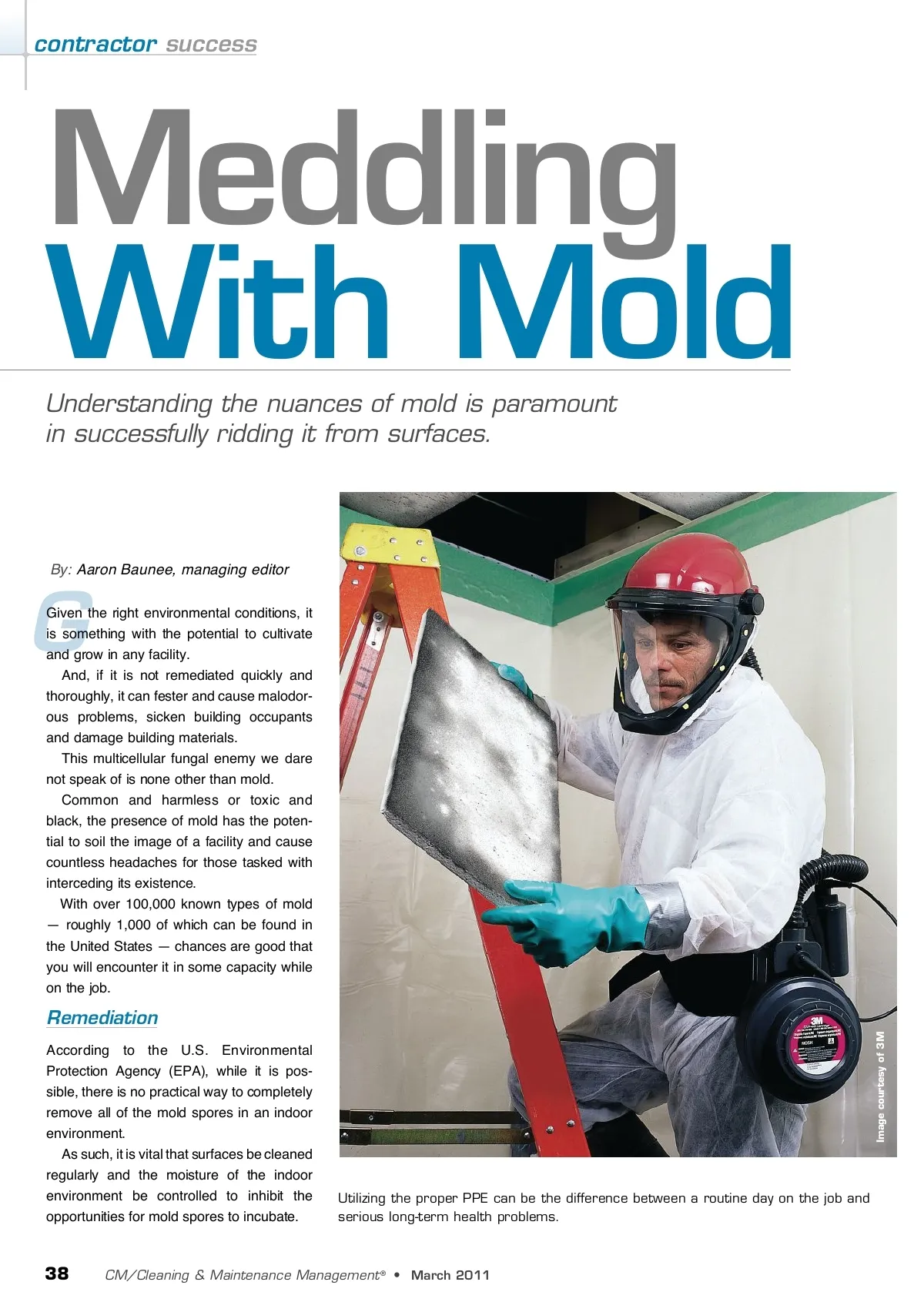
Where Is The Mold? While it can be found nearly anywhere, here are the top 10 states for mold, according to the relative mold hazard ranking model developed by American Risk Management Resources (ARMR). 1. Texas 2. Florida 3. Oklahoma 4. South Carolina 5. Nevada 6. Arizona 7. California 8. South Dakota 9. Tennessee 10. Kansas “Mold requires four things for growth: Air, warmth, moisture and a food source,” says Damon Gersh, president and chief execu-tive officer (CEO) of Maxons Restorations Inc. “Air and warmth are constants in indoor environments, and food sources can be any cellulose material — drywall, wood, carpet-ing, adhesive used with floor and wall cov-erings, etc. Moisture sources are the most critical factors in mold prevention and detec-tion. In areas that are not well-ventilated, excessive humidity can be enough moisture to promote mold growth.” There are currently no federal standards pertaining to mold remediation. However, organizations like the Institute of Inspection, Cleaning and Restoration Certification (IICRC) recognize best practice methods that include the use of high-efficien-cy particulate air (HEPA) filtered vacuums to minimize the chance of spores becoming airborne during removal, discarding contami-nated items and using biocides to both kill existing mold and inhibit its regrowth. Of course, the easiest and most effective method is to keep mold growth at a minimum through routine, preventive cleaning and maintenance. It is generally accepted that a custodial or maintenance professional can handle an isolated contamination incident of 10 square feet or less. However, for anyone tasked with ridding a larger, more widespread area, specific training must be undertaken and certification received to remain in compliance with the EPA. Such training courses are offered by numerous companies and organizations. But, given the often high employee turnover rates seen in our industry, providing this train-ing to employees can become rather costly. According to Peter Sheldon, vice presi-dent of operations for Coverall Health-Based Cleaning System, hiring a qualified contrac-tor to deal with mold issues is a good idea. “Mold can create substantial and some-times life-threatening health risks,” notes Sheldon. While someone can look for the sources of the problem themselves, the proper equipment to find hidden causes can be cost-prohibitive and exposure to poten-tially toxic mold spores can be dangerous for untrained individuals without the proper per-sonal protective equipment (PPE). A trained and certified mold remediation expert has the necessary testing and removal equip-ment. These certified professionals possess the expertise to not only remove the existing mold, but also recommend solutions to pre-vent future reoccurrences.” Stay Safe As with any task, certain PPE is recommend-ed for anyone addressing a mold issue. Just as a racecar driver would not start a race without a helmet and a fireproof suit, someone remediating mold would be foolish not to have, at a minimum, goggles, gloves and a respirator. “Mold cleanup workers are required by the U.S. Occupational Safety and Health Administration (OSHA) to use disposable protective clothing and respirators,” states Joe Akin, media coordinator for Healthy Homes Inc. “Respirators include the half-face or full-face air purifying respirator (APR) and the full-face, powered air purifying respirator (PAPR). As specified by OSHA, workers who use the respirators must be properly trained, be properly fit tested and have a medical clearance.” The thinking behind this is to create a barrier between the contamination and the worker. Since mold inhalation has been associated with countless respiratory ail-ments, it is of the utmost importance that corners not be cut when it comes to worker safety. And, to ensure that all of the risks are known and accounted for, ongoing training and education is prudent. Mold Prevention Tips From OSHA Repair plumbing leaks and leaks in the building structure as soon as possible Look for condensation and wet spots and fix sources of moisture immediately Prevent moisture from condensing by increasing surface temperature or reducing the moisture level in the air Keep heating, ventilation and air conditioning (HVAC) drip pans clean, flowing properly and unobstructed Perform regularly scheduled building and HVAC inspections and maintenance, including filter changes Maintain relative indoor humidity below 70 percent Vent moisture-generating appliances, such as dryers, to the outside where possible and vent kitchens and restrooms according to local code requirements Clean and dry wet or damp spots as soon as possible and no more than 48 hours after discovery Provide adequate drainage around buildings and slope the ground away from building foundations Pinpoint areas where leaks have occurred and take preventive action to ensure that they do not reoccur. CM Do It Yourself? Most custodial professionals, while Jacks — or Jills — of all trades, lack the acute knowledge and training necessary to safely and successfully conquer mold. www.cmmonline.com 39
CMM – Archives Mar 2011: 39