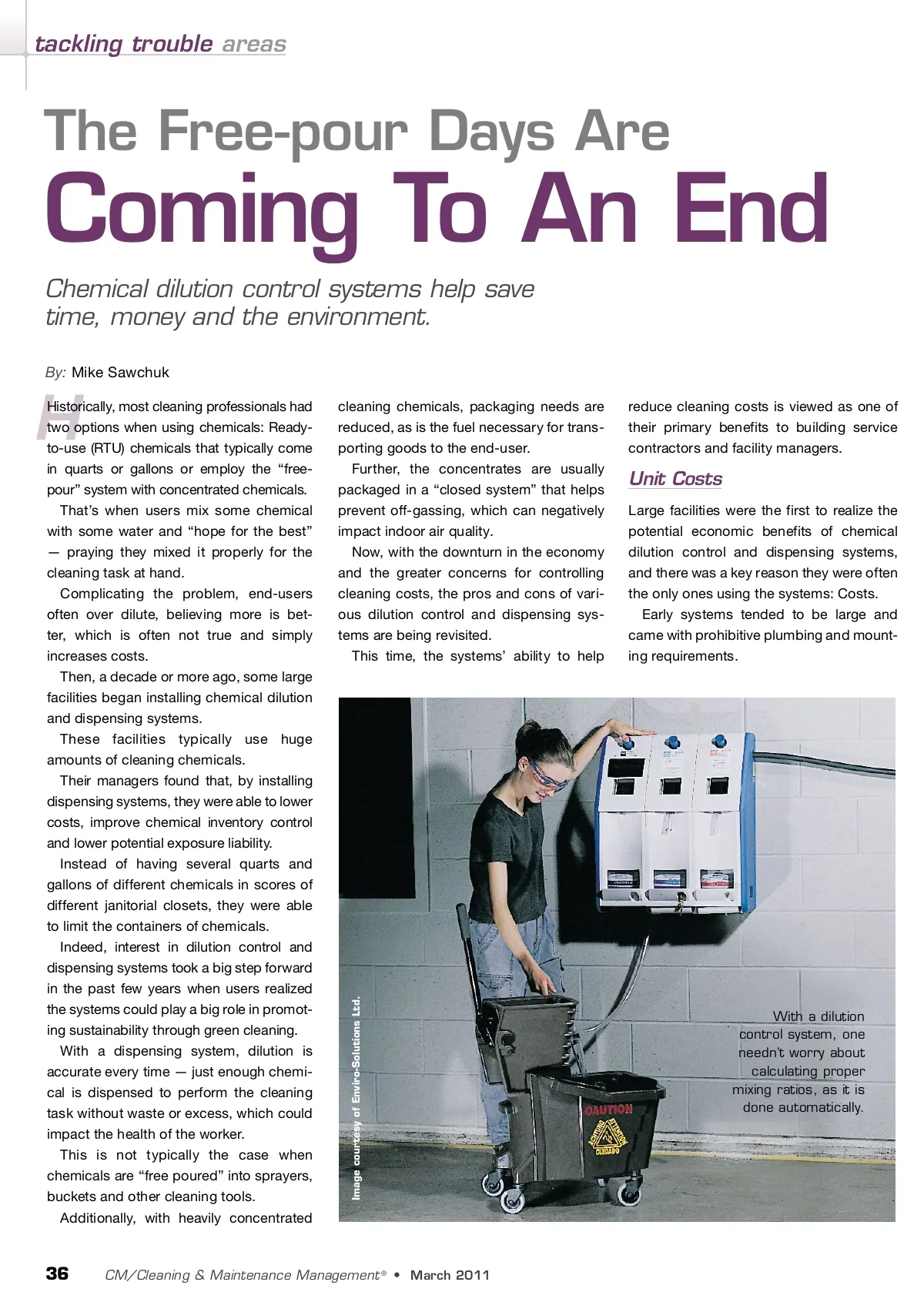
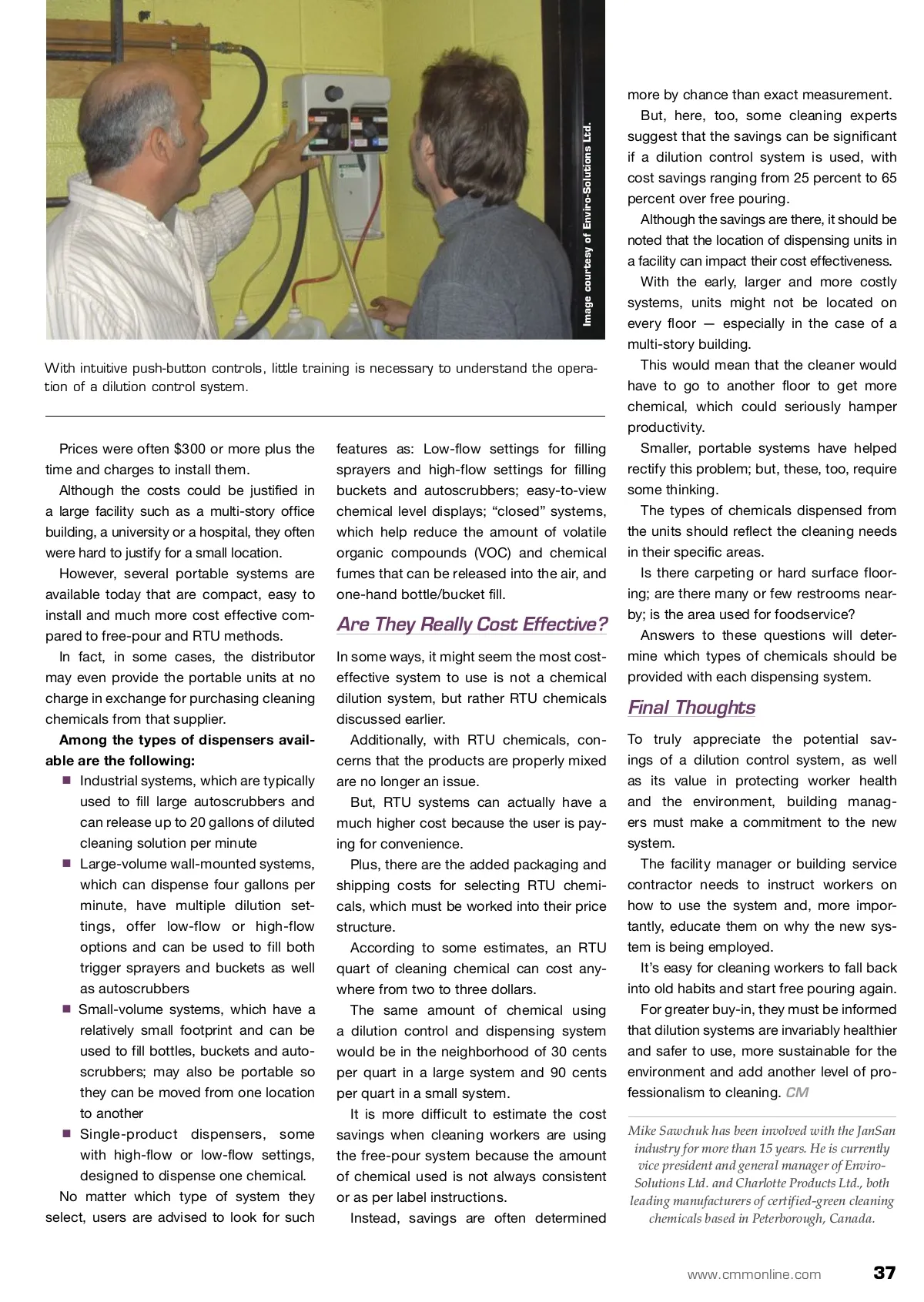
With intuitive push-button controls, little training is necessary to understand the opera-tion of a dilution control system. Prices were often $300 or more plus the time and charges to install them. Although the costs could be justified in a large facility such as a multi-story office building, a university or a hospital, they often were hard to justify for a small location. However, several portable systems are available today that are compact, easy to install and much more cost effective com-pared to free-pour and RTU methods. In fact, in some cases, the distributor may even provide the portable units at no charge in exchange for purchasing cleaning chemicals from that supplier. Among the types of dispensers avail-able are the following: Industrial systems, which are typically used to fill large autoscrubbers and can release up to 20 gallons of diluted cleaning solution per minute Large-volume wall-mounted systems, which can dispense four gallons per minute, have multiple dilution set-tings, offer low-flow or high-flow options and can be used to fill both trigger sprayers and buckets as well as autoscrubbers Small-volume systems, which have a relatively small footprint and can be used to fill bottles, buckets and auto-scrubbers; may also be portable so they can be moved from one location to another Single-product dispensers, some with high-flow or low-flow settings, designed to dispense one chemical. No matter which type of system they select, users are advised to look for such features as: Low-flow settings for filling sprayers and high-flow settings for filling buckets and autoscrubbers; easy-to-view chemical level displays; “closed” systems, which help reduce the amount of volatile organic compounds (VOC) and chemical fumes that can be released into the air, and one-hand bottle/bucket fill. Are They Really Cost Effective? In some ways, it might seem the most cost-effective system to use is not a chemical dilution system, but rather RTU chemicals discussed earlier. Additionally, with RTU chemicals, con-cerns that the products are properly mixed are no longer an issue. But, RTU systems can actually have a much higher cost because the user is pay-ing for convenience. Plus, there are the added packaging and shipping costs for selecting RTU chemi-cals, which must be worked into their price structure. According to some estimates, an RTU quart of cleaning chemical can cost any-where from two to three dollars. The same amount of chemical using a dilution control and dispensing system would be in the neighborhood of 30 cents per quart in a large system and 90 cents per quart in a small system. It is more difficult to estimate the cost savings when cleaning workers are using the free-pour system because the amount of chemical used is not always consistent or as per label instructions. Instead, savings are often determined more by chance than exact measurement. But, here, too, some cleaning experts suggest that the savings can be significant if a dilution control system is used, with cost savings ranging from 25 percent to 65 percent over free pouring. Although the savings are there, it should be noted that the location of dispensing units in a facility can impact their cost effectiveness. With the early, larger and more costly systems, units might not be located on every floor — especially in the case of a multi-story building. This would mean that the cleaner would have to go to another floor to get more chemical, which could seriously hamper productivity. Smaller, portable systems have helped rectify this problem; but, these, too, require some thinking. The types of chemicals dispensed from the units should reflect the cleaning needs in their specific areas. Is there carpeting or hard surface floor-ing; are there many or few restrooms near-by; is the area used for foodservice? Answers to these questions will deter-mine which types of chemicals should be provided with each dispensing system. Image courtesy of Enviro-Solutions Ltd. Final Thoughts To truly appreciate the potential sav-ings of a dilution control system, as well as its value in protecting worker health and the environment, building manag-ers must make a commitment to the new system. The facility manager or building service contractor needs to instruct workers on how to use the system and, more impor-tantly, educate them on why the new sys-tem is being employed. It’s easy for cleaning workers to fall back into old habits and start free pouring again. For greater buy-in, they must be informed that dilution systems are invariably healthier and safer to use, more sustainable for the environment and add another level of pro-fessionalism to cleaning. CM Mike Sawchuk has been involved with the JanSan industry for more than 15 years. He is currently vice president and general manager of Enviro-Solutions Ltd. and Charlotte Products Ltd., both leading manufacturers of certified-green cleaning chemicals based in Peterborough, Canada. www.cmmonline.com 37
CMM – Archives Mar 2011: 37