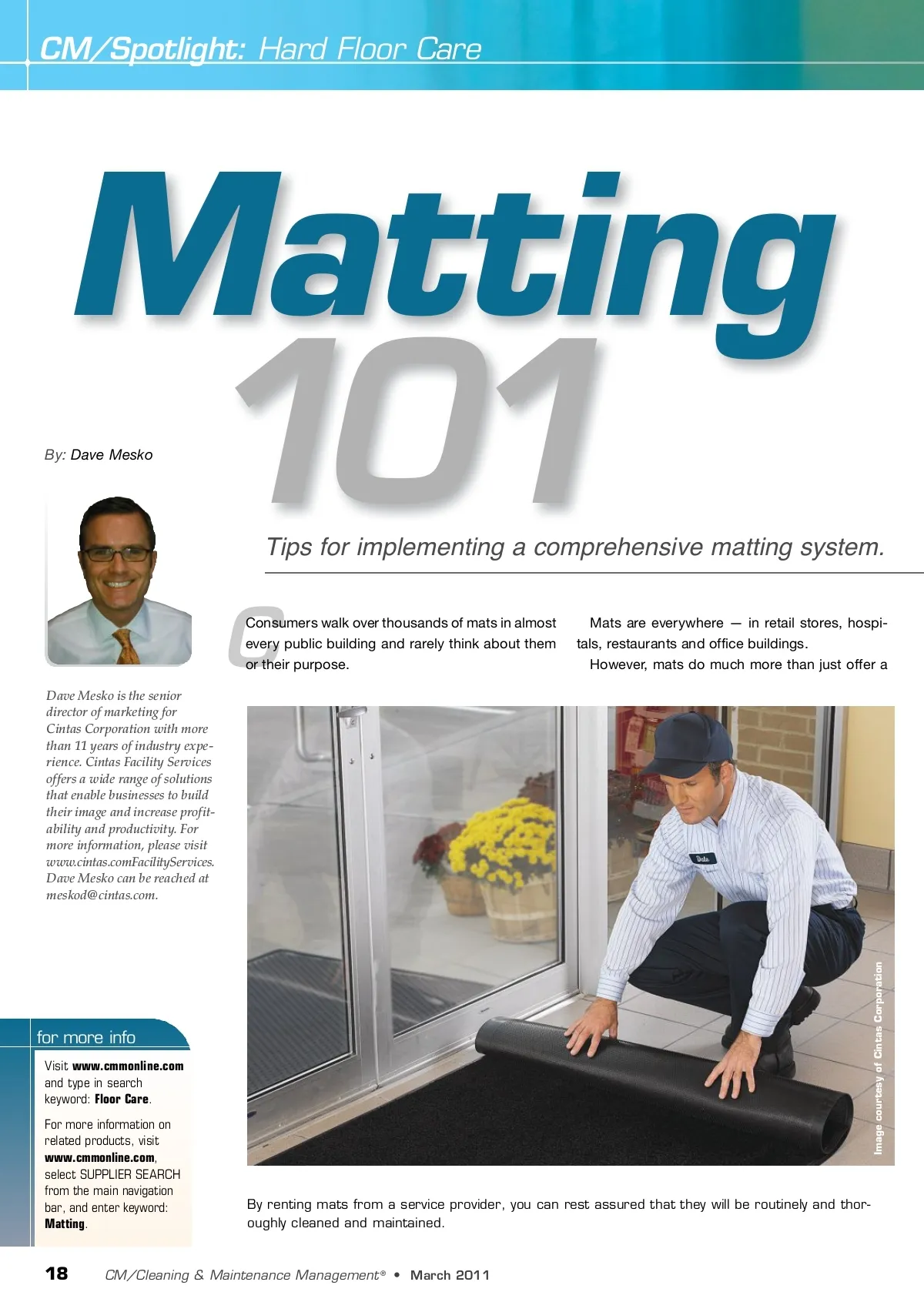
place for one to wipe his or her feet. They impact your business by helping you to avoid risk, elevate image and save money. But, to achieve these benefits, you must strategically place mats and develop a floor maintenance program. Protect Against Slips, Trips and Falls Floor mats on carpeted and hard floor surfaces capture dirt and contaminants before they are tracked through a facility to help keep it clean and reduce maintenance costs. Moreover, they help keep building occu-pants safe from slips, trips and falls. You never want someone to slip, trip or fall in your establishment; not only is it costly, but it also can ruin your reputation and damage your brand. Unfortunately, slip, trip and fall accidents are a common occurrence if proper pre-caution is not taken. According to the National Safety Council, more than 9 million disabling slips, trips and falls occur each year, with the average cost being more than $20,953 per claim. A vital step to help create a slip-free envi-ronment is to implement a matting system. The National Floor Safety Institute (NFSI) estimates that more than 80 percent of slip, trip and fall accidents take place on wet surfaces, so it is important to take preventative measures to help protect your building occupants and guests. including dirt and water. Mats should be placed at the front entrance, back doors, side doors and employee entrances. To properly protect entrance zones, organi-zations should place scraper mats out-side and carpet mats inside to serve as a dual-mat system. High-risk zones High-risk zones are areas with a high probability of attracting contaminants such as dirt, moisture and grease. These areas include transitional walkways such as from the bathroom to the hallway. Additional areas to consider include water fountains, ice machines, produce sections and sinks. Placing mats in high-risk zones will protect the floors from becoming slick to help eliminate slips, trips and falls. High-traffic zones High-traffic zones are areas with the highest foot traffic. These include hall-ways and areas in front of time clocks, copiers and checkout stations. Properly protecting these areas with mats will reduce wear and track patterns. It will also enhance your organization’s image and reduce housekeeping costs. Productivity zones Mats protect floors, but they can also improve productivity. By using the right type of matting, such as anti-fatigue mats or message mats at workstations or customer service areas, you can help reduce fatigue and improve employee morale. In order for your program to be effec-tive, contaminants such as water, dirt and grease that are captured by the mats must be removed from the facility. By renting from a facilities services provider, your mats will be profession-ally cleaned on a routine basis to maximize performance. Further, a rental program allows flexibil-ity, giving you the option to increase service frequencies and the amount of mats during the rainy season or wintertime for more protection. If you buy the mats, the cleaning is up to you; regular vacuuming does not clean a mat as deeply or thoroughly as a laundry service. According to Georgia State University, only 10 percent of dirt is removed from mats with a vacuum cleaner. If mats are not cleaned thoroughly on a regular basis, they can become saturated with contaminants that could ultimately spread across your facility and potentially create more slip, trip and fall hazards. Maintain Floors On A Regular Basis Beyond a matting system, you should main-tain floors on a daily basis by pairing clean-ing tools such as mops with the right clean-ing chemicals for different floor surfaces. By designating clean mops for specific areas, you can help prevent cross-contami-nation between departments. For example, mops used to clean rest-room floors should not be used to clean floors in other areas of the building. You should also deep clean floors on a routine basis. Deep cleaning services remove dirt, break down buildup and extract all contaminants from grout lines, tile and carpeted areas throughout the building. Regular maintenance helps keep surfaces safe and enables organizations to extend the life of their flooring. Clean and safe floors begin with a com-prehensive matting system. Partnering with a service provider to develop an ongoing floor maintenance pro-gram is the first step to help keep building occupants safe and provide a spotless, pleasant atmosphere. CM Identify Zones To Protect A comprehensive mat system provides 24/7 floor protection to help ensure clean, safe floors. The best way to identify and proac-tively protect all areas is to request a walk-through consultation from a qualified service provider. Key zones to protect include: Entrance zones According to the Institute of Industrial Launderers, 80 percent of dirt is tracked into a building from the out-side. Therefore, the essential first line of defense is to have maximum coverage at the entrance to absorb contaminants Should You Rent Or Buy Mats? When implementing a matting program, you have the option to rent or buy. The major differences exist in the quality of mats and the service component. Before implementing a program, it’s important to verify the mats are certified “High Traction” by the NFSI. This guarantees that the mats possess proven slip-resistant characteristics and have passed a laboratory test and a “real world” test to help reduce slips, trips and falls. Service is a vital element to consider when implementing a matting program. www.cmmonline.com 19
CMM – Archives Mar 2011: 19