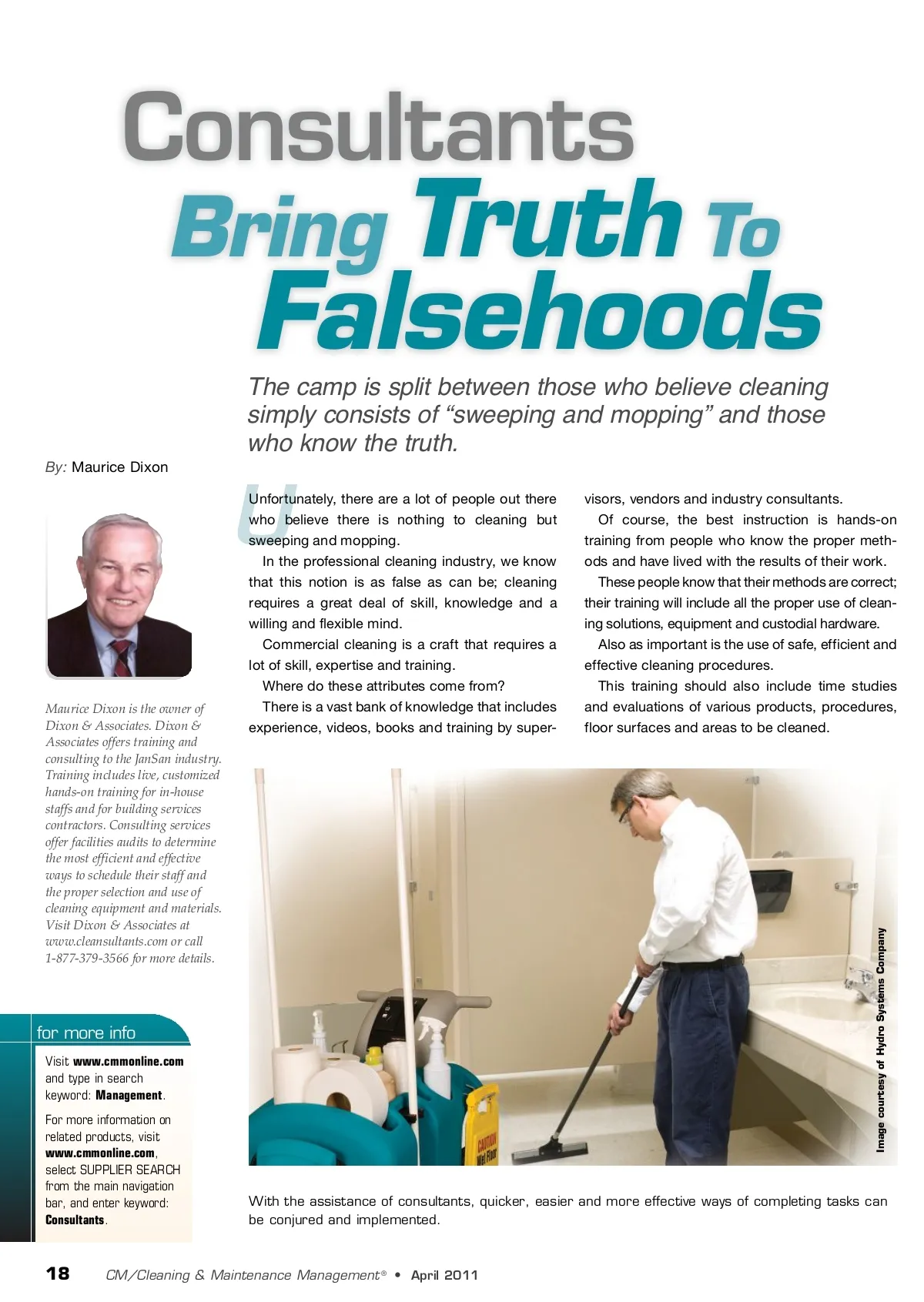
Establishing A Starting Point A building audit by a cleaning consultant of the space involved, floor surfaces and cur-rent procedures in use is also very helpful as a starting point. Let’s take an example of one area of your facility, a first impression area that is a crucial part of your cleaning program: Restrooms. Restrooms may be small or large and may be located in various types of facili-ties — schools, office buildings, health care facilities, industrial plants, hotels, motels and many others. Whatever the case, they are a “first impression area,” and the image presented to users reflects upon your image. There are some important points when it comes to cleaning restrooms. Start with a cleaning checklist to be sure the person cleaning the restrooms is equipped with the correct personal pro-tective equipment (PPE) for their safety as well as the proper cleaning materials and procedures to be used. PPE includes things like gloves, goggles, facemasks and other equipment that cre-ates a barrier between a custodian’s skin and potentially harmful substances. A product’s material safety data sheet (MSDS) will list these PPE requirements. Caution signs must be in place to alert people that cleaning is in progress and that the floors may be wet. Cleaning products include such things as a germicidal detergent, glass cleaner, bowl cleaner, a scrub brush, cloths for cleaning, drying and general use and consumables like paper towels, toilet tissue, hand soap, air fresheners, trashcan liners and more. The products you use, how often and when you clean the restrooms and whether or not you close the restrooms to traffic will all require a great deal of judgment; this will vary depending upon your circumstances. Cleaning Procedures Empty the waste containers and clean inside and out as needed Start by spraying toilets, sinks and high-touch areas such as soap and towel dispensers, hand dryers and door handles with your bottle of dis-infectant cleaner Allow your disinfectant to dwell on these fixtures for the manufacturer’s recommended amount of time While the disinfectant is wet on these fixtures, clean your mirrors and spray and wipe down the partitions and other vertical and horizontal surfaces Use a bowl cleaner to clean the flush-able fixtures, remembering to only use the bowl cleaner in the “cavity” of the fixtures, not the outsides Push or force the water down over the trap in the toilets and use your scrub brush to clean the inside of the cavity before flushing the unit to bring in fresh, clean water Clean the outside of the flushable fixtures, which you have pre-sprayed and on which you have allowed your cleaning solution to dwell Clean the non-flushable fixtures and dispensers, which have also been pre-sprayed. Now, it’s time to clean the floor. We don’t believe that just mopping will get your floor clean or keep it clean over a period of time. The floor should be scrubbed with a combination scrubbing machine or a floor machine and wet vacuum. If this equipment isn’t available or you think it is too time-consuming, consider this: Mopping the floor will not get your floor clean, and in order to keep your rest-rooms clean and sanitary, scrubbing and wet vacuuming on a regular basis should be strongly considered. Here, we are talking about judgments that you must make in order to keep your restrooms clean and sanitary. Another point: Inspecting the restroom between cleanings is very important and is a judgment call you must make as to how often it should be done. There are also many more areas to be cleaned in your facility, which require entirely different cleaning proce-dures, products and equipment than what we have reviewed here for restroom cleaning. Don’t assume that your cleaning staff is prepared to do all of this in a proper, effec-tive and efficient manner. Consider doing some evaluation, audit-ing and training with a certified indus-try consultant to help you maximize your efforts in the restroom and beyond. CM Circle Product Information no. 201 on page 32 www.cmmonline.com 19
CMM – Archives Apr 2011: 19