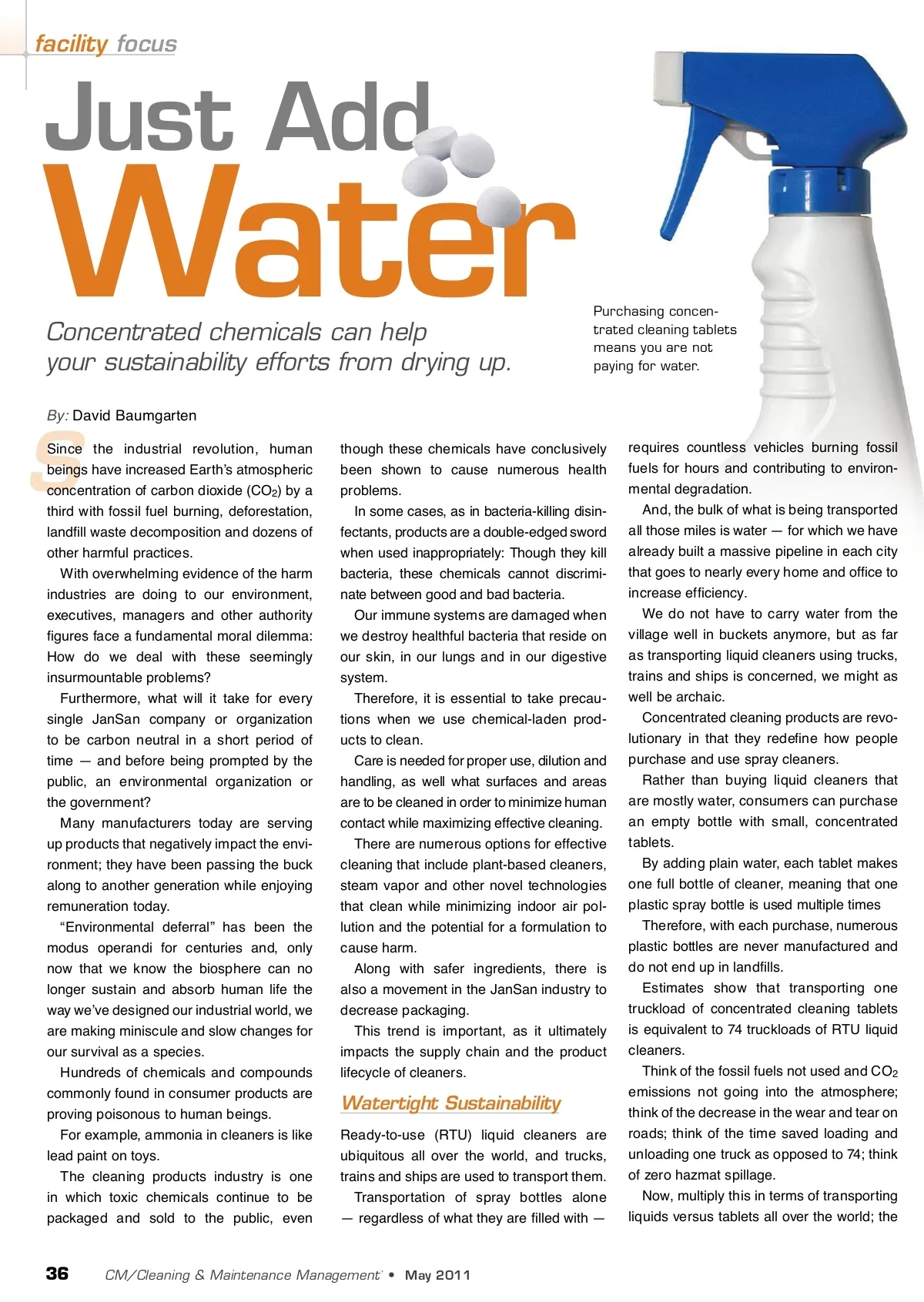
facility focus JustAdd Water Concentrated chemicals can help your sustainability efforts from drying up. By: David Baumgarten Purchasing concen-trated cleaning tablets means you are not paying for water. S Since the industrial revolution, human beings have increased Earth’s atmospheric concentration of carbon dioxide (CO 2 ) by a third with fossil fuel burning, deforestation, landfill waste decomposition and dozens of other harmful practices. With overwhelming evidence of the harm industries are doing to our environment, executives, managers and other authority figures face a fundamental moral dilemma: How do we deal with these seemingly insurmountable problems? Furthermore, what will it take for every single JanSan company or organization to be carbon neutral in a short period of time — and before being prompted by the public, an environmental organization or the government? Many manufacturers today are serving up products that negatively impact the envi-ronment; they have been passing the buck along to another generation while enjoying remuneration today. “Environmental deferral” has been the modus operandi for centuries and, only now that we know the biosphere can no longer sustain and absorb human life the way we’ve designed our industrial world, we are making miniscule and slow changes for our survival as a species. Hundreds of chemicals and compounds commonly found in consumer products are proving poisonous to human beings. For example, ammonia in cleaners is like lead paint on toys. The cleaning products industry is one in which toxic chemicals continue to be packaged and sold to the public, even though these chemicals have conclusively been shown to cause numerous health problems. In some cases, as in bacteria-killing disin-fectants, products are a double-edged sword when used inappropriately: Though they kill bacteria, these chemicals cannot discrimi-nate between good and bad bacteria. Our immune systems are damaged when we destroy healthful bacteria that reside on our skin, in our lungs and in our digestive system. Therefore, it is essential to take precau-tions when we use chemical-laden prod-ucts to clean. Care is needed for proper use, dilution and handling, as well what surfaces and areas are to be cleaned in order to minimize human contact while maximizing effective cleaning. There are numerous options for effective cleaning that include plant-based cleaners, steam vapor and other novel technologies that clean while minimizing indoor air pol-lution and the potential for a formulation to cause harm. Along with safer ingredients, there is also a movement in the JanSan industry to decrease packaging. This trend is important, as it ultimately impacts the supply chain and the product lifecycle of cleaners. Watertight Sustainability Ready-to-use (RTU) liquid cleaners are ubiquitous all over the world, and trucks, trains and ships are used to transport them. Transportation of spray bottles alone — regardless of what they are filled with — requires countless vehicles burning fossil fuels for hours and contributing to environ-mental degradation. And, the bulk of what is being transported all those miles is water — for which we have already built a massive pipeline in each city that goes to nearly every home and office to increase efficiency. We do not have to carry water from the village well in buckets anymore, but as far as transporting liquid cleaners using trucks, trains and ships is concerned, we might as well be archaic. Concentrated cleaning products are revo-lutionary in that they redefine how people purchase and use spray cleaners. Rather than buying liquid cleaners that are mostly water, consumers can purchase an empty bottle with small, concentrated tablets. By adding plain water, each tablet makes one full bottle of cleaner, meaning that one plastic spray bottle is used multiple times Therefore, with each purchase, numerous plastic bottles are never manufactured and do not end up in landfills. Estimates show that transporting one truckload of concentrated cleaning tablets is equivalent to 74 truckloads of RTU liquid cleaners. Think of the fossil fuels not used and CO 2 emissions not going into the atmosphere; think of the decrease in the wear and tear on roads; think of the time saved loading and unloading one truck as opposed to 74; think of zero hazmat spillage. Now, multiply this in terms of transporting liquids versus tablets all over the world; the 36 CM/Cleaning & Maintenance Management ® • May2011
CMM – Archives May 2011: 36