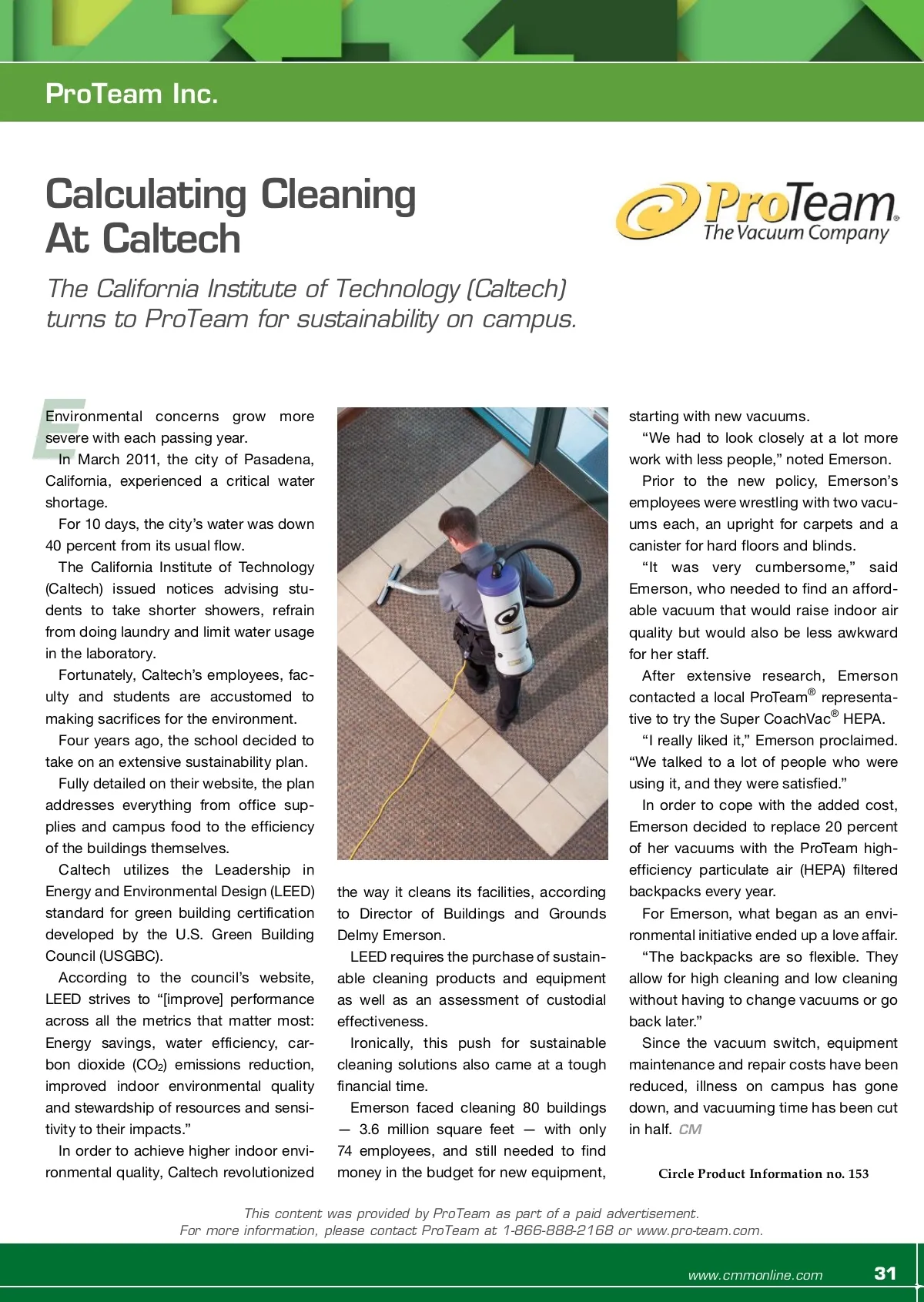
ProTeam Inc. Calculating Cleaning At Caltech The California Institute of Technology (Caltech) turns to ProTeam for sustainability on campus. E Environmental concerns grow more severe with each passing year. In March 2011, the city of Pasadena, California, experienced a critical water shortage. For 10 days, the city’s water was down 40 percent from its usual flow. The California Institute of Technology (Caltech) issued notices advising stu-dents to take shorter showers, refrain from doing laundry and limit water usage in the laboratory. Fortunately, Caltech’s employees, fac-ulty and students are accustomed to making sacrifices for the environment. Four years ago, the school decided to take on an extensive sustainability plan. Fully detailed on their website, the plan addresses everything from office sup-plies and campus food to the efficiency of the buildings themselves. Caltech utilizes the Leadership in Energy and Environmental Design (LEED) standard for green building certification developed by the U.S. Green Building Council (USGBC). According to the council’s website, LEED strives to “[improve] performance across all the metrics that matter most: Energy savings, water efficiency, car-bon dioxide (CO 2 ) emissions reduction, improved indoor environmental quality and stewardship of resources and sensi-tivity to their impacts.” In order to achieve higher indoor envi-ronmental quality, Caltech revolutionized the way it cleans its facilities, according to Director of Buildings and Grounds Delmy Emerson. LEED requires the purchase of sustain-able cleaning products and equipment as well as an assessment of custodial effectiveness. Ironically, this push for sustainable cleaning solutions also came at a tough financial time. Emerson faced cleaning 80 buildings — 3.6 million square feet — with only 74 employees, and still needed to find money in the budget for new equipment, starting with new vacuums. “We had to look closely at a lot more work with less people,” noted Emerson. Prior to the new policy, Emerson’s employees were wrestling with two vacu-ums each, an upright for carpets and a canister for hard floors and blinds. “It was very cumbersome,” said Emerson, who needed to find an afford-able vacuum that would raise indoor air quality but would also be less awkward for her staff. After extensive research, Emerson contacted a local ProTeam ® representa-tive to try the Super CoachVac ® HEPA. “I really liked it,” Emerson proclaimed. “We talked to a lot of people who were using it, and they were satisfied.” In order to cope with the added cost, Emerson decided to replace 20 percent of her vacuums with the ProTeam high-efficiency particulate air (HEPA) filtered backpacks every year. For Emerson, what began as an envi-ronmental initiative ended up a love affair. “The backpacks are so flexible. They allow for high cleaning and low cleaning without having to change vacuums or go back later.” Since the vacuum switch, equipment maintenance and repair costs have been reduced, illness on campus has gone down, and vacuuming time has been cut in half. CM Circle Product Information no. 153 This content was provided by ProTeam as part of a paid advertisement. For more information, please contact ProTeam at 1-866-888-2168 or www.pro-team.com. www.cmmonline.com 31
CMM – Archives May 2011: 31