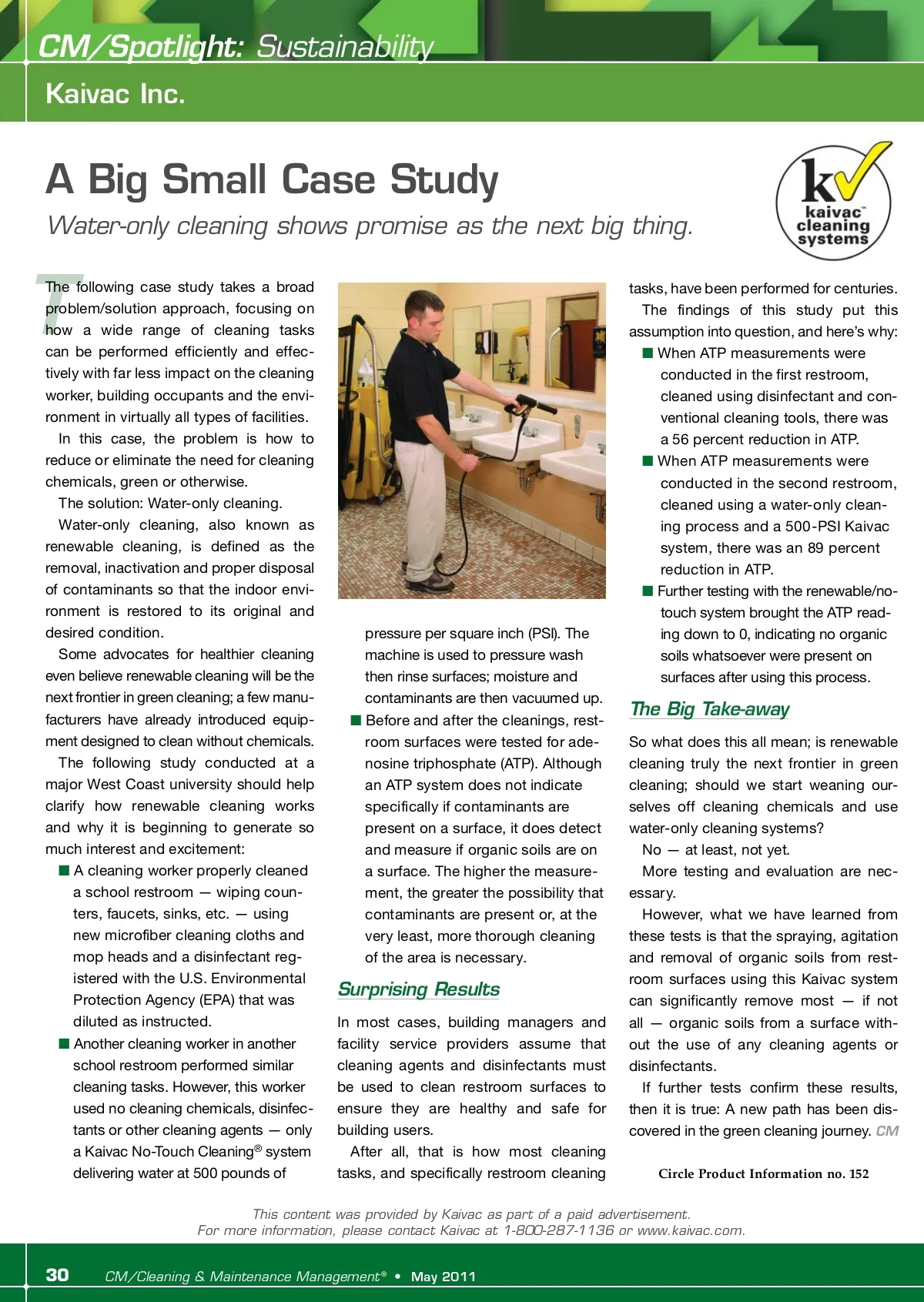
CM/Spotlight: Sustainability Kaivac Inc. A Big Small Case Study Water-only cleaning shows promise as the next big thing. T The following case study takes a broad problem/solution approach, focusing on how a wide range of cleaning tasks can be performed efficiently and effec-tively with far less impact on the cleaning worker, building occupants and the envi-ronment in virtually all types of facilities. In this case, the problem is how to reduce or eliminate the need for cleaning chemicals, green or otherwise. The solution: Water-only cleaning. Water-only cleaning, also known as renewable cleaning, is defined as the removal, inactivation and proper disposal of contaminants so that the indoor envi-ronment is restored to its original and desired condition. Some advocates for healthier cleaning even believe renewable cleaning will be the next frontier in green cleaning; a few manu-facturers have already introduced equip-ment designed to clean without chemicals. The following study conducted at a major West Coast university should help clarify how renewable cleaning works and why it is beginning to generate so much interest and excitement: ■ A cleaning worker properly cleaned a school restroom — wiping coun-ters, faucets, sinks, etc. — using new microfiber cleaning cloths and mop heads and a disinfectant reg-istered with the U.S. Environmental Protection Agency (EPA) that was diluted as instructed. ■ Another cleaning worker in another school restroom performed similar cleaning tasks. However, this worker used no cleaning chemicals, disinfec-tants or other cleaning agents — only a Kaivac No-Touch Cleaning ® system delivering water at 500 pounds of pressure per square inch (PSI). The machine is used to pressure wash then rinse surfaces; moisture and contaminants are then vacuumed up. ■ Before and after the cleanings, rest-room surfaces were tested for ade-nosine triphosphate (ATP). Although an ATP system does not indicate specifically if contaminants are present on a surface, it does detect and measure if organic soils are on a surface. The higher the measure-ment, the greater the possibility that contaminants are present or, at the very least, more thorough cleaning of the area is necessary. tasks, have been performed for centuries. The findings of this study put this assumption into question, and here’s why: ■ When ATP measurements were conducted in the first restroom, cleaned using disinfectant and con-ventional cleaning tools, there was a 56 percent reduction in ATP. ■ When ATP measurements were conducted in the second restroom, cleaned using a water-only clean-ing process and a 500-PSI Kaivac system, there was an 89 percent reduction in ATP. ■ Further testing with the renewable/no-touch system brought the ATP read-ing down to 0, indicating no organic soils whatsoever were present on surfaces after using this process. The Big Take-away So what does this all mean; is renewable cleaning truly the next frontier in green cleaning; should we start weaning our-selves off cleaning chemicals and use water-only cleaning systems? No — at least, not yet. More testing and evaluation are nec-essary. However, what we have learned from these tests is that the spraying, agitation and removal of organic soils from rest-room surfaces using this Kaivac system can significantly remove most — if not all — organic soils from a surface with-out the use of any cleaning agents or disinfectants. If further tests confirm these results, then it is true: A new path has been dis-covered in the green cleaning journey. CM Circle Product Information no. 152 Surprising Results In most cases, building managers and facility service providers assume that cleaning agents and disinfectants must be used to clean restroom surfaces to ensure they are healthy and safe for building users. After all, that is how most cleaning tasks, and specifically restroom cleaning This content was provided by Kaivac as part of a paid advertisement. For more information, please contact Kaivac at 1-800-287-1136 or www.kaivac.com. 30 CM/Cleaning & Maintenance Management ® • May 2011
CMM – Archives May 2011: 30