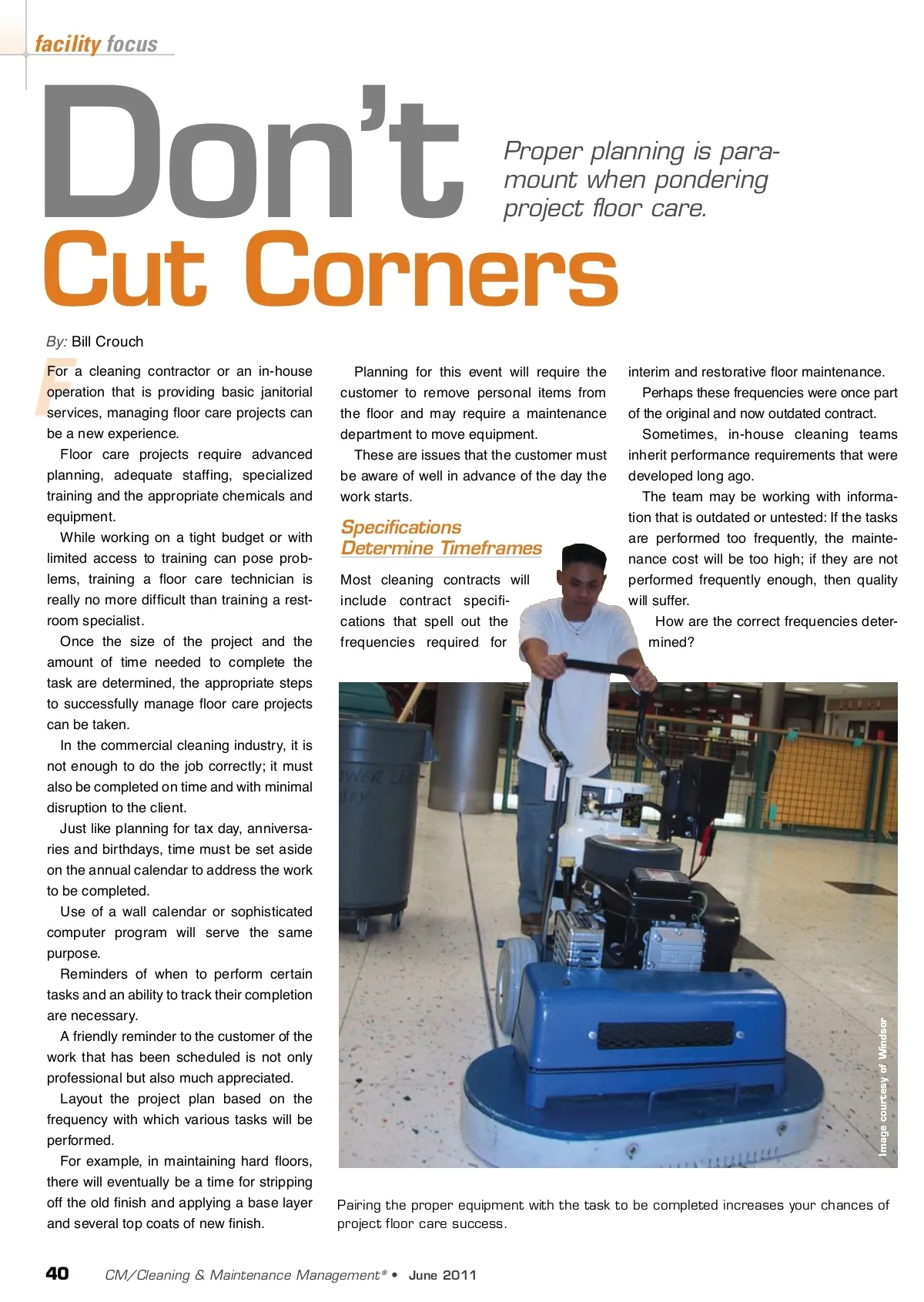
facility focus Don’t CutCorners By: Bill Crouch Proper planning is para-mount when pondering project floor care. F For a cleaning contractor or an in-house operation that is providing basic janitorial services, managing floor care projects can be a new experience. Floor care projects require advanced planning, adequate staffing, specialized training and the appropriate chemicals and equipment. While working on a tight budget or with limited access to training can pose prob-lems, training a floor care technician is really no more difficult than training a rest-room specialist. Once the size of the project and the amount of time needed to complete the task are determined, the appropriate steps to successfully manage floor care projects can be taken. In the commercial cleaning industry, it is not enough to do the job correctly; it must also be completed on time and with minimal disruption to the client. Just like planning for tax day, anniversa-ries and birthdays, time must be set aside on the annual calendar to address the work to be completed. Use of a wall calendar or sophisticated computer program will serve the same purpose. Reminders of when to perform certain tasks and an ability to track their completion are necessary. A friendly reminder to the customer of the work that has been scheduled is not only professional but also much appreciated. Layout the project plan based on the frequency with which various tasks will be performed. For example, in maintaining hard floors, there will eventually be a time for stripping off the old finish and applying a base layer and several top coats of new finish. Planning for this event will require the customer to remove personal items from the floor and may require a maintenance department to move equipment. These are issues that the customer must be aware of well in advance of the day the work starts. Specifications Determine Timeframes Most cleaning contracts will include contract specifi-cations that spell out the frequencies required for interim and restorative floor maintenance. Perhaps these frequencies were once part of the original and now outdated contract. Sometimes, in-house cleaning teams inherit performance requirements that were developed long ago. The team may be working with informa-tion that is outdated or untested: If the tasks are performed too frequently, the mainte-nance cost will be too high; if they are not performed frequently enough, then quality will suffer. How are the correct frequencies deter-mined? Pairing the proper equipment with the task to be completed increases your chances of project floor care success. 40 CM/Cleaning & Maintenance Management ® • June2011 Image courtesy of Windsor
CMM – Archives Jun 2011: 40