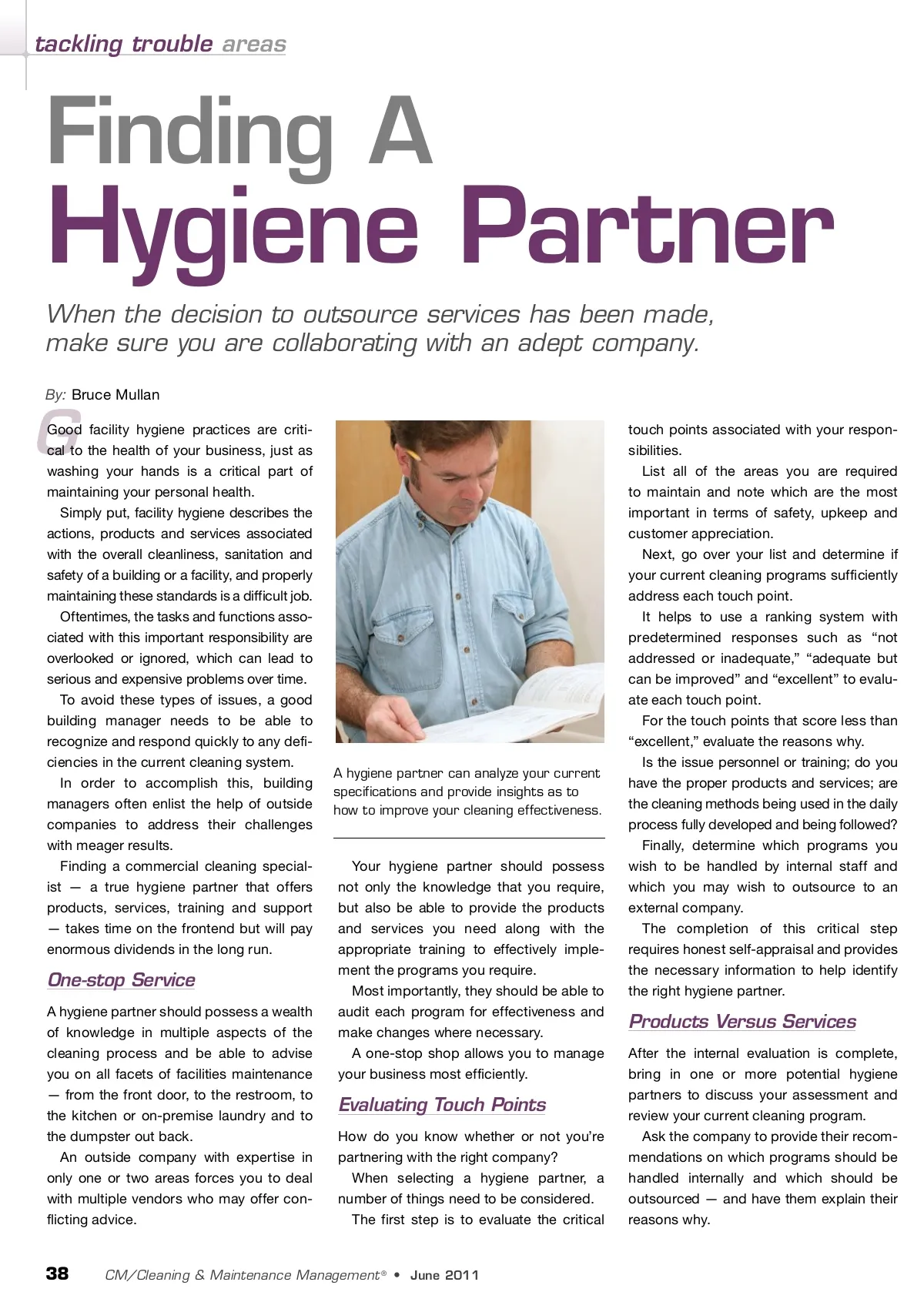
tackling trouble areas Finding A Hygiene Partner When the decision to outsource services has been made, make sure you are collaborating with an adept company. By: Bruce Mullan G Good facility hygiene practices are criti-cal to the health of your business, just as washing your hands is a critical part of maintaining your personal health. Simply put, facility hygiene describes the actions, products and services associated with the overall cleanliness, sanitation and safety of a building or a facility, and properly maintaining these standards is a difficult job. Oftentimes, the tasks and functions asso-ciated with this important responsibility are overlooked or ignored, which can lead to serious and expensive problems over time. To avoid these types of issues, a good building manager needs to be able to recognize and respond quickly to any defi-ciencies in the current cleaning system. In order to accomplish this, building managers often enlist the help of outside companies to address their challenges with meager results. Finding a commercial cleaning special-ist — a true hygiene partner that offers products, services, training and support — takes time on the frontend but will pay enormous dividends in the long run. A hygiene partner can analyze your current specifications and provide insights as to how to improve your cleaning effectiveness. One-stop Service A hygiene partner should possess a wealth of knowledge in multiple aspects of the cleaning process and be able to advise you on all facets of facilities maintenance — from the front door, to the restroom, to the kitchen or on-premise laundry and to the dumpster out back. An outside company with expertise in only one or two areas forces you to deal with multiple vendors who may offer con-flicting advice. Your hygiene partner should possess not only the knowledge that you require, but also be able to provide the products and services you need along with the appropriate training to effectively imple-ment the programs you require. Most importantly, they should be able to audit each program for effectiveness and make changes where necessary. A one-stop shop allows you to manage your business most efficiently. touch points associated with your respon-sibilities. List all of the areas you are required to maintain and note which are the most important in terms of safety, upkeep and customer appreciation. Next, go over your list and determine if your current cleaning programs sufficiently address each touch point. It helps to use a ranking system with predetermined responses such as “not addressed or inadequate,” “adequate but can be improved” and “excellent” to evalu-ate each touch point. For the touch points that score less than “excellent,” evaluate the reasons why. Is the issue personnel or training; do you have the proper products and services; are the cleaning methods being used in the daily process fully developed and being followed? Finally, determine which programs you wish to be handled by internal staff and which you may wish to outsource to an external company. The completion of this critical step requires honest self-appraisal and provides the necessary information to help identify the right hygiene partner. Products Versus Services After the internal evaluation is complete, bring in one or more potential hygiene partners to discuss your assessment and review your current cleaning program. Ask the company to provide their recom-mendations on which programs should be handled internally and which should be outsourced — and have them explain their reasons why. Evaluating Touch Points How do you know whether or not you’re partnering with the right company? When selecting a hygiene partner, a number of things need to be considered. The first step is to evaluate the critical 38 CM/Cleaning & Maintenance Management ® • June 2011
CMM – Archives Jun 2011: 38