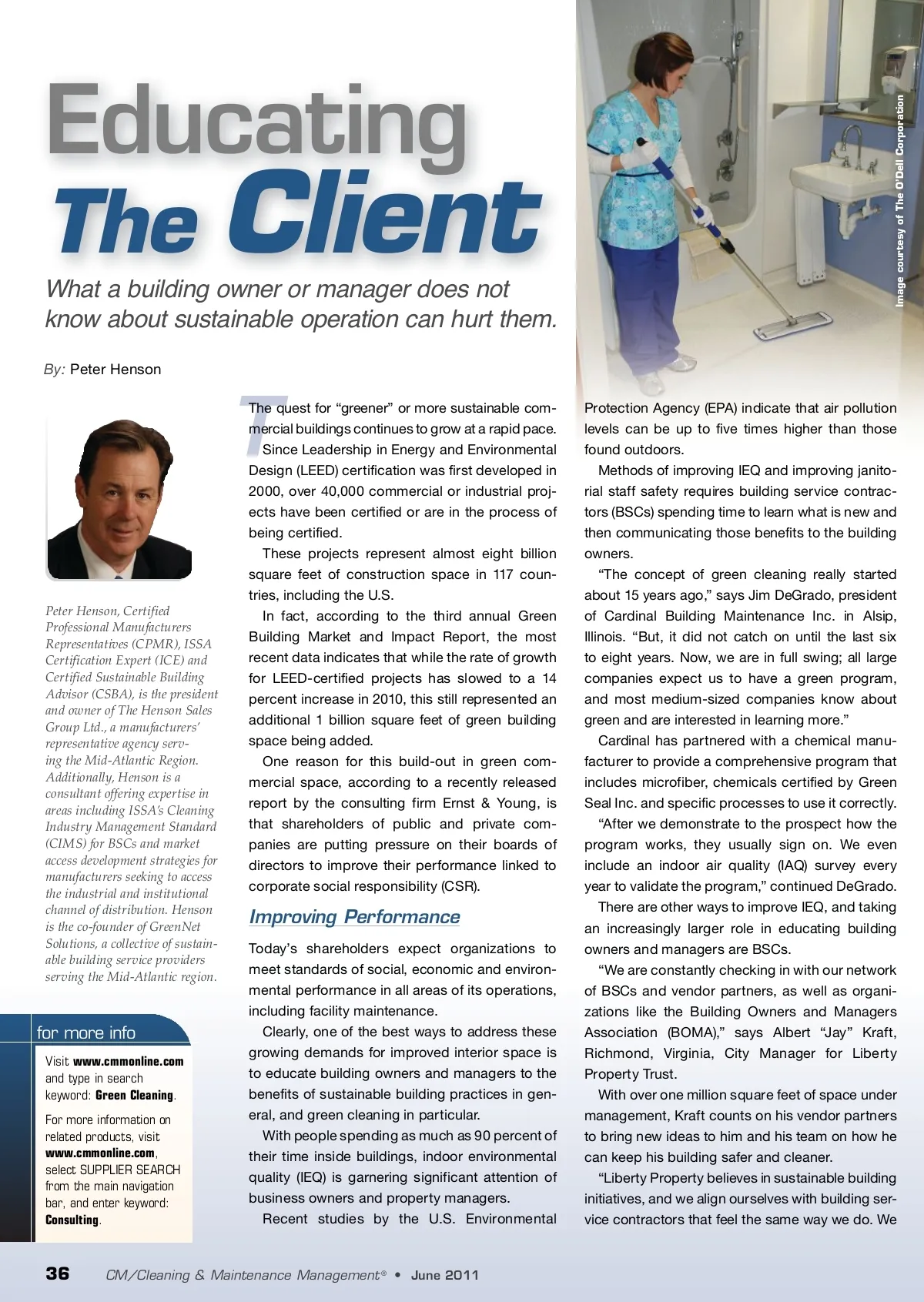
The By: Peter Henson Client T The quest for “greener” or more sustainable com-mercial buildings continues to grow at a rapid pace. Since Leadership in Energy and Environmental Design (LEED) certification was first developed in 2000, over 40,000 commercial or industrial proj-ects have been certified or are in the process of being certified. These projects represent almost eight billion square feet of construction space in 117 coun-tries, including the U.S. In fact, according to the third annual Green Building Market and Impact Report, the most recent data indicates that while the rate of growth for LEED-certified projects has slowed to a 14 percent increase in 2010, this still represented an additional 1 billion square feet of green building space being added. One reason for this build-out in green com-mercial space, according to a recently released report by the consulting firm Ernst & Young, is that shareholders of public and private com-panies are putting pressure on their boards of directors to improve their performance linked to corporate social responsibility (CSR). What a building owner or manager does not know about sustainable operation can hurt them. Peter Henson, Certified Professional Manufacturers Representatives (CPMR), ISSA Certification Expert (ICE) and Certified Sustainable Building Advisor (CSBA), is the president and owner of The Henson Sales Group Ltd., a manufacturers’ representative agency serv-ing the Mid-Atlantic Region. Additionally, Henson is a consultant offering expertise in areas including ISSA’s Cleaning Industry Management Standard (CIMS) for BSCs and market access development strategies for manufacturers seeking to access the industrial and institutional channel of distribution. Henson is the co-founder of GreenNet Solutions, a collective of sustain-able building service providers serving the Mid-Atlantic region. Improving Performance Today’s shareholders expect organizations to meet standards of social, economic and environ-mental performance in all areas of its operations, including facility maintenance. Clearly, one of the best ways to address these growing demands for improved interior space is to educate building owners and managers to the benefits of sustainable building practices in gen-eral, and green cleaning in particular. With people spending as much as 90 percent of their time inside buildings, indoor environmental quality (IEQ) is garnering significant attention of business owners and property managers. Recent studies by the U.S. Environmental for more info Visit www.cmmonline.com and type in search keyword: Green Cleaning . For more information on related products, visit www.cmmonline.com , select SUPPLIER SEARCH from the main navigation bar, and enter keyword: Consulting . Protection Agency (EPA) indicate that air pollution levels can be up to five times higher than those found outdoors. Methods of improving IEQ and improving janito-rial staff safety requires building service contrac-tors (BSCs) spending time to learn what is new and then communicating those benefits to the building owners. “The concept of green cleaning really started about 15 years ago,” says Jim DeGrado, president of Cardinal Building Maintenance Inc. in Alsip, Illinois. “But, it did not catch on until the last six to eight years. Now, we are in full swing; all large companies expect us to have a green program, and most medium-sized companies know about green and are interested in learning more.” Cardinal has partnered with a chemical manu-facturer to provide a comprehensive program that includes microfiber, chemicals certified by Green Seal Inc. and specific processes to use it correctly. “After we demonstrate to the prospect how the program works, they usually sign on. We even include an indoor air quality (IAQ) survey every year to validate the program,” continued DeGrado. There are other ways to improve IEQ, and taking an increasingly larger role in educating building owners and managers are BSCs. “We are constantly checking in with our network of BSCs and vendor partners, as well as organi-zations like the Building Owners and Managers Association (BOMA),” says Albert “Jay” Kraft, Richmond, Virginia, City Manager for Liberty Property Trust. With over one million square feet of space under management, Kraft counts on his vendor partners to bring new ideas to him and his team on how he can keep his building safer and cleaner. “Liberty Property believes in sustainable building initiatives, and we align ourselves with building ser-vice contractors that feel the same way we do. We 36 CM/Cleaning & Maintenance Management ® • June 2011 Image courtesy of The O’Dell Corporation Educating
CMM – Archives Jun 2011: 36