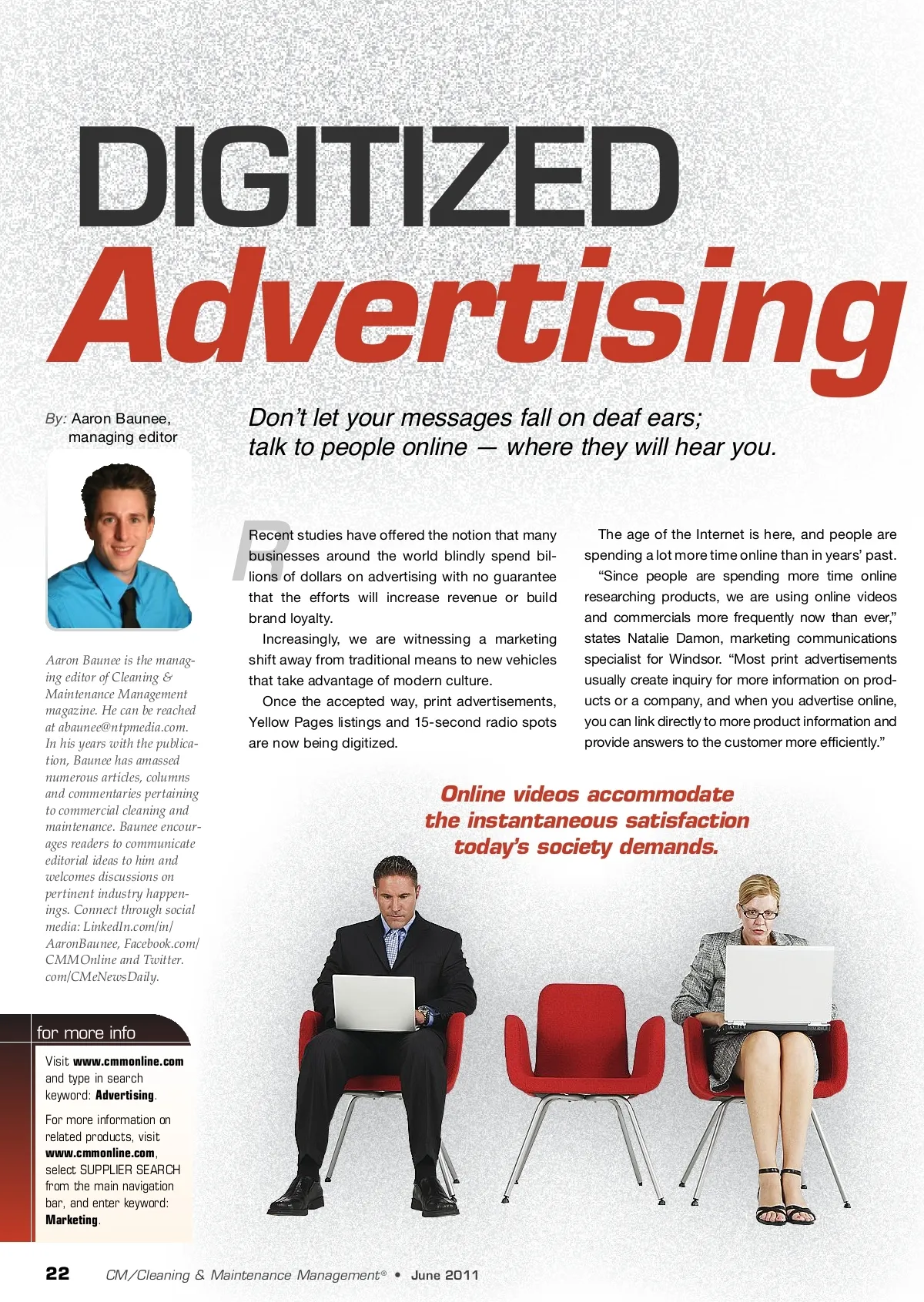
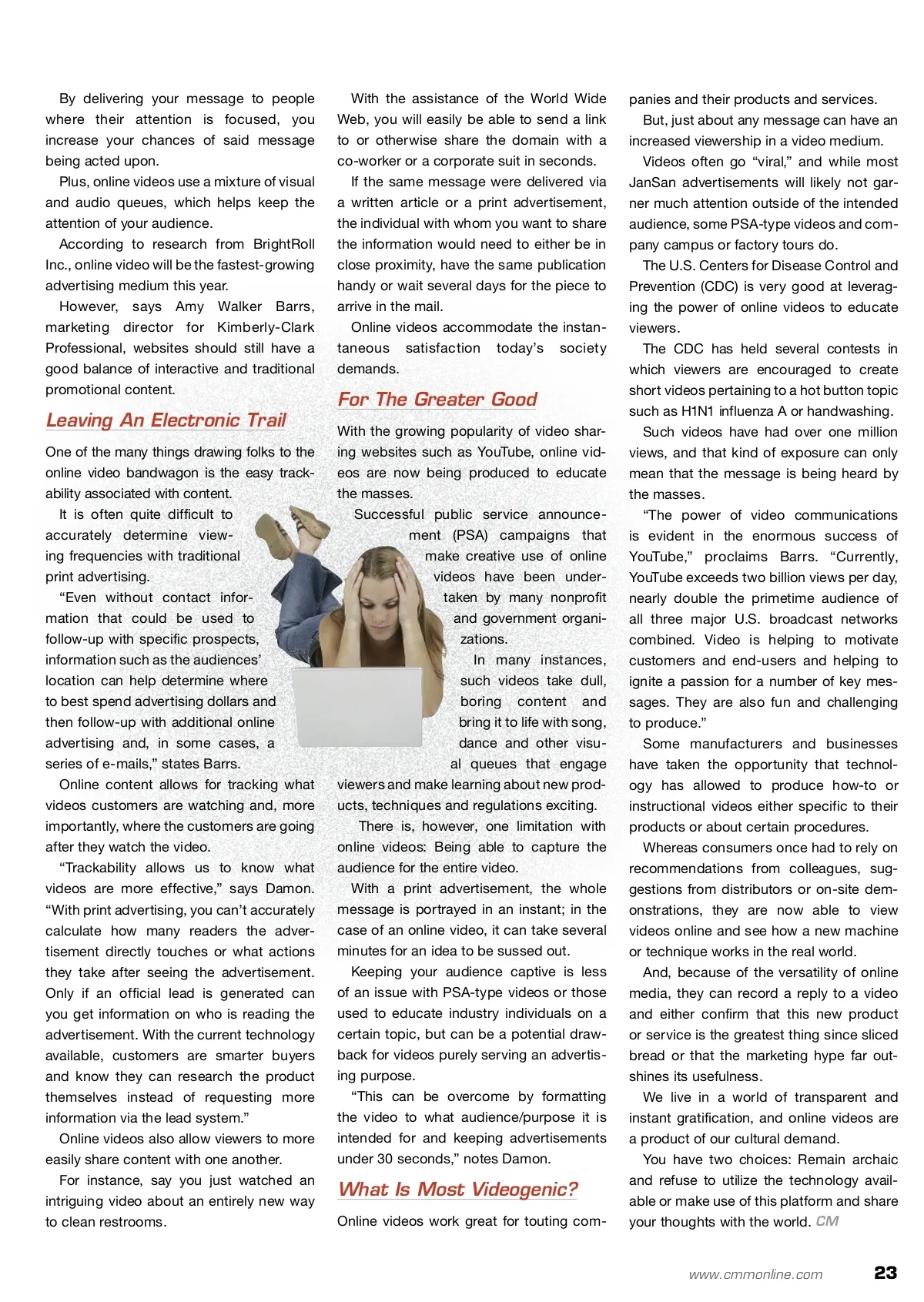
By delivering your message to people where their attention is focused, you increase your chances of said message being acted upon. Plus, online videos use a mixture of visual and audio queues, which helps keep the attention of your audience. According to research from BrightRoll Inc., online video will be the fastest-growing advertising medium this year. However, says Amy Walker Barrs, marketing director for Kimberly-Clark Professional, websites should still have a good balance of interactive and traditional promotional content. With the assistance of the World Wide Web, you will easily be able to send a link to or otherwise share the domain with a co-worker or a corporate suit in seconds. If the same message were delivered via a written article or a print advertisement, the individual with whom you want to share the information would need to either be in close proximity, have the same publication handy or wait several days for the piece to arrive in the mail. Online videos accommodate the instan-taneous satisfaction today’s society demands. For The Greater Good With the growing popularity of video shar-ing websites such as YouTube, online vid-eos are now being produced to educate the masses. Successful public service announce-ment (PSA) campaigns that make creative use of online videos have been under-taken by many nonprofit and government organi-zations. In many instances, such videos take dull, boring content and bring it to life with song, dance and other visu-al queues that engage viewers and make learning about new prod-ucts, techniques and regulations exciting. There is, however, one limitation with online videos: Being able to capture the audience for the entire video. With a print advertisement, the whole message is portrayed in an instant; in the case of an online video, it can take several minutes for an idea to be sussed out. Keeping your audience captive is less of an issue with PSA-type videos or those used to educate industry individuals on a certain topic, but can be a potential draw-back for videos purely serving an advertis-ing purpose. “This can be overcome by formatting the video to what audience/purpose it is intended for and keeping advertisements under 30 seconds,” notes Damon. Leaving An Electronic Trail One of the many things drawing folks to the online video bandwagon is the easy track-ability associated with content. It is often quite difficult to accurately determine view-ing frequencies with traditional print advertising. “Even without contact infor-mation that could be used to follow-up with specific prospects, information such as the audiences’ location can help determine where to best spend advertising dollars and then follow-up with additional online advertising and, in some cases, a series of e-mails,” states Barrs. Online content allows for tracking what videos customers are watching and, more importantly, where the customers are going after they watch the video. “Trackability allows us to know what videos are more effective,” says Damon. “With print advertising, you can’t accurately calculate how many readers the adver-tisement directly touches or what actions they take after seeing the advertisement. Only if an official lead is generated can you get information on who is reading the advertisement. With the current technology available, customers are smarter buyers and know they can research the product themselves instead of requesting more information via the lead system.” Online videos also allow viewers to more easily share content with one another. For instance, say you just watched an intriguing video about an entirely new way to clean restrooms. What Is Most Videogenic? Online videos work great for touting com-panies and their products and services. But, just about any message can have an increased viewership in a video medium. Videos often go “viral,” and while most JanSan advertisements will likely not gar-ner much attention outside of the intended audience, some PSA-type videos and com-pany campus or factory tours do. The U.S. Centers for Disease Control and Prevention (CDC) is very good at leverag-ing the power of online videos to educate viewers. The CDC has held several contests in which viewers are encouraged to create short videos pertaining to a hot button topic such as H1N1 influenza A or handwashing. Such videos have had over one million views, and that kind of exposure can only mean that the message is being heard by the masses. “The power of video communications is evident in the enormous success of YouTube,” proclaims Barrs. “Currently, YouTube exceeds two billion views per day, nearly double the primetime audience of all three major U.S. broadcast networks combined. Video is helping to motivate customers and end-users and helping to ignite a passion for a number of key mes-sages. They are also fun and challenging to produce.” Some manufacturers and businesses have taken the opportunity that technol-ogy has allowed to produce how-to or instructional videos either specific to their products or about certain procedures. Whereas consumers once had to rely on recommendations from colleagues, sug-gestions from distributors or on-site dem-onstrations, they are now able to view videos online and see how a new machine or technique works in the real world. And, because of the versatility of online media, they can record a reply to a video and either confirm that this new product or service is the greatest thing since sliced bread or that the marketing hype far out-shines its usefulness. We live in a world of transparent and instant gratification, and online videos are a product of our cultural demand. You have two choices: Remain archaic and refuse to utilize the technology avail-able or make use of this platform and share your thoughts with the world. CM www.cmmonline.com 23
CMM – Archives Jun 2011: 23