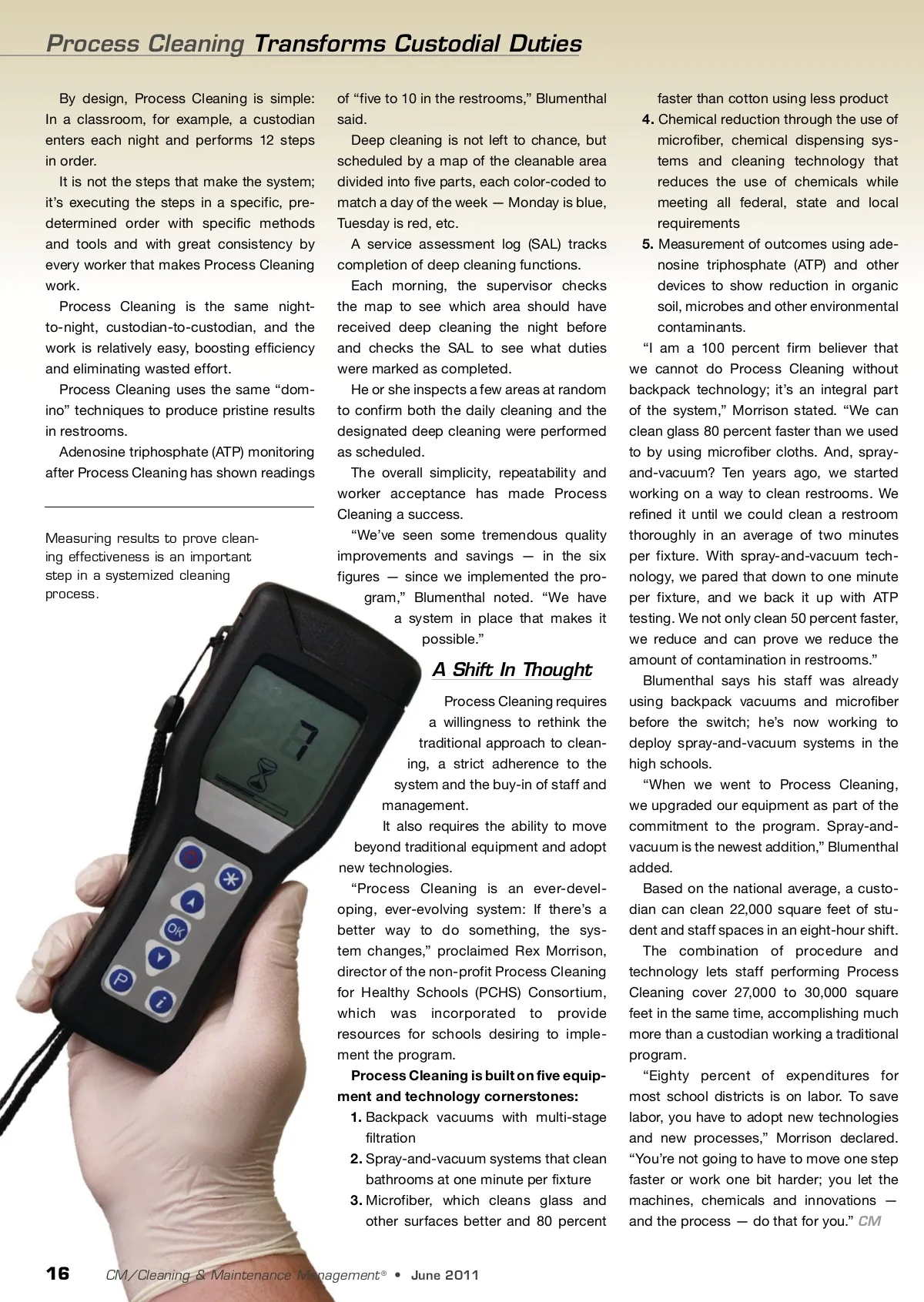
Process Cleaning Transforms Custodial Duties By design, Process Cleaning is simple: In a classroom, for example, a custodian enters each night and performs 12 steps in order. It is not the steps that make the system; it’s executing the steps in a specific, pre-determined order with specific methods and tools and with great consistency by every worker that makes Process Cleaning work. Process Cleaning is the same night-to-night, custodian-to-custodian, and the work is relatively easy, boosting efficiency and eliminating wasted effort. Process Cleaning uses the same “dom-ino” techniques to produce pristine results in restrooms. Adenosine triphosphate (ATP) monitoring after Process Cleaning has shown readings of “five to 10 in the restrooms,” Blumenthal said. Deep cleaning is not left to chance, but scheduled by a map of the cleanable area divided into five parts, each color-coded to match a day of the week — Monday is blue, Tuesday is red, etc. A service assessment log (SAL) tracks completion of deep cleaning functions. Each morning, the supervisor checks the map to see which area should have received deep cleaning the night before and checks the SAL to see what duties were marked as completed. He or she inspects a few areas at random to confirm both the daily cleaning and the designated deep cleaning were performed as scheduled. The overall simplicity, repeatability and worker acceptance has made Process Cleaning a success. “We’ve seen some tremendous quality improvements and savings — in the six figures — since we implemented the pro-gram,” Blumenthal noted. “We have a system in place that makes it possible.” faster than cotton using less product 4. Chemical reduction through the use of microfiber, chemical dispensing sys-tems and cleaning technology that reduces the use of chemicals while meeting all federal, state and local requirements 5. Measurement of outcomes using ade-nosine triphosphate (ATP) and other devices to show reduction in organic soil, microbes and other environmental contaminants. “I am a 100 percent firm believer that we cannot do Process Cleaning without backpack technology; it’s an integral part of the system,” Morrison stated. “We can clean glass 80 percent faster than we used to by using microfiber cloths. And, spray-and-vacuum? Ten years ago, we started working on a way to clean restrooms. We refined it until we could clean a restroom thoroughly in an average of two minutes per fixture. With spray-and-vacuum tech-nology, we pared that down to one minute per fixture, and we back it up with ATP testing. We not only clean 50 percent faster, we reduce and can prove we reduce the amount of contamination in restrooms.” Blumenthal says his staff was already using backpack vacuums and microfiber before the switch; he’s now working to deploy spray-and-vacuum systems in the high schools. “When we went to Process Cleaning, we upgraded our equipment as part of the commitment to the program. Spray-and-vacuum is the newest addition,” Blumenthal added. Based on the national average, a custo-dian can clean 22,000 square feet of stu-dent and staff spaces in an eight-hour shift. The combination of procedure and technology lets staff performing Process Cleaning cover 27,000 to 30,000 square feet in the same time, accomplishing much more than a custodian working a traditional program. “Eighty percent of expenditures for most school districts is on labor. To save labor, you have to adopt new technologies and new processes,” Morrison declared. “You’re not going to have to move one step faster or work one bit harder; you let the machines, chemicals and innovations — and the process — do that for you.” CM Measuring results to prove clean-ing effectiveness is an important step in a systemized cleaning process. A Shift In Thought Process Cleaning requires a willingness to rethink the traditional approach to clean-ing, a strict adherence to the system and the buy-in of staff and management. It also requires the ability to move beyond traditional equipment and adopt new technologies. “Process Cleaning is an ever-devel-oping, ever-evolving system: If there’s a better way to do something, the sys-tem changes,” proclaimed Rex Morrison, director of the non-profit Process Cleaning for Healthy Schools (PCHS) Consortium, which was incorporated to provide resources for schools desiring to imple-ment the program. Process Cleaning is built on five equip-ment and technology cornerstones: 1. Backpack vacuums with multi-stage filtration 2. Spray-and-vacuum systems that clean bathrooms at one minute per fixture 3. Microfiber, which cleans glass and other surfaces better and 80 percent 16 CM/Cleaning & Maintenance Management ® • June 2011
CMM – Archives Jun 2011: 16