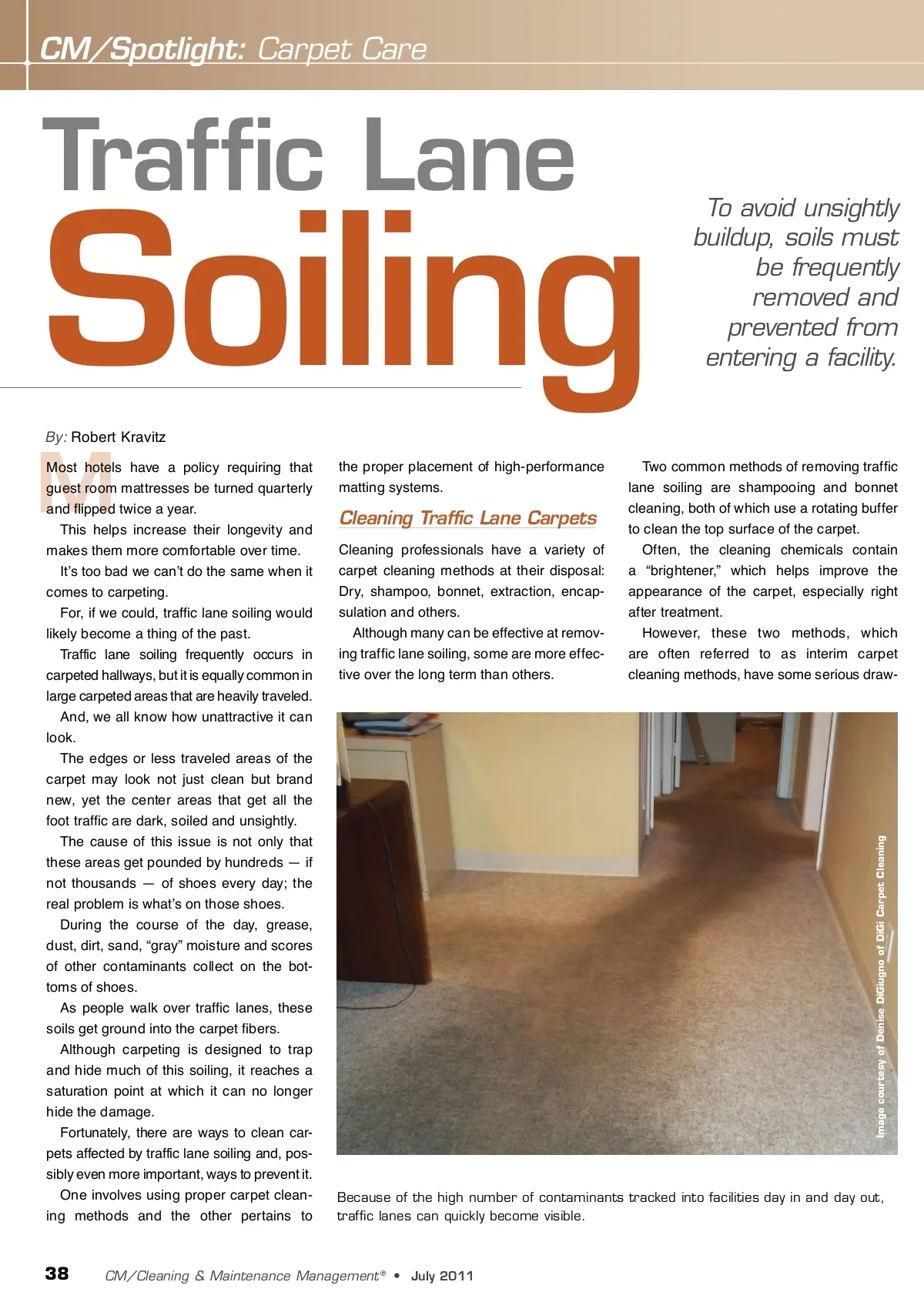
backs when it comes to removing traffic lane soils: First, they typically clean just the top fibers of the carpet; the deeply embed-ded soiling is not touched Second, the chemicals used in the shampoo/bonnet cleaning process can leave a chemical residue in the carpets, acting like a magnet and drawing more soils to it — referred to as resoiling Third, they can actually spread soils during the cleaning process in the traf-fic lanes instead of removing them. Although these two methods can still be used, the key thing to realize is that they are interim steps that essentially keep the car-pet “evenly dirty” by “feathering” dirty traffic lanes into the surrounding cleaner areas so they aren’t as noticeable. When carpet traffic lanes must be cleaned quickly and drying time is an issue, these methods can be effective. However, the traffic lanes eventually need a much more thorough cleaning, and this is when the “big guns,” carpet extractors, are required. The Big Guns Carpet extractors inject water and solution into the carpet in one forward pass and then extract the solution along with soils and contaminants by pulling back on the wand. Typically, to treat pathway soiling, as many as three passes are required. According to Doug Berjer, product man-ager for CFR Corporation, manufacturers of recycling extractors, key to the extractor cleaning process in all carpet cleaning, but especially with traffic lane soiling, are three things: Pounds of pressure per square inch (PSI) of the machine Effective moisture removal Heat. “A portable extractor for effectively clean-ing traffic lanes should have 500 PSI or more,” says Berjer. “This provides the pres-sure and power necessary to reach deep into carpet fibers, removing the soiling that is causing the darkened traffic lanes.” As to moisture removal, along with the vacuuming power of the machine, the wand plays a crucial role. Wand technology has advanced consid-erably in recent years. Some systems, Berjer says, “atomize” the cleaning process, ensuring that mois-ture never rests on the carpet surface or backing. The process more effectively removes moisture and cleaning solution — and car-pets dry faster. “This is also important because, if the traf-fic lanes are walked on before the carpets Circle Product Information no. 201 on page 32 www.cmmonline.com 39
CMM – Archives Jul 2011: 39