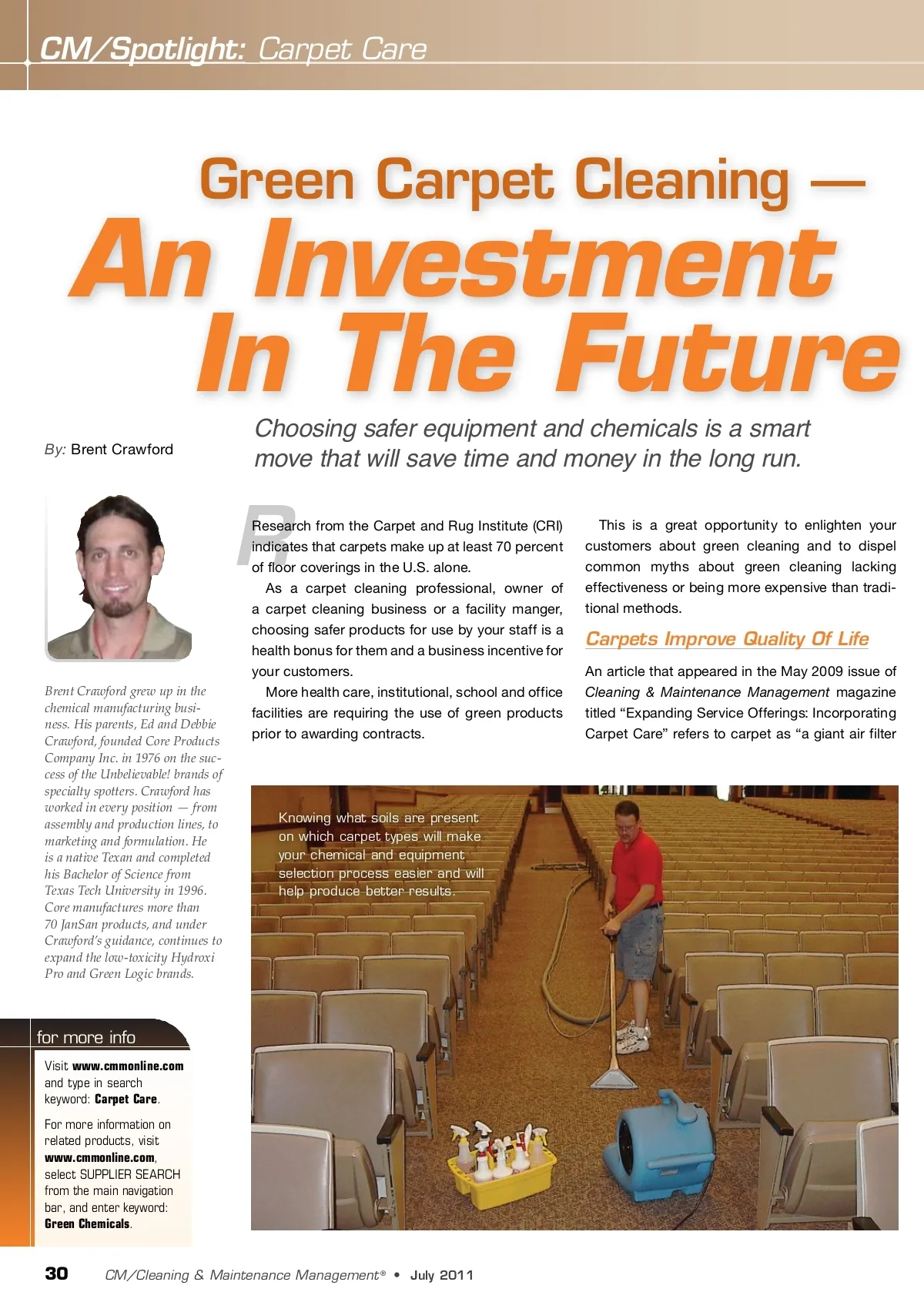
inside of a building, trapping dirt and other contaminants that would otherwise be air-borne.” Routine carpet maintenance extends the life of the carpet and reduces allergens and germs that can become airborne, according to a study by Dr. Alan Luedtke titled Carpet and Airborne Allergens: A Literature Review. Equipment used for this important, fre-quent task should be in good working order. High-efficiency particle air (HEPA) filters individually certified to have a minimum efficiency of 99.97 percent soil removal of particulates down to .3 microns in size should also be used with your vacuum. Don’t fall for a “HEPA-type” filter that only captures about 80 percent of soils down to .1 microns in size. Filters should also be changed out as needed. of products much easier, too. Providing the time and funding for official training and certification should also be considered to get the most buy-in from staff for the green change. Assess Before Your Address Now that you have made the decision to turn to a green carpet cleaning program, the logical next step is to use your experi-ence and newfound awareness as you approach and inspect each job. Pre-inspection is the time to determine what type of carpet and padding/back-ing materials will be cleaned, any unusual or particularly challenging cleaning issues and what equipment and products are necessary. This is an opportunity to provide realistic expectations to the customer about the job results. This is also the time to provide an aware-ness regarding green processes, if not initially requested. After thoroughly vacuuming particulate soils, it is time to determine whether a pre-conditioner that suspends and emulsifies soils can be used or whether specialty spot treating is necessary. The sooner a spot is treated, the better the chances to eliminate the stain. A real plus for greener products, as men-tioned earlier, is their concentration levels and multi-purpose applications. The pH level for many greener choices will be neutral, so for a wine stain — for instance — this is a great choice. Greasy soils are protein-based, so in these instances, a solvent application is necessary. Rather than a petrochemical-based sol-vent, choose a product that is citrus-based. A nice byproduct of citrus-based sol-vents is a lingering fresh, natural scent without the additional harsh chemical fra-grances that some people find irritating. If an odor-eliminating product is neces-sary, use one that is not an aerosol and that has little or no volatile organic compounds (VOCs) that can safely eliminate odors at the source and not simply mask them with a heavy fragrance. Sometimes, a small amount of an odor-eliminating product may be added to the shampoo prior to application, so a minimal amount of detergent and fragrance are used. Doing so not only saves time, but by using products as per the manufacturer recommendations, you also save money. The age old adage “more is better” does not apply to carpet cleaning. Generally, hot water extraction and car-pet shampooing are used for the majority of jobs. Dry absorbent compounds or dry foam extraction may also be used. Encapsulation technology, special soil retardants and crystallizing agents in the products that are used ensures that soils are removed. The dry foam method is a good choice for Berber carpets due to the pile and the tendency for wicking when overwetting occurs. Where to Begin? You would have to be hiding under a rock for the past decade if you haven’t seen or heard about Leadership in Energy and Environmental Design (LEED). Most government facilities are obliged to attain LEED certification, a requirement of which is the implementation of green products and services. The most obvious distinction for green products is third-party certification from organizations such as Green Seal Inc., the GREENGUARD Environmental Institute or the U.S. Environmental Protection Agency’s (EPA) Design for the Environment (DfE). Becoming educated about product ingredients and those most common in certified products is a good first step for greener carpet cleaning. These products are generally concen-trated, and when used at the proper dilu-tion, will save money for big jobs. Steer clear of hazard warnings on labels that indicate “poison” or “danger” — or those that require an inordinate amount of specialized equipment to handle. Many certified products are multi-pur-posed, so depending upon the dilution, they may be used for several cleaning steps — from spotting and pre-spraying, to actual carpet shampooing. This makes your inventory and transport The Finishing Touch Grooming carpet pile and increasing air-flow speeds up drying time, which means the customer can access the area sooner. The last thing you want is someone walking over a damp area, distributing dirt on the surface or, even worse, making the transition to a tiled surface treacherous. Quality green products, which can per-form as well as or better than traditional counterparts, have many positive attri-butes, including the following philosophies: Traditional methods may work and improve the appearance of carpeting, but now more than ever, it is important to use better technology and safer products to improve the overall health of building occupants and the envi-ronment The reality is that green products work when used as per manufacturer rec-ommendations Engage staff to read labels, noting certifications and becoming familiar with basic cleaning ingredients Choosing the right products for any job eliminates rework and provides consistent, predictable results. It pays to focus on the obvious — spend your time and money wisely. There’s no better time to make green choices. CM www.cmmonline.com 31
CMM – Archives Jul 2011: 31