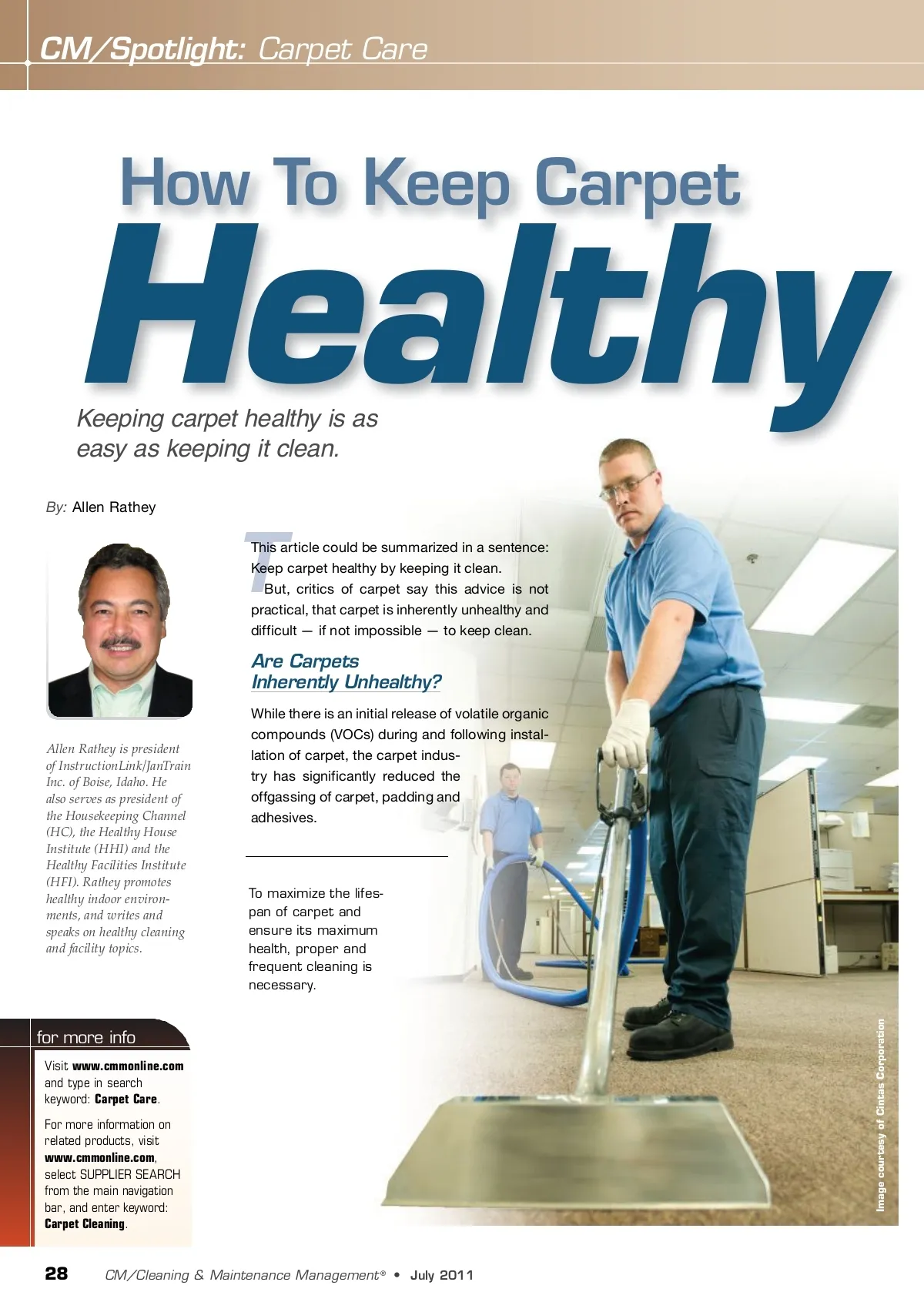
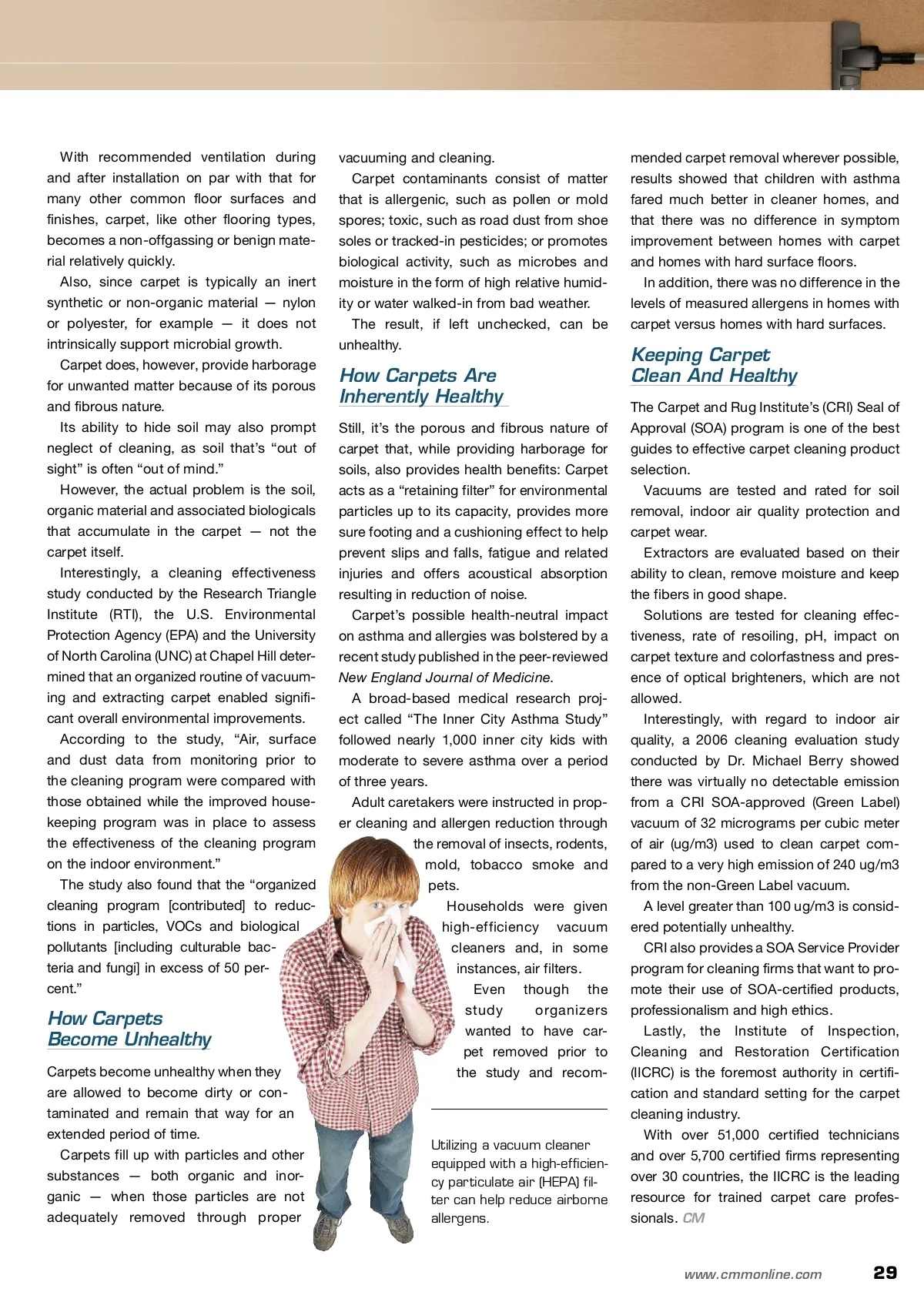
With recommended ventilation during and after installation on par with that for many other common floor surfaces and finishes, carpet, like other flooring types, becomes a non-offgassing or benign mate-rial relatively quickly. Also, since carpet is typically an inert synthetic or non-organic material — nylon or polyester, for example — it does not intrinsically support microbial growth. Carpet does, however, provide harborage for unwanted matter because of its porous and fibrous nature. Its ability to hide soil may also prompt neglect of cleaning, as soil that’s “out of sight” is often “out of mind.” However, the actual problem is the soil, organic material and associated biologicals that accumulate in the carpet — not the carpet itself. Interestingly, a cleaning effectiveness study conducted by the Research Triangle Institute (RTI), the U.S. Environmental Protection Agency (EPA) and the University of North Carolina (UNC) at Chapel Hill deter-mined that an organized routine of vacuum-ing and extracting carpet enabled signifi-cant overall environmental improvements. According to the study, “Air, surface and dust data from monitoring prior to the cleaning program were compared with those obtained while the improved house-keeping program was in place to assess the effectiveness of the cleaning program on the indoor environment.” The study also found that the “organized cleaning program [contributed] to reduc-tions in particles, VOCs and biological pollutants [including culturable bac-teria and fungi] in excess of 50 per-cent.” vacuuming and cleaning. Carpet contaminants consist of matter that is allergenic, such as pollen or mold spores; toxic, such as road dust from shoe soles or tracked-in pesticides; or promotes biological activity, such as microbes and moisture in the form of high relative humid-ity or water walked-in from bad weather. The result, if left unchecked, can be unhealthy. mended carpet removal wherever possible, results showed that children with asthma fared much better in cleaner homes, and that there was no difference in symptom improvement between homes with carpet and homes with hard surface floors. In addition, there was no difference in the levels of measured allergens in homes with carpet versus homes with hard surfaces. How Carpets Are Inherently Healthy Still, it’s the porous and fibrous nature of carpet that, while providing harborage for soils, also provides health benefits: Carpet acts as a “retaining filter” for environmental particles up to its capacity, provides more sure footing and a cushioning effect to help prevent slips and falls, fatigue and related injuries and offers acoustical absorption resulting in reduction of noise. Carpet’s possible health-neutral impact on asthma and allergies was bolstered by a recent study published in the peer-reviewed New England Journal of Medicine . A broad-based medical research proj-ect called “The Inner City Asthma Study” followed nearly 1,000 inner city kids with moderate to severe asthma over a period of three years. Adult caretakers were instructed in prop-er cleaning and allergen reduction through the removal of insects, rodents, mold, tobacco smoke and pets. Households were given high-efficiency vacuum cleaners and, in some instances, air filters. Even though the study organizers wanted to have car-pet removed prior to the study and recom-Keeping Carpet Clean And Healthy The Carpet and Rug Institute’s (CRI) Seal of Approval (SOA) program is one of the best guides to effective carpet cleaning product selection. Vacuums are tested and rated for soil removal, indoor air quality protection and carpet wear. Extractors are evaluated based on their ability to clean, remove moisture and keep the fibers in good shape. Solutions are tested for cleaning effec-tiveness, rate of resoiling, pH, impact on carpet texture and colorfastness and pres-ence of optical brighteners, which are not allowed. Interestingly, with regard to indoor air quality, a 2006 cleaning evaluation study conducted by Dr. Michael Berry showed there was virtually no detectable emission from a CRI SOA-approved (Green Label) vacuum of 32 micrograms per cubic meter of air (ug/m3) used to clean carpet com-pared to a very high emission of 240 ug/m3 from the non-Green Label vacuum. A level greater than 100 ug/m3 is consid-ered potentially unhealthy. CRI also provides a SOA Service Provider program for cleaning firms that want to pro-mote their use of SOA-certified products, professionalism and high ethics. Lastly, the Institute of Inspection, Cleaning and Restoration Certification (IICRC) is the foremost authority in certifi-cation and standard setting for the carpet cleaning industry. With over 51,000 certified technicians and over 5,700 certified firms representing over 30 countries, the IICRC is the leading resource for trained carpet care profes-sionals. CM How Carpets Become Unhealthy Carpets become unhealthy when they are allowed to become dirty or con-taminated and remain that way for an extended period of time. Carpets fill up with particles and other substances — both organic and inor-ganic — when those particles are not adequately removed through proper Utilizing a vacuum cleaner equipped with a high-efficien-cy particulate air (HEPA) fil-ter can help reduce airborne allergens. www.cmmonline.com 29
CMM – Archives Jul 2011: 29