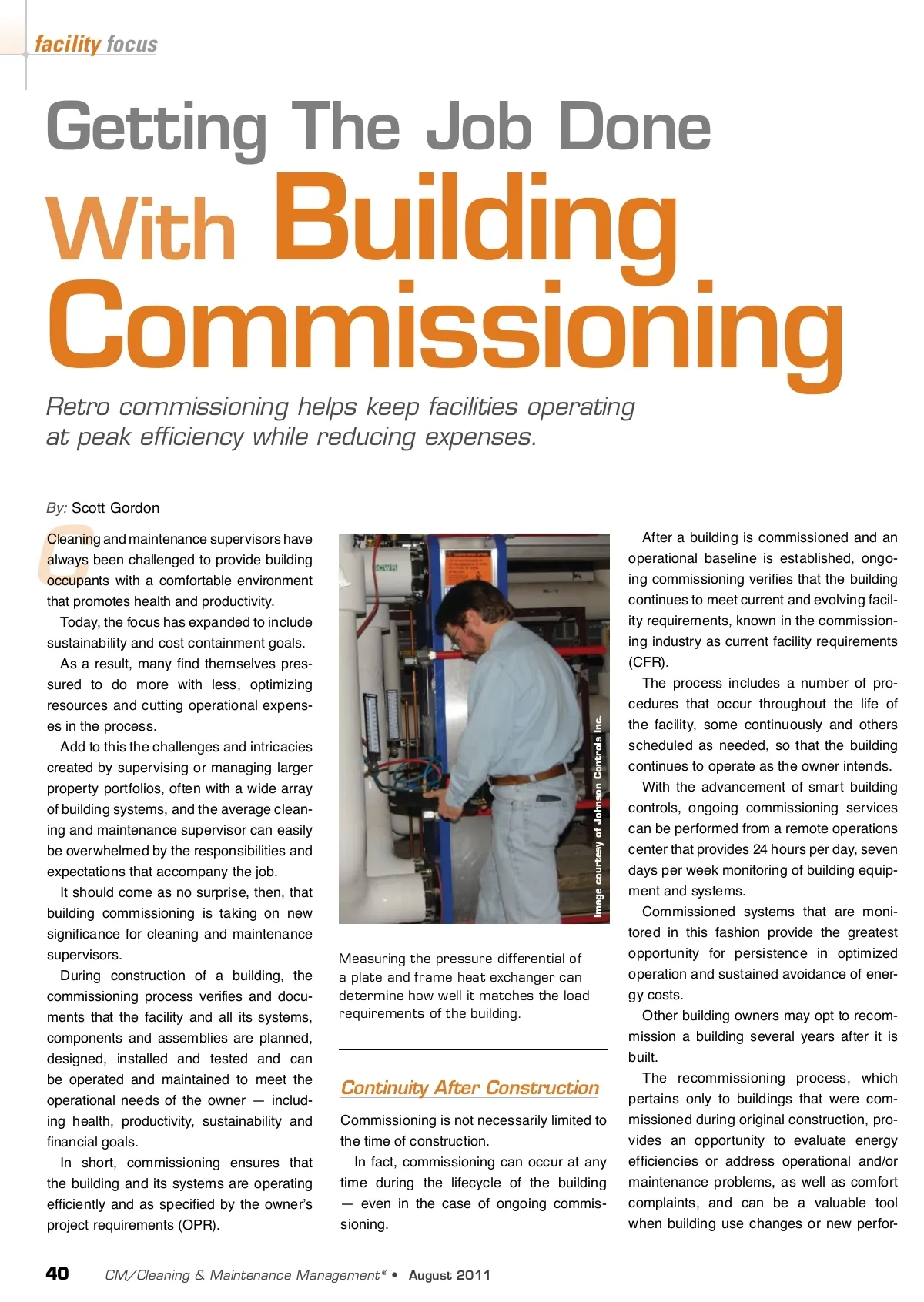
facility focus GettingTheJobDone Retro commissioning helps keep facilities operating at peak efficiency while reducing expenses. By: Scott Gordon Commissioning Cleaning and maintenance supervisors have always been challenged to provide building occupants with a comfortable environment that promotes health and productivity. Today, the focus has expanded to include sustainability and cost containment goals. As a result, many find themselves pres-sured to do more with less, optimizing resources and cutting operational expens-es in the process. Add to this the challenges and intricacies created by supervising or managing larger property portfolios, often with a wide array of building systems, and the average clean-ing and maintenance supervisor can easily be overwhelmed by the responsibilities and expectations that accompany the job. It should come as no surprise, then, that building commissioning is taking on new significance for cleaning and maintenance supervisors. During construction of a building, the commissioning process verifies and docu-ments that the facility and all its systems, components and assemblies are planned, designed, installed and tested and can be operated and maintained to meet the operational needs of the owner — includ-ing health, productivity, sustainability and financial goals. In short, commissioning ensures that the building and its systems are operating efficiently and as specified by the owner’s project requirements (OPR). After a building is commissioned and an operational baseline is established, ongo-ing commissioning verifies that the building continues to meet current and evolving facil-ity requirements, known in the commission-ing industry as current facility requirements (CFR). The process includes a number of pro-cedures that occur throughout the life of the facility, some continuously and others scheduled as needed, so that the building continues to operate as the owner intends. With the advancement of smart building controls, ongoing commissioning services can be performed from a remote operations center that provides 24 hours per day, seven days per week monitoring of building equip-ment and systems. Commissioned systems that are moni-tored in this fashion provide the greatest opportunity for persistence in optimized operation and sustained avoidance of ener-gy costs. Other building owners may opt to recom-mission a building several years after it is built. The recommissioning process, which pertains only to buildings that were com-missioned during original construction, pro-vides an opportunity to evaluate energy efficiencies or address operational and/or maintenance problems, as well as comfort complaints, and can be a valuable tool when building use changes or new perfor-With Building C Measuring the pressure differential of a plate and frame heat exchanger can determine how well it matches the load requirements of the building. Continuity After Construction Commissioning is not necessarily limited to the time of construction. In fact, commissioning can occur at any time during the lifecycle of the building — even in the case of ongoing commis-sioning. 40 CM/Cleaning & Maintenance Management ® • August2011 Image courtesy of Johnson Controls Inc.
CMM – Archives Aug 2011: 40