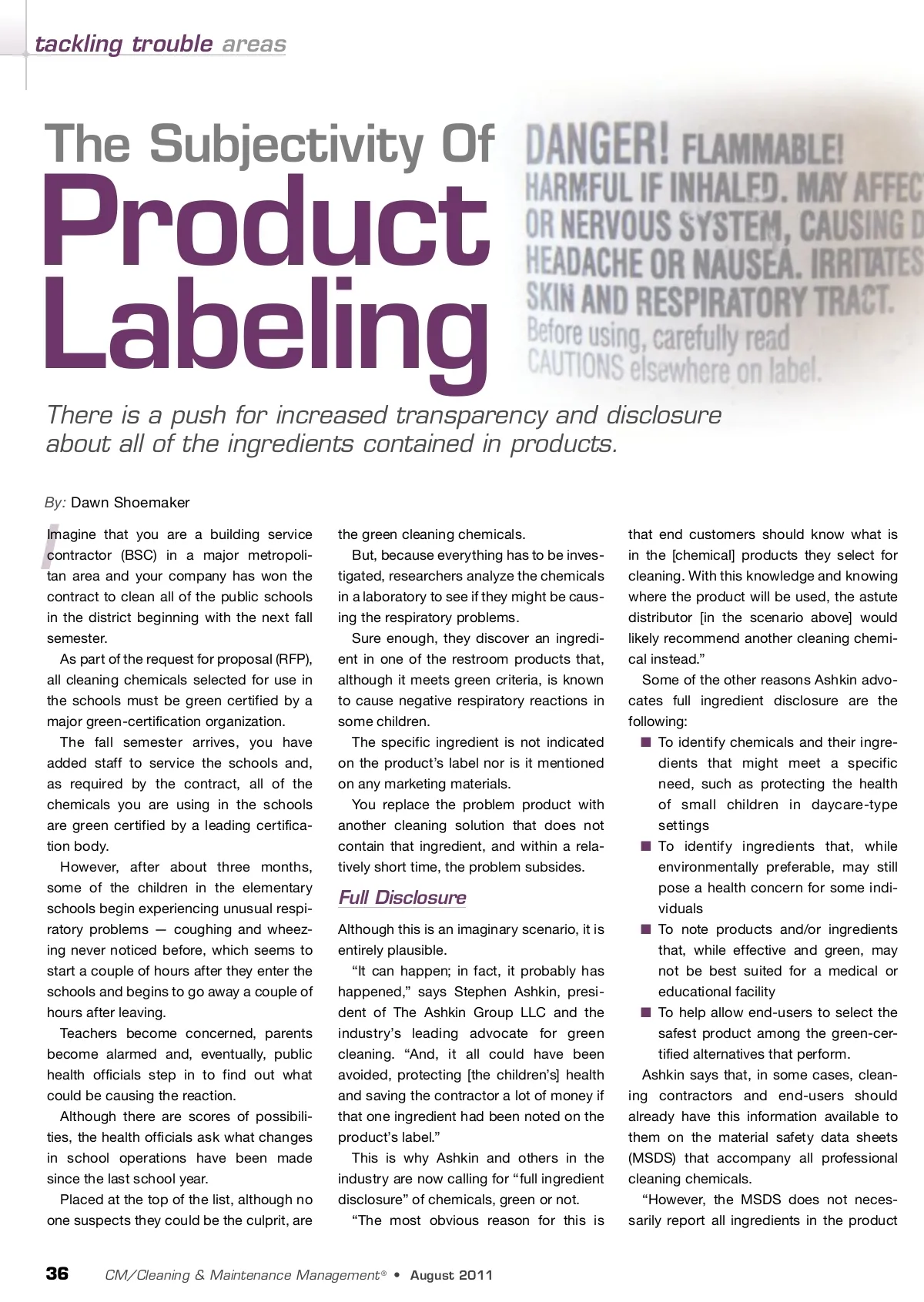
tackling trouble areas Product Labeling By: Dawn Shoemaker The Subjectivity Of There is a push for increased transparency and disclosure about all of the ingredients contained in products. I Imagine that you are a building service contractor (BSC) in a major metropoli-tan area and your company has won the contract to clean all of the public schools in the district beginning with the next fall semester. As part of the request for proposal (RFP), all cleaning chemicals selected for use in the schools must be green certified by a major green-certification organization. The fall semester arrives, you have added staff to service the schools and, as required by the contract, all of the chemicals you are using in the schools are green certified by a leading certifica-tion body. However, after about three months, some of the children in the elementary schools begin experiencing unusual respi-ratory problems — coughing and wheez-ing never noticed before, which seems to start a couple of hours after they enter the schools and begins to go away a couple of hours after leaving. Teachers become concerned, parents become alarmed and, eventually, public health officials step in to find out what could be causing the reaction. Although there are scores of possibili-ties, the health officials ask what changes in school operations have been made since the last school year. Placed at the top of the list, although no one suspects they could be the culprit, are the green cleaning chemicals. But, because everything has to be inves-tigated, researchers analyze the chemicals in a laboratory to see if they might be caus-ing the respiratory problems. Sure enough, they discover an ingredi-ent in one of the restroom products that, although it meets green criteria, is known to cause negative respiratory reactions in some children. The specific ingredient is not indicated on the product’s label nor is it mentioned on any marketing materials. You replace the problem product with another cleaning solution that does not contain that ingredient, and within a rela-tively short time, the problem subsides. Full Disclosure Although this is an imaginary scenario, it is entirely plausible. “It can happen; in fact, it probably has happened,” says Stephen Ashkin, presi-dent of The Ashkin Group LLC and the industry’s leading advocate for green cleaning. “And, it all could have been avoided, protecting [the children’s] health and saving the contractor a lot of money if that one ingredient had been noted on the product’s label.” This is why Ashkin and others in the industry are now calling for “full ingredient disclosure” of chemicals, green or not. “The most obvious reason for this is that end customers should know what is in the [chemical] products they select for cleaning. With this knowledge and knowing where the product will be used, the astute distributor [in the scenario above] would likely recommend another cleaning chemi-cal instead.” Some of the other reasons Ashkin advo-cates full ingredient disclosure are the following: ■ To identify chemicals and their ingre-dients that might meet a specific need, such as protecting the health of small children in daycare-type settings ■ To identify ingredients that, while environmentally preferable, may still pose a health concern for some indi-viduals ■ To note products and/or ingredients that, while effective and green, may not be best suited for a medical or educational facility ■ To help allow end-users to select the safest product among the green-cer-tified alternatives that perform. Ashkin says that, in some cases, clean-ing contractors and end-users should already have this information available to them on the material safety data sheets (MSDS) that accompany all professional cleaning chemicals. “However, the MSDS does not neces-sarily report all ingredients in the product 36 CM/Cleaning & Maintenance Management ® • August 2011
CMM – Archives Aug 2011: 36