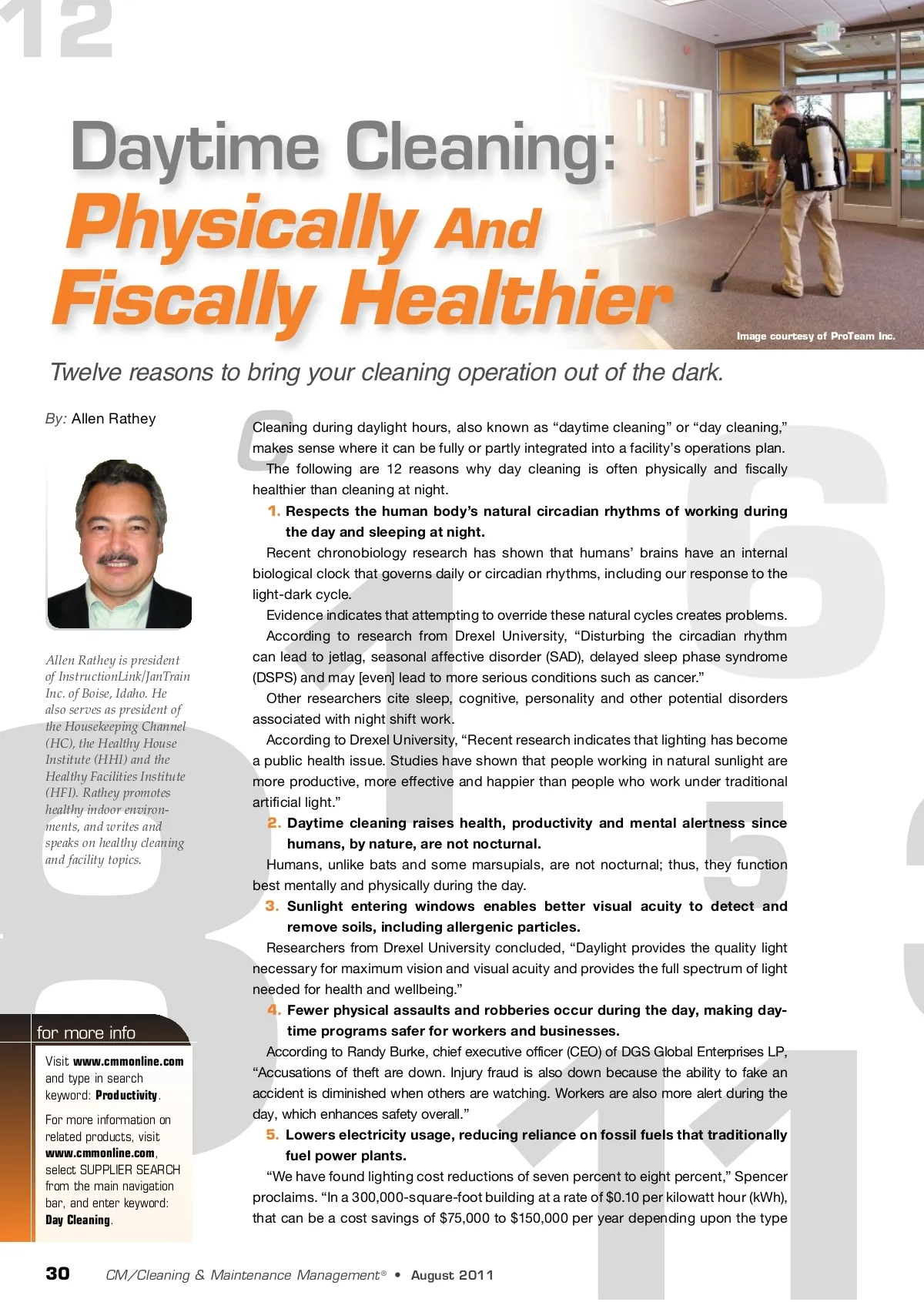
12 Daytime Cleaning: Physically And Fiscally Healthier Twelve reasons to bring your cleaning operation out of the dark. By: Allen Rathey Image courtesy of ProTeam Inc. C 8 for more info Visit www.cmmonline.com and type in search keyword: Productivity . For more information on related products, visit www.cmmonline.com , select SUPPLIER SEARCH from the main navigation bar, and enter keyword: Day Cleaning . Allen Rathey is president of InstructionLink/JanTrain Inc. of Boise, Idaho. He also serves as president of the Housekeeping Channel (HC), the Healthy House Institute (HHI) and the Healthy Facilities Institute (HFI). Rathey promotes healthy indoor environ-ments, and writes and speaks on healthy cleaning and facility topics. Cleaning during daylight hours, also known as “daytime cleaning” or “day cleaning,” makes sense where it can be fully or partly integrated into a facility’s operations plan. The following are 12 reasons why day cleaning is often physically and fiscally healthier than cleaning at night. 1. Respects the human body’s natural circadian rhythms of working during the day and sleeping at night. Recent chronobiology research has shown that humans’ brains have an internal biological clock that governs daily or circadian rhythms, including our response to the light-dark cycle. Evidence indicates that attempting to override these natural cycles creates problems. According to research from Drexel University, “Disturbing the circadian rhythm can lead to jetlag, seasonal affective disorder (SAD), delayed sleep phase syndrome (DSPS) and may [even] lead to more serious conditions such as cancer.” Other researchers cite sleep, cognitive, personality and other potential disorders associated with night shift work. According to Drexel University, “Recent research indicates that lighting has become a public health issue. Studies have shown that people working in natural sunlight are more productive, more effective and happier than people who work under traditional artificial light.” 2. Daytime cleaning raises health, productivity and mental alertness since humans, by nature, are not nocturnal. Humans, unlike bats and some marsupials, are not nocturnal; thus, they function best mentally and physically during the day. 3. Sunlight entering windows enables better visual acuity to detect and remove soils, including allergenic particles. Researchers from Drexel University concluded, “Daylight provides the quality light necessary for maximum vision and visual acuity and provides the full spectrum of light needed for health and wellbeing.” 4. Fewer physical assaults and robberies occur during the day, making day-time programs safer for workers and businesses. According to Randy Burke, chief executive officer (CEO) of DGS Global Enterprises LP, “Accusations of theft are down. Injury fraud is also down because the ability to fake an accident is diminished when others are watching. Workers are also more alert during the day, which enhances safety overall.” 5. Lowers electricity usage, reducing reliance on fossil fuels that traditionally fuel power plants. “We have found lighting cost reductions of seven percent to eight percent,” Spencer proclaims. “In a 300,000-square-foot building at a rate of $0.10 per kilowatt hour (kWh), that can be a cost savings of $75,000 to $150,000 per year depending upon the type 30 CM/Cleaning & Maintenance Management ® • August 2011 6 1 5 3 11
CMM – Archives Aug 2011: 30