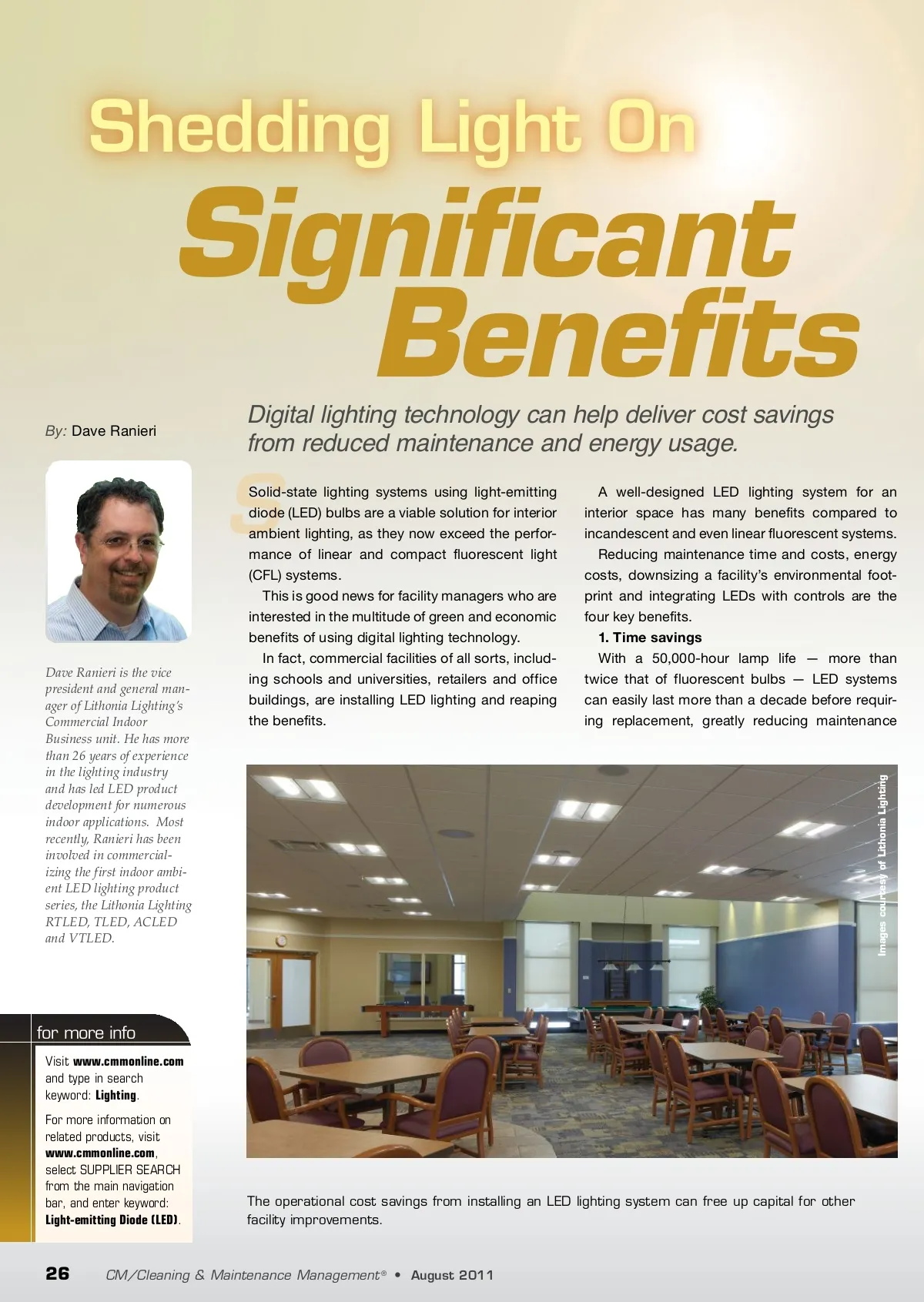
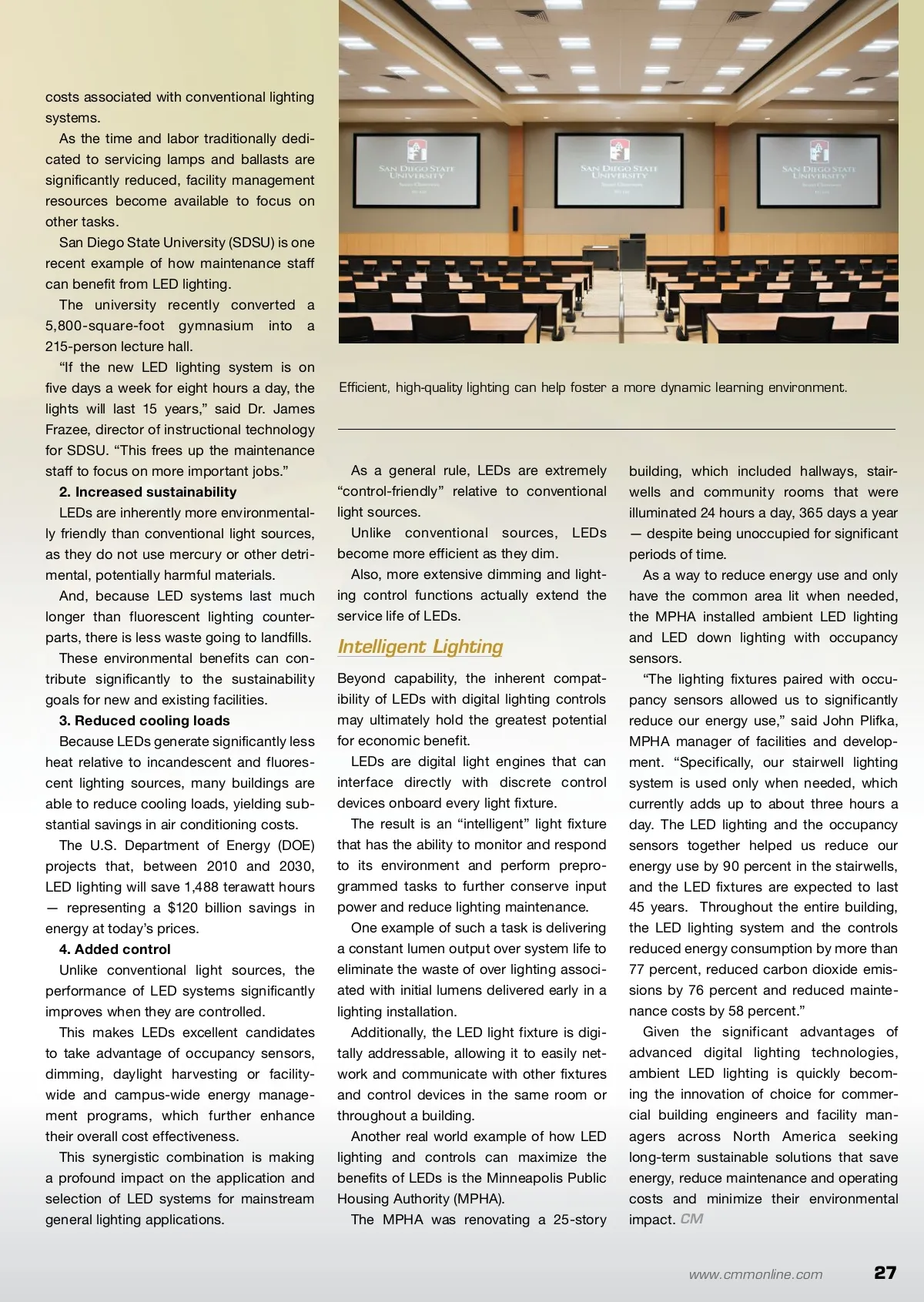
costs associated with conventional lighting systems. As the time and labor traditionally dedi-cated to servicing lamps and ballasts are significantly reduced, facility management resources become available to focus on other tasks. San Diego State University (SDSU) is one recent example of how maintenance staff can benefit from LED lighting. The university recently converted a 5,800-square-foot gymnasium into a 215-person lecture hall. “If the new LED lighting system is on five days a week for eight hours a day, the lights will last 15 years,” said Dr. James Frazee, director of instructional technology for SDSU. “This frees up the maintenance staff to focus on more important jobs.” 2. Increased sustainability LEDs are inherently more environmental-ly friendly than conventional light sources, as they do not use mercury or other detri-mental, potentially harmful materials. And, because LED systems last much longer than fluorescent lighting counter-parts, there is less waste going to landfills. These environmental benefits can con-tribute significantly to the sustainability goals for new and existing facilities. 3. Reduced cooling loads Because LEDs generate significantly less heat relative to incandescent and fluores-cent lighting sources, many buildings are able to reduce cooling loads, yielding sub-stantial savings in air conditioning costs. The U.S. Department of Energy (DOE) projects that, between 2010 and 2030, LED lighting will save 1,488 terawatt hours — representing a $120 billion savings in energy at today’s prices. 4. Added control Unlike conventional light sources, the performance of LED systems significantly improves when they are controlled. This makes LEDs excellent candidates to take advantage of occupancy sensors, dimming, daylight harvesting or facility-wide and campus-wide energy manage-ment programs, which further enhance their overall cost effectiveness. This synergistic combination is making a profound impact on the application and selection of LED systems for mainstream general lighting applications. Efficient, high-quality lighting can help foster a more dynamic learning environment. As a general rule, LEDs are extremely “control-friendly” relative to conventional light sources. Unlike conventional sources, LEDs become more efficient as they dim. Also, more extensive dimming and light-ing control functions actually extend the service life of LEDs. Intelligent Lighting Beyond capability, the inherent compat-ibility of LEDs with digital lighting controls may ultimately hold the greatest potential for economic benefit. LEDs are digital light engines that can interface directly with discrete control devices onboard every light fixture. The result is an “intelligent” light fixture that has the ability to monitor and respond to its environment and perform prepro-grammed tasks to further conserve input power and reduce lighting maintenance. One example of such a task is delivering a constant lumen output over system life to eliminate the waste of over lighting associ-ated with initial lumens delivered early in a lighting installation. Additionally, the LED light fixture is digi-tally addressable, allowing it to easily net-work and communicate with other fixtures and control devices in the same room or throughout a building. Another real world example of how LED lighting and controls can maximize the benefits of LEDs is the Minneapolis Public Housing Authority (MPHA). The MPHA was renovating a 25-story building, which included hallways, stair-wells and community rooms that were illuminated 24 hours a day, 365 days a year — despite being unoccupied for significant periods of time. As a way to reduce energy use and only have the common area lit when needed, the MPHA installed ambient LED lighting and LED down lighting with occupancy sensors. “The lighting fixtures paired with occu-pancy sensors allowed us to significantly reduce our energy use,” said John Plifka, MPHA manager of facilities and develop-ment. “Specifically, our stairwell lighting system is used only when needed, which currently adds up to about three hours a day. The LED lighting and the occupancy sensors together helped us reduce our energy use by 90 percent in the stairwells, and the LED fixtures are expected to last 45 years. Throughout the entire building, the LED lighting system and the controls reduced energy consumption by more than 77 percent, reduced carbon dioxide emis-sions by 76 percent and reduced mainte-nance costs by 58 percent.” Given the significant advantages of advanced digital lighting technologies, ambient LED lighting is quickly becom-ing the innovation of choice for commer-cial building engineers and facility man-agers across North America seeking long-term sustainable solutions that save energy, reduce maintenance and operating costs and minimize their environmental impact. CM www.cmmonline.com 27
CMM – Archives Aug 2011: 27