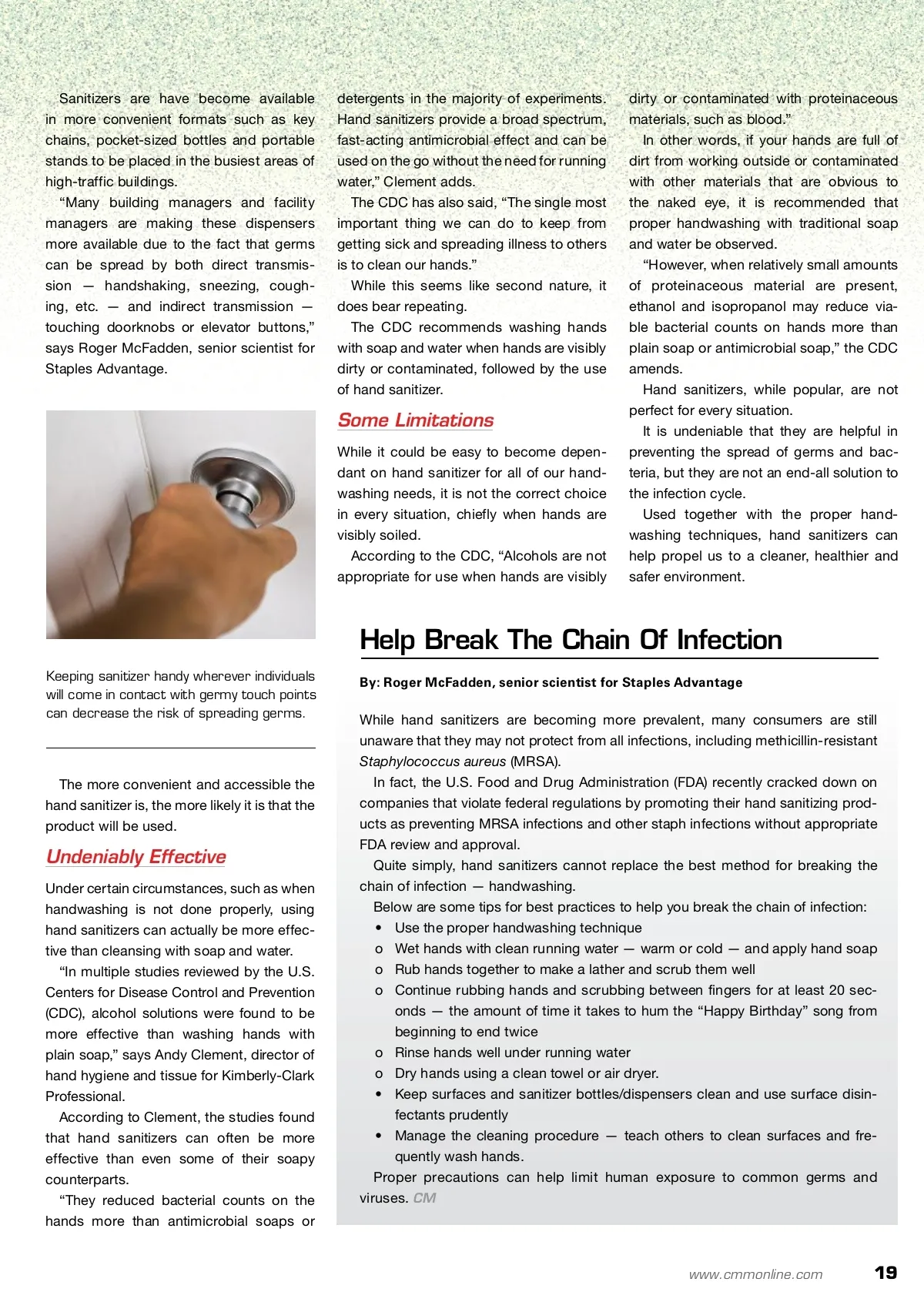
Sanitizers are have become available in more convenient formats such as key chains, pocket-sized bottles and portable stands to be placed in the busiest areas of high-traffic buildings. “Many building managers and facility managers are making these dispensers more available due to the fact that germs can be spread by both direct transmis-sion — handshaking, sneezing, cough-ing, etc. — and indirect transmission — touching doorknobs or elevator buttons,” says Roger McFadden, senior scientist for Staples Advantage. detergents in the majority of experiments. Hand sanitizers provide a broad spectrum, fast-acting antimicrobial effect and can be used on the go without the need for running water,” Clement adds. The CDC has also said, “The single most important thing we can do to keep from getting sick and spreading illness to others is to clean our hands.” While this seems like second nature, it does bear repeating. The CDC recommends washing hands with soap and water when hands are visibly dirty or contaminated, followed by the use of hand sanitizer. Some Limitations While it could be easy to become depen-dant on hand sanitizer for all of our hand-washing needs, it is not the correct choice in every situation, chiefly when hands are visibly soiled. According to the CDC, “Alcohols are not appropriate for use when hands are visibly dirty or contaminated with proteinaceous materials, such as blood.” In other words, if your hands are full of dirt from working outside or contaminated with other materials that are obvious to the naked eye, it is recommended that proper handwashing with traditional soap and water be observed. “However, when relatively small amounts of proteinaceous material are present, ethanol and isopropanol may reduce via-ble bacterial counts on hands more than plain soap or antimicrobial soap,” the CDC amends. Hand sanitizers, while popular, are not perfect for every situation. It is undeniable that they are helpful in preventing the spread of germs and bac-teria, but they are not an end-all solution to the infection cycle. Used together with the proper hand-washing techniques, hand sanitizers can help propel us to a cleaner, healthier and safer environment. Help Break The Chain Of Infection Keeping sanitizer handy wherever individuals will come in contact with germy touch points can decrease the risk of spreading germs. By: Roger McFadden, senior scientist for Staples Advantage The more convenient and accessible the hand sanitizer is, the more likely it is that the product will be used. Undeniably Effective Under certain circumstances, such as when handwashing is not done properly, using hand sanitizers can actually be more effec-tive than cleansing with soap and water. “In multiple studies reviewed by the U.S. Centers for Disease Control and Prevention (CDC), alcohol solutions were found to be more effective than washing hands with plain soap,” says Andy Clement, director of hand hygiene and tissue for Kimberly-Clark Professional. According to Clement, the studies found that hand sanitizers can often be more effective than even some of their soapy counterparts. “They reduced bacterial counts on the hands more than antimicrobial soaps or While hand sanitizers are becoming more prevalent, many consumers are still unaware that they may not protect from all infections, including methicillin-resistant Staphylococcus aureus (MRSA). In fact, the U.S. Food and Drug Administration (FDA) recently cracked down on companies that violate federal regulations by promoting their hand sanitizing prod-ucts as preventing MRSA infections and other staph infections without appropriate FDA review and approval. Quite simply, hand sanitizers cannot replace the best method for breaking the chain of infection — handwashing. Below are some tips for best practices to help you break the chain of infection: • Use the proper handwashing technique o Wet hands with clean running water — warm or cold — and apply hand soap o Rub hands together to make a lather and scrub them well o Continue rubbing hands and scrubbing between fingers for at least 20 sec-onds — the amount of time it takes to hum the “Happy Birthday” song from beginning to end twice o Rinse hands well under running water o Dry hands using a clean towel or air dryer. • Keep surfaces and sanitizer bottles/dispensers clean and use surface disin-fectants prudently • Manage the cleaning procedure — teach others to clean surfaces and fre-quently wash hands. Proper precautions can help limit human exposure to common germs and viruses. CM www.cmmonline.com 19
CMM – Archives Aug 2011: 19