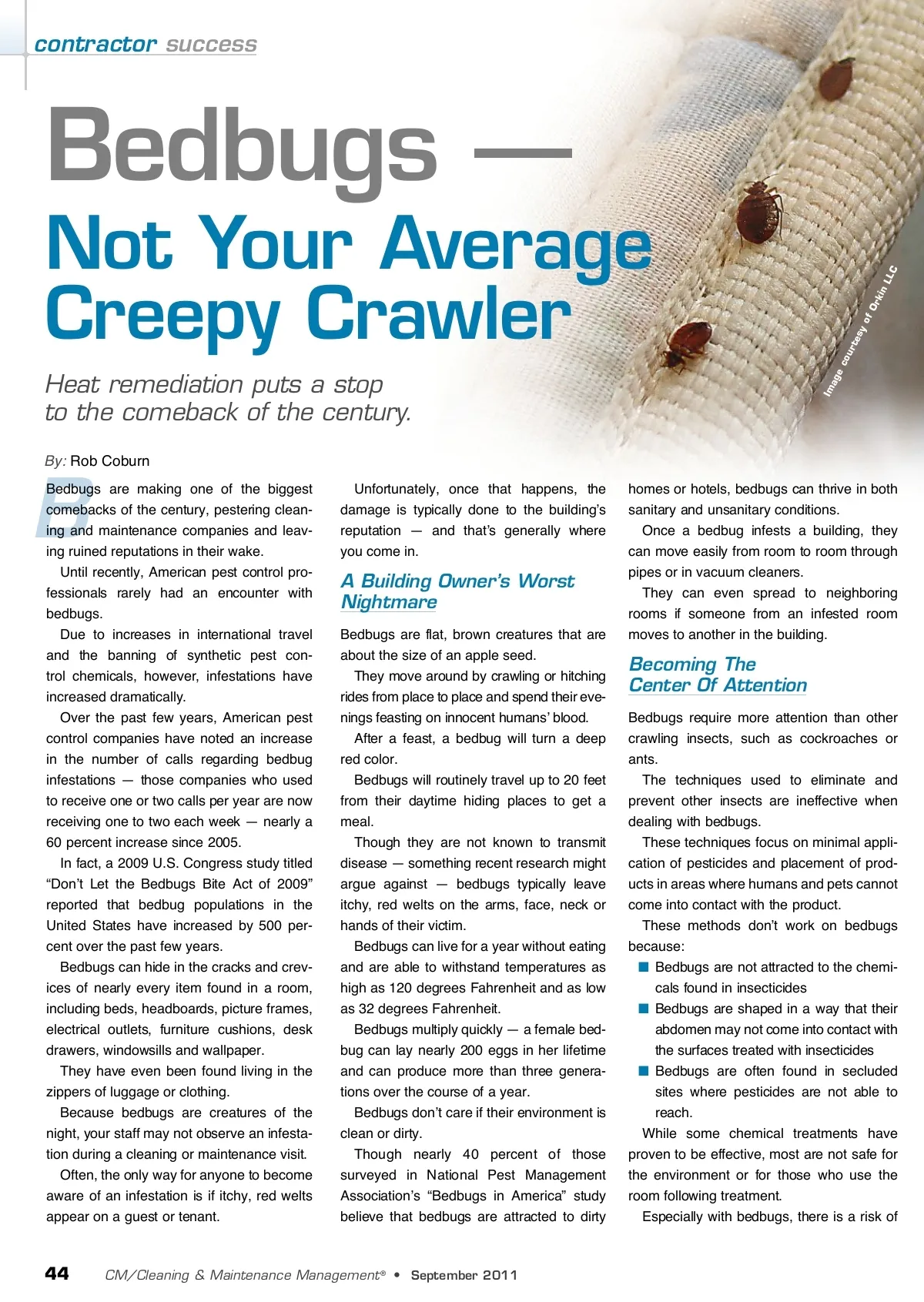
contractor success Bedbugs — Heat remediation puts a stop to the comeback of the century. By: Rob Coburn Image courtesy Not Your Average Creepy Crawler B Bedbugs are making one of the biggest comebacks of the century, pestering clean-ing and maintenance companies and leav-ing ruined reputations in their wake. Until recently, American pest control pro-fessionals rarely had an encounter with bedbugs. Due to increases in international travel and the banning of synthetic pest con-trol chemicals, however, infestations have increased dramatically. Over the past few years, American pest control companies have noted an increase in the number of calls regarding bedbug infestations — those companies who used to receive one or two calls per year are now receiving one to two each week — nearly a 60 percent increase since 2005. In fact, a 2009 U.S. Congress study titled “Don’t Let the Bedbugs Bite Act of 2009” reported that bedbug populations in the United States have increased by 500 per-cent over the past few years. Bedbugs can hide in the cracks and crev-ices of nearly every item found in a room, including beds, headboards, picture frames, electrical outlets, furniture cushions, desk drawers, windowsills and wallpaper. They have even been found living in the zippers of luggage or clothing. Because bedbugs are creatures of the night, your staff may not observe an infesta-tion during a cleaning or maintenance visit. Often, the only way for anyone to become aware of an infestation is if itchy, red welts appear on a guest or tenant. Unfortunately, once that happens, the damage is typically done to the building’s reputation — and that’s generally where you come in. A Building Owner’s Worst Nightmare Bedbugs are flat, brown creatures that are about the size of an apple seed. They move around by crawling or hitching rides from place to place and spend their eve-nings feasting on innocent humans’ blood. After a feast, a bedbug will turn a deep red color. Bedbugs will routinely travel up to 20 feet from their daytime hiding places to get a meal. Though they are not known to transmit disease — something recent research might argue against — bedbugs typically leave itchy, red welts on the arms, face, neck or hands of their victim. Bedbugs can live for a year without eating and are able to withstand temperatures as high as 120 degrees Fahrenheit and as low as 32 degrees Fahrenheit. Bedbugs multiply quickly — a female bed-bug can lay nearly 200 eggs in her lifetime and can produce more than three genera-tions over the course of a year. Bedbugs don’t care if their environment is clean or dirty. Though nearly 40 percent of those surveyed in National Pest Management Association’s “Bedbugs in America” study believe that bedbugs are attracted to dirty homes or hotels, bedbugs can thrive in both sanitary and unsanitary conditions. Once a bedbug infests a building, they can move easily from room to room through pipes or in vacuum cleaners. They can even spread to neighboring rooms if someone from an infested room moves to another in the building. Becoming The Center Of Attention Bedbugs require more attention than other crawling insects, such as cockroaches or ants. The techniques used to eliminate and prevent other insects are ineffective when dealing with bedbugs. These techniques focus on minimal appli-cation of pesticides and placement of prod-ucts in areas where humans and pets cannot come into contact with the product. These methods don’t work on bedbugs because: ■ Bedbugs are not attracted to the chemi-cals found in insecticides ■ Bedbugs are shaped in a way that their abdomen may not come into contact with the surfaces treated with insecticides ■ Bedbugs are often found in secluded sites where pesticides are not able to reach. While some chemical treatments have proven to be effective, most are not safe for the environment or for those who use the room following treatment. Especially with bedbugs, there is a risk of 44 CM/Cleaning & Maintenance Management ® • September 2011 of Orkin LLC
CMM – Archives Sept 2011: 44