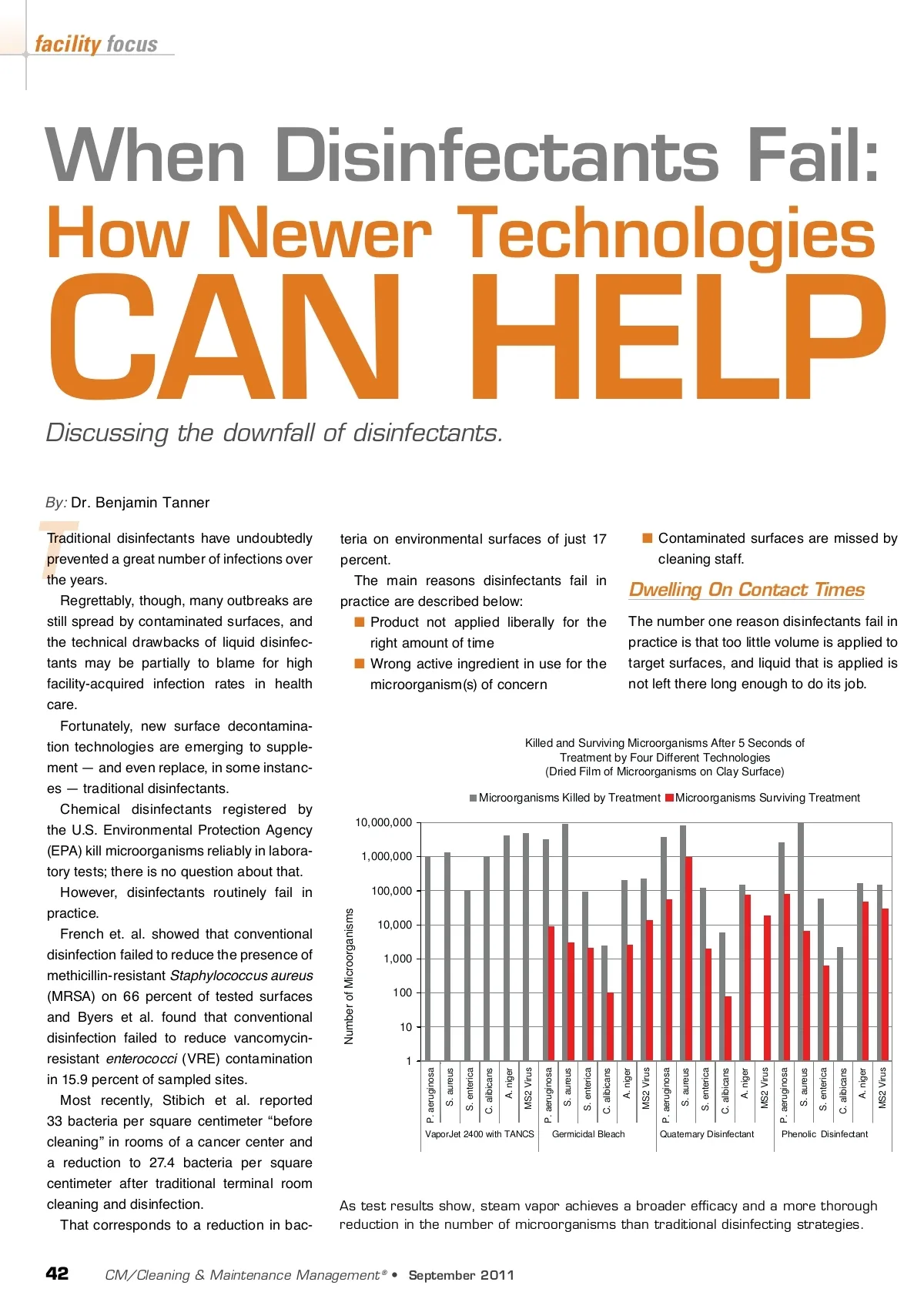
Every EPA-registered disinfectant product label lists detailed application instructions. Generally, these specify a pre-cleaning step followed by liberal application of the disinfectant, then a “dwell” or contact time. For example, one well-known disinfec-tant’s label directs users to, “Spray surface until thoroughly wet. Let stand 10 minutes.” Such language is not merely a recom-mendation; use instructions cascade directly from parameters used in laboratory testing. For spray products, microorganisms inoc-ulated onto a glass slide in a Petri dish are sprayed three to five times and then allowed to sit for 10 minutes prior to evaluation of disinfection. In laboratory testing, the ratio of liquid to surface area is enormous; if one wanted to use this same ratio to clean the high-touch surfaces in a single hospital room — to get true disinfection — about a gallon of product would be needed. The volume of product required to get true disinfection from liquid chemicals on a sur-face is simply not realistic in many cases. One can still achieve sufficient sanitiza-tion, however, so long as an appreciable volume of product is applied for the full contact time on the label. A reasonable and effective application of disinfectant product may be one full spray of disinfectant per square foot of surface area. Applying disinfectant products for the full contact time on the label is clearly very problematic. The reality is that hospital staff may only spend 10 minutes cleaning a room, so adhering to label-stated contact times is not practical in this context. Furthermore, disinfectant will run off verti-cal and other irregular surfaces during the proposed contact time and may simply evap-orate before the proper dwell time is reached. A study conducted by Antimicrobial Test Laboratories LLC demonstrated what hap-pens to the efficacy of a disinfectant chemi-cal when used in a manner close to what is commonly observed in the field. The results of this controlled laboratory study showed that for ultra-low contact times, traditional disinfectants left many microorganisms behind on the surface. a newer technology that disinfects more quickly than chemicals and helps address many of the issues that plague disinfectants in normal use. Commercial steam vapor systems pro-duce a targeted amount of “saturated” steam with relatively low moisture content, high temperature and low particle size rela-tive to steam produced by ordinary steam cleaners. Additionally, commercial steam vapor systems greatly reduce the potential for surface-to-surface or room-to-room cross-contamination because the cleaning tool remains very hot. This is in contrast to traditional approach-es, which may actually spread pathogens from one surface to the next if the disinfec-tant becomes overused or is inactivated. Another reason disinfectants sometimes fail in the field is that some lack efficacy against problematic microorganisms. Most EPA-registered chemical disinfec-tants are efficacious against “typical” gram-negative and gram-positive bacteria, such as Escherichia coli ( E. coli ) and Staph . However, a great many EPA-registered products lack efficacy against certain virus-es, including norovirus, and bacterial endo-spores. As such, it is important to recognize these deficiencies to prevent normal disin-fection activities from making contamination problems worse by spreading problematic microorganisms around the facility. A traditional approach to expanding the breadth of kill spectrum is to rotate bleach into the disinfection regimen. Bleach is a well-known broad-spectrum disinfectant that is effective against virtually all microorganisms, including norovirus and Clostridium difficile ( C. diff ). However, bleach can discolor some sur-faces and cause respiratory problems in workers and sensitive populations. If chemical irritancy is of concern, then newer steam vapor systems may prove valuable, since heat works broadly across most groups of microorganisms. A recent study published in 2008 by Carling et al. from Caritas Carney Hospital reported that, on average, 49 percent of fre-quently touched surfaces in 23 acute care hospitals were not cleaned during terminal cleaning. Because terminal cleaning and disinfec-tion are well understood, it is reasonable to think the Carling study is representa-tive of nationwide practices and that about half of surfaces that should be cleaned in health care facilities are regularly skipped or missed. This suggests missed areas may be a major cause of disinfection failures in the field. New whole-room chemical fogging and ultraviolet (UV) light disinfection technolo-gies may provide a solution to the problem of surfaces skipped during cleaning. Chemical fogging, such as with hydrogen peroxide gas, carries the advantage of dis-infecting all surfaces in a room at once. One well-studied device uses a pulsed UV technology to decontaminate rooms in minutes. Laboratory and hospital studies indicate that even indirect exposure of surfaces to the pulsed UV light carries a substantial sanitization benefit. Both of these new technologies will sani-tize easy-to-miss surfaces, but both must be used in combination with cleaning since neither has the benefit of soil removal. To help control outbreaks within facili-ties, cleaning professionals would do well to focus on the efficacy of the methods and technologies they are using to control pathogens. Given the challenges of achieving consis-tent and effective surface disinfection using traditional liquid disinfectants alone, com-plementing these approaches with newer technologies may provide a valuable inte-grated solution to help protect public health better than any one method in isolation. CM Careful And Complete Cleaning Another main reason disinfectants some-times fail in the field is that staffs simply don’t clean all the surfaces. A Simmering Solution Steam vapor for surface disinfection is Dr. Benjamin Tanner is the principal of Antimicrobial Test Laboratories, an independent testing facility specializing in the research and development of antimicrobials, including disinfec-tants. Dr. Tanner holds a B.S. in Molecular Biology and a Ph.D. in Microbiology and Immunology from the University of Arizona, where he studied environmentally mediated disease transmission and assessed infection risks for workers. www.cmmonline.com 43
CMM – Archives Sept 2011: 43