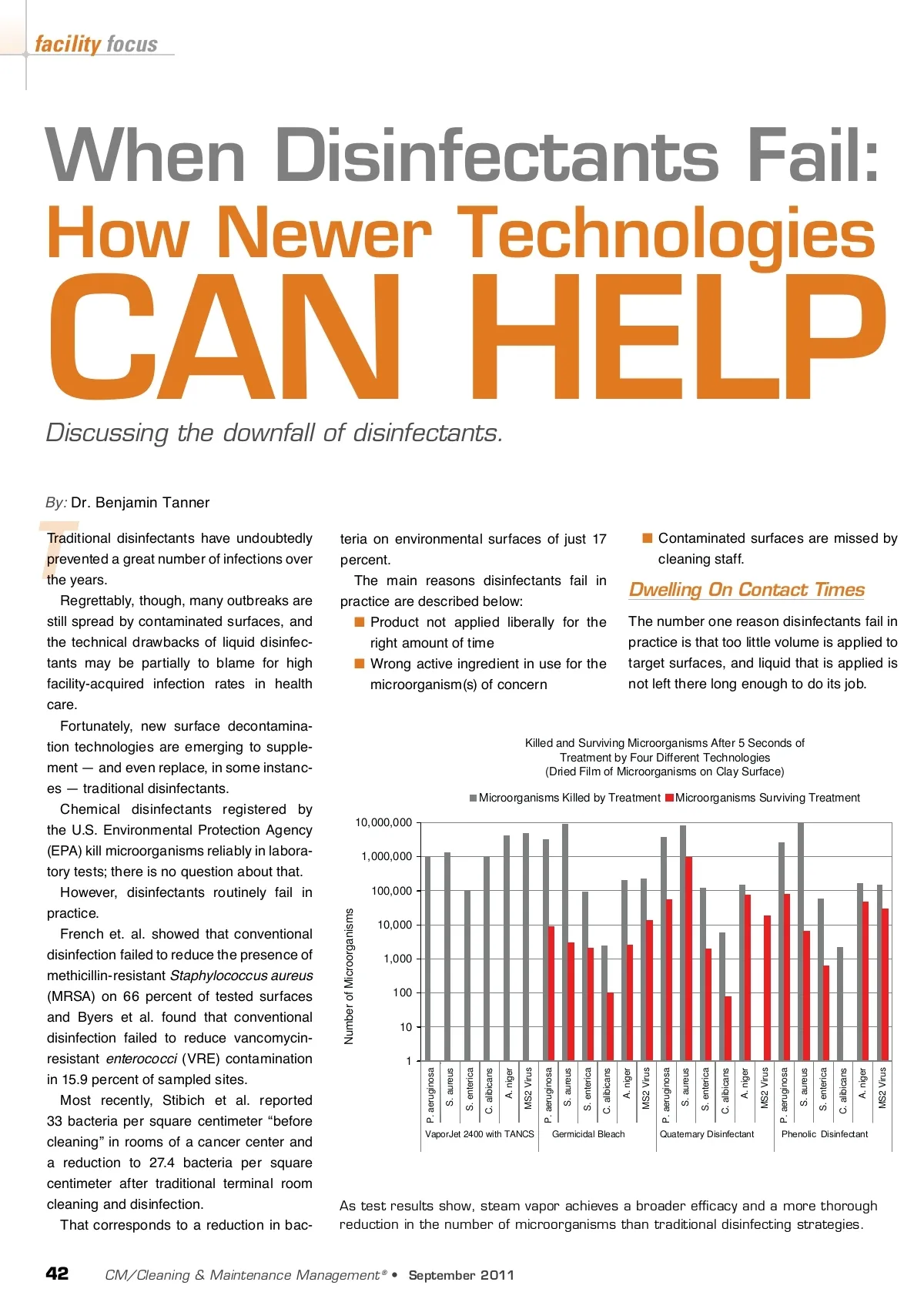
facility focus WhenDisinfectantsFail: HowNewerTechnologies CaN HELP Discussing the downfall of disinfectants. By: Dr. Benjamin Tanner T Traditional disinfectants have undoubtedly prevented a great number of infections over the years. Regrettably, though, many outbreaks are still spread by contaminated surfaces, and the technical drawbacks of liquid disinfec-tants may be partially to blame for high facility-acquired infection rates in health care. Fortunately, new surface decontamina-tion technologies are emerging to supple-ment — and even replace, in some instanc-es — traditional disinfectants. Chemical disinfectants registered by the U.S. Environmental Protection Agency (EPA) kill microorganisms reliably in labora-tory tests; there is no question about that. However, disinfectants routinely fail in practice. French et. al. showed that conventional disinfection failed to reduce the presence of methicillin-resistant Staphylococcus aureus (MRSA) on 66 percent of tested surfaces and Byers et al. found that conventional disinfection failed to reduce vancomycin-resistant enterococci (VRE) contamination in 15.9 percent of sampled sites. Most recently, Stibich et al. reported 33 bacteria per square centimeter “before cleaning” in rooms of a cancer center and a reduction to 27.4 bacteria per square centimeter after traditional terminal room cleaning and disinfection. That corresponds to a reduction in bac-teria on environmental surfaces of just 17 percent. The main reasons disinfectants fail in practice are described below: ■ Product not applied liberally for the right amount of time ■ Wrong active ingredient in use for the microorganism(s) of concern ■ Contaminated surfaces are missed by cleaning staff. Dwelling On Contact Times The number one reason disinfectants fail in practice is that too little volume is applied to target surfaces, and liquid that is applied is not left there long enough to do its job. Killed and Surviving Microorganisms After 5 Seconds of Treatment by Four Different Technologies (Dried Film of Microorganisms on Clay Surface) Microorganisms Killed by Treatment 10,000,000 1,000,000 100,000 Number of Microorganisms 10,000 1,000 100 10 1 MS2 Virus MS2 Virus MS2 Virus P. aeruginosa P. aeruginosa P. aeruginosa P. aeruginosa S. enterica S. enterica S. enterica S. enterica C. alibicans C. alibicans C. alibicans C. alibicans MS2 Virus A. niger A. niger A. niger S. aureus S. aureus S. aureus S. aureus A. niger Microorganisms Surviving Treatment VaporJet 2400 with TANCS Germicidal Bleach Quaternary Disinfectant Phenolic Disinfectant As test results show, steam vapor achieves a broader efficacy and a more thorough reduction in the number of microorganisms than traditional disinfecting strategies. 42 CM/Cleaning & Maintenance Management ® • September2011
CMM – Archives Sept 2011: 42