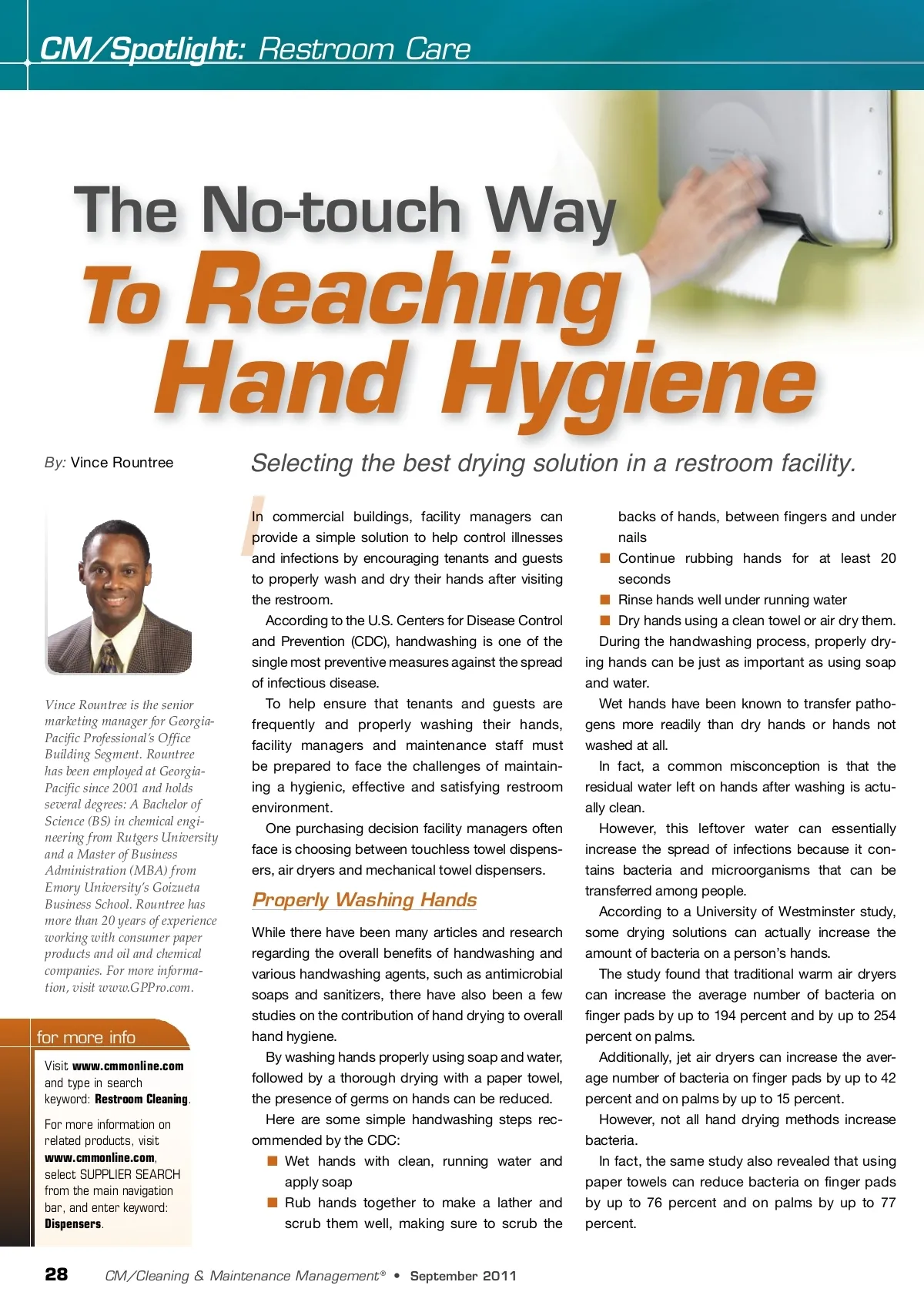
CM/Spotlight: Restroom Care The No-touch Way To Reaching By: Vince Rountree Hand Hygiene Selecting the best drying solution in a restroom facility. I Vince Rountree is the senior marketing manager for Georgia-Pacific Professional’s Office Building Segment. Rountree has been employed at Georgia-Pacific since 2001 and holds several degrees: A Bachelor of Science (BS) in chemical engi-neering from Rutgers University and a Master of Business Administration (MBA) from Emory University’s Goizueta Business School. Rountree has more than 20 years of experience working with consumer paper products and oil and chemical companies. For more informa-tion, visit www.GPPro.com. In commercial buildings, facility managers can provide a simple solution to help control illnesses and infections by encouraging tenants and guests to properly wash and dry their hands after visiting the restroom. According to the U.S. Centers for Disease Control and Prevention (CDC), handwashing is one of the single most preventive measures against the spread of infectious disease. To help ensure that tenants and guests are frequently and properly washing their hands, facility managers and maintenance staff must be prepared to face the challenges of maintain-ing a hygienic, effective and satisfying restroom environment. One purchasing decision facility managers often face is choosing between touchless towel dispens-ers, air dryers and mechanical towel dispensers. Properly Washing Hands While there have been many articles and research regarding the overall benefits of handwashing and various handwashing agents, such as antimicrobial soaps and sanitizers, there have also been a few studies on the contribution of hand drying to overall hand hygiene. By washing hands properly using soap and water, followed by a thorough drying with a paper towel, the presence of germs on hands can be reduced. Here are some simple handwashing steps rec-ommended by the CDC: ■ Wet hands with clean, running water and apply soap ■ Rub hands together to make a lather and scrub them well, making sure to scrub the for more info Visit www.cmmonline.com and type in search keyword: Restroom Cleaning . For more information on related products, visit www.cmmonline.com , select SUPPLIER SEARCH from the main navigation bar, and enter keyword: Dispensers . backs of hands, between fingers and under nails ■ Continue rubbing hands for at least 20 seconds ■ Rinse hands well under running water ■ Dry hands using a clean towel or air dry them. During the handwashing process, properly dry-ing hands can be just as important as using soap and water. Wet hands have been known to transfer patho-gens more readily than dry hands or hands not washed at all. In fact, a common misconception is that the residual water left on hands after washing is actu-ally clean. However, this leftover water can essentially increase the spread of infections because it con-tains bacteria and microorganisms that can be transferred among people. According to a University of Westminster study, some drying solutions can actually increase the amount of bacteria on a person’s hands. The study found that traditional warm air dryers can increase the average number of bacteria on finger pads by up to 194 percent and by up to 254 percent on palms. Additionally, jet air dryers can increase the aver-age number of bacteria on finger pads by up to 42 percent and on palms by up to 15 percent. However, not all hand drying methods increase bacteria. In fact, the same study also revealed that using paper towels can reduce bacteria on finger pads by up to 76 percent and on palms by up to 77 percent. 28 CM/Cleaning & Maintenance Management ® • September 2011
CMM – Archives Sept 2011: 28