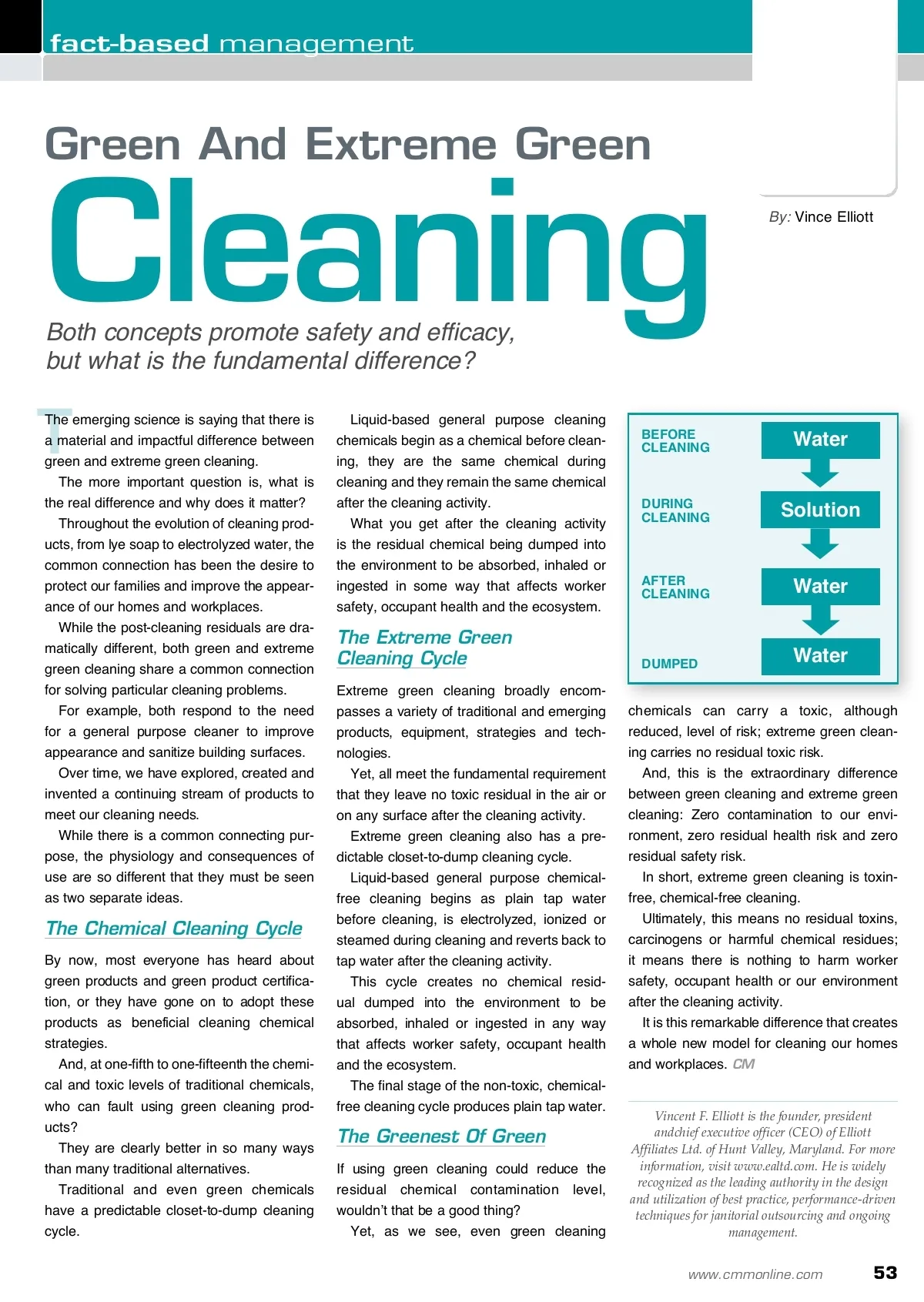
fact-based management Green And Extreme Green Both concepts promote safety and efficacy, but what is the fundamental difference? Cleaning Liquid-based general purpose cleaning chemicals begin as a chemical before clean-ing, they are the same chemical during cleaning and they remain the same chemical after the cleaning activity. What you get after the cleaning activity is the residual chemical being dumped into the environment to be absorbed, inhaled or ingested in some way that affects worker safety, occupant health and the ecosystem. Before Cleaning During Cleaning after Cleaning By: Vince Elliott The Extreme Green Cleaning Cycle Extreme green cleaning broadly encom-passes a variety of traditional and emerging products, equipment, strategies and tech-nologies. Yet, all meet the fundamental requirement that they leave no toxic residual in the air or on any surface after the cleaning activity. Extreme green cleaning also has a pre-dictable closet-to-dump cleaning cycle. Liquid-based general purpose chemical-free cleaning begins as plain tap water before cleaning, is electrolyzed, ionized or steamed during cleaning and reverts back to tap water after the cleaning activity. This cycle creates no chemical resid-ual dumped into the environment to be absorbed, inhaled or ingested in any way that affects worker safety, occupant health and the ecosystem. The final stage of the non-toxic, chemical-free cleaning cycle produces plain tap water. DumpeD The Chemical Cleaning Cycle By now, most everyone has heard about green products and green product certifica-tion, or they have gone on to adopt these products as beneficial cleaning chemical strategies. And, at one-fifth to one-fifteenth the chemi-cal and toxic levels of traditional chemicals, who can fault using green cleaning prod-ucts? They are clearly better in so many ways than many traditional alternatives. Traditional and even green chemicals have a predictable closet-to-dump cleaning cycle. chemicals can carry a toxic, although reduced, level of risk; extreme green clean-ing carries no residual toxic risk. And, this is the extraordinary difference between green cleaning and extreme green cleaning: Zero contamination to our envi-ronment, zero residual health risk and zero residual safety risk. In short, extreme green cleaning is toxin-free, chemical-free cleaning. Ultimately, this means no residual toxins, carcinogens or harmful chemical residues; it means there is nothing to harm worker safety, occupant health or our environment after the cleaning activity. It is this remarkable difference that creates a whole new model for cleaning our homes and workplaces. CM The Greenest Of Green If using green cleaning could reduce the residual chemical contamination level, wouldn’t that be a good thing? Yet, as we see, even green cleaning Vincent F. Elliott is the founder, president andchief executive officer (CEO) of Elliott Affiliates Ltd. of Hunt Valley, Maryland. For more information, visit www.ealtd.com. He is widely recognized as the leading authority in the design and utilization of best practice, performance-driven techniques for janitorial outsourcing and ongoing management. www.cmmonline.com Solution Water Water 53 T The emerging science is saying that there is a material and impactful difference between green and extreme green cleaning. The more important question is, what is the real difference and why does it matter? Throughout the evolution of cleaning prod-ucts, from lye soap to electrolyzed water, the common connection has been the desire to protect our families and improve the appear-ance of our homes and workplaces. While the post-cleaning residuals are dra-matically different, both green and extreme green cleaning share a common connection for solving particular cleaning problems. For example, both respond to the need for a general purpose cleaner to improve appearance and sanitize building surfaces. Over time, we have explored, created and invented a continuing stream of products to meet our cleaning needs. While there is a common connecting pur-pose, the physiology and consequences of use are so different that they must be seen as two separate ideas. Water
CMM – Archives Oct 2011: 53