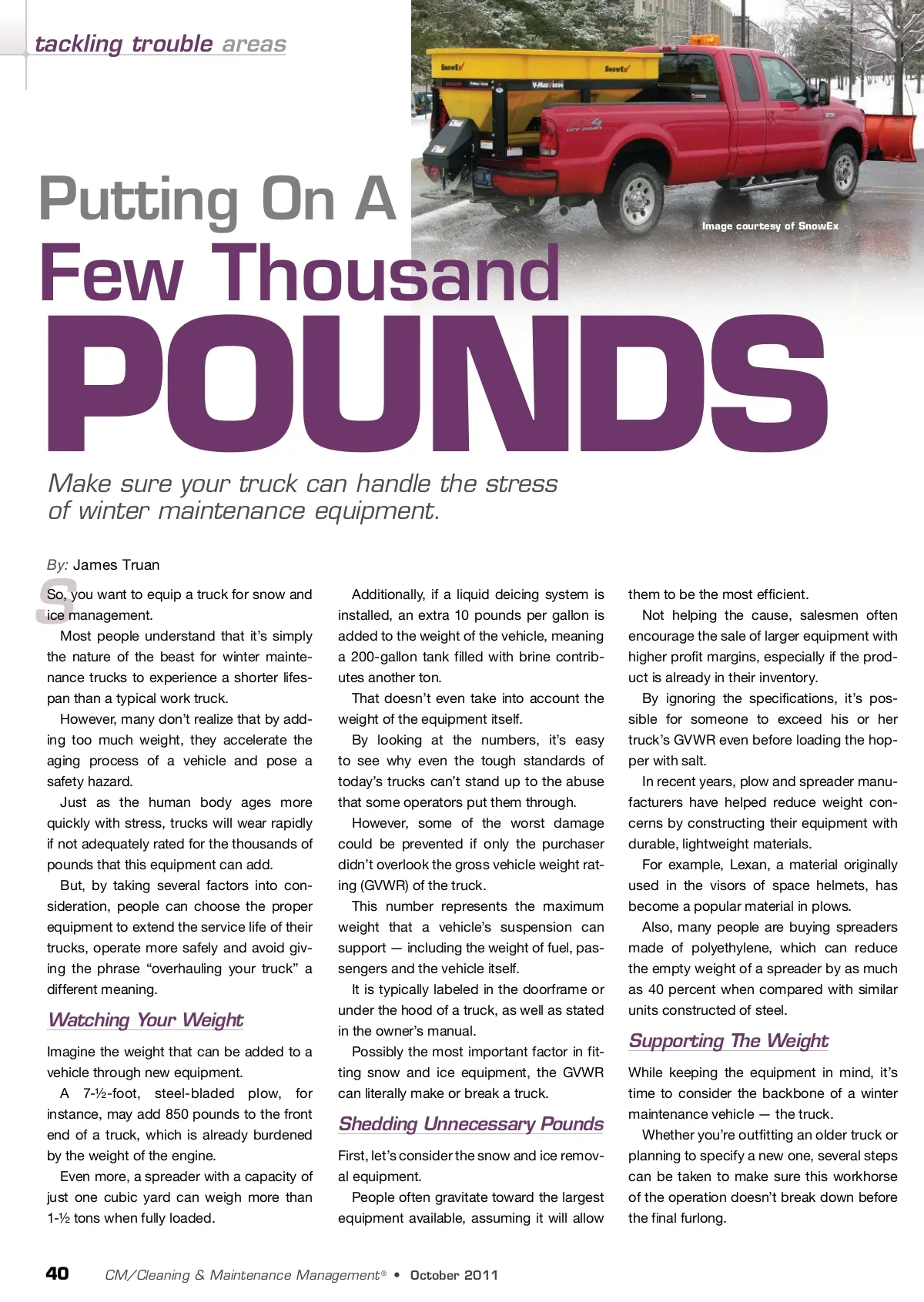
tackling trouble areas Putting On A Image courtesy of SnowEx Few Thousand Make sure your truck can handle the stress of winter maintenance equipment. By: James Truan POUNDS S So, you want to equip a truck for snow and ice management. Most people understand that it’s simply the nature of the beast for winter mainte-nance trucks to experience a shorter lifes-pan than a typical work truck. However, many don’t realize that by add-ing too much weight, they accelerate the aging process of a vehicle and pose a safety hazard. Just as the human body ages more quickly with stress, trucks will wear rapidly if not adequately rated for the thousands of pounds that this equipment can add. But, by taking several factors into con-sideration, people can choose the proper equipment to extend the service life of their trucks, operate more safely and avoid giv-ing the phrase “overhauling your truck” a different meaning. Additionally, if a liquid deicing system is installed, an extra 10 pounds per gallon is added to the weight of the vehicle, meaning a 200-gallon tank filled with brine contrib-utes another ton. That doesn’t even take into account the weight of the equipment itself. By looking at the numbers, it’s easy to see why even the tough standards of today’s trucks can’t stand up to the abuse that some operators put them through. However, some of the worst damage could be prevented if only the purchaser didn’t overlook the gross vehicle weight rat-ing (GVWR) of the truck. This number represents the maximum weight that a vehicle’s suspension can support — including the weight of fuel, pas-sengers and the vehicle itself. It is typically labeled in the doorframe or under the hood of a truck, as well as stated in the owner’s manual. Possibly the most important factor in fit-ting snow and ice equipment, the GVWR can literally make or break a truck. them to be the most efficient. Not helping the cause, salesmen often encourage the sale of larger equipment with higher profit margins, especially if the prod-uct is already in their inventory. By ignoring the specifications, it’s pos-sible for someone to exceed his or her truck’s GVWR even before loading the hop-per with salt. In recent years, plow and spreader manu-facturers have helped reduce weight con-cerns by constructing their equipment with durable, lightweight materials. For example, Lexan, a material originally used in the visors of space helmets, has become a popular material in plows. Also, many people are buying spreaders made of polyethylene, which can reduce the empty weight of a spreader by as much as 40 percent when compared with similar units constructed of steel. Watching Your Weight Imagine the weight that can be added to a vehicle through new equipment. A 7-½-foot, steel-bladed plow, for instance, may add 850 pounds to the front end of a truck, which is already burdened by the weight of the engine. Even more, a spreader with a capacity of just one cubic yard can weigh more than 1-½ tons when fully loaded. Supporting The Weight While keeping the equipment in mind, it’s time to consider the backbone of a winter maintenance vehicle — the truck. Whether you’re outfitting an older truck or planning to specify a new one, several steps can be taken to make sure this workhorse of the operation doesn’t break down before the final furlong. Shedding Unnecessary Pounds First, let’s consider the snow and ice remov-al equipment. People often gravitate toward the largest equipment available, assuming it will allow 40 CM/Cleaning & Maintenance Management ® • October 2011
CMM – Archives Oct 2011: 40