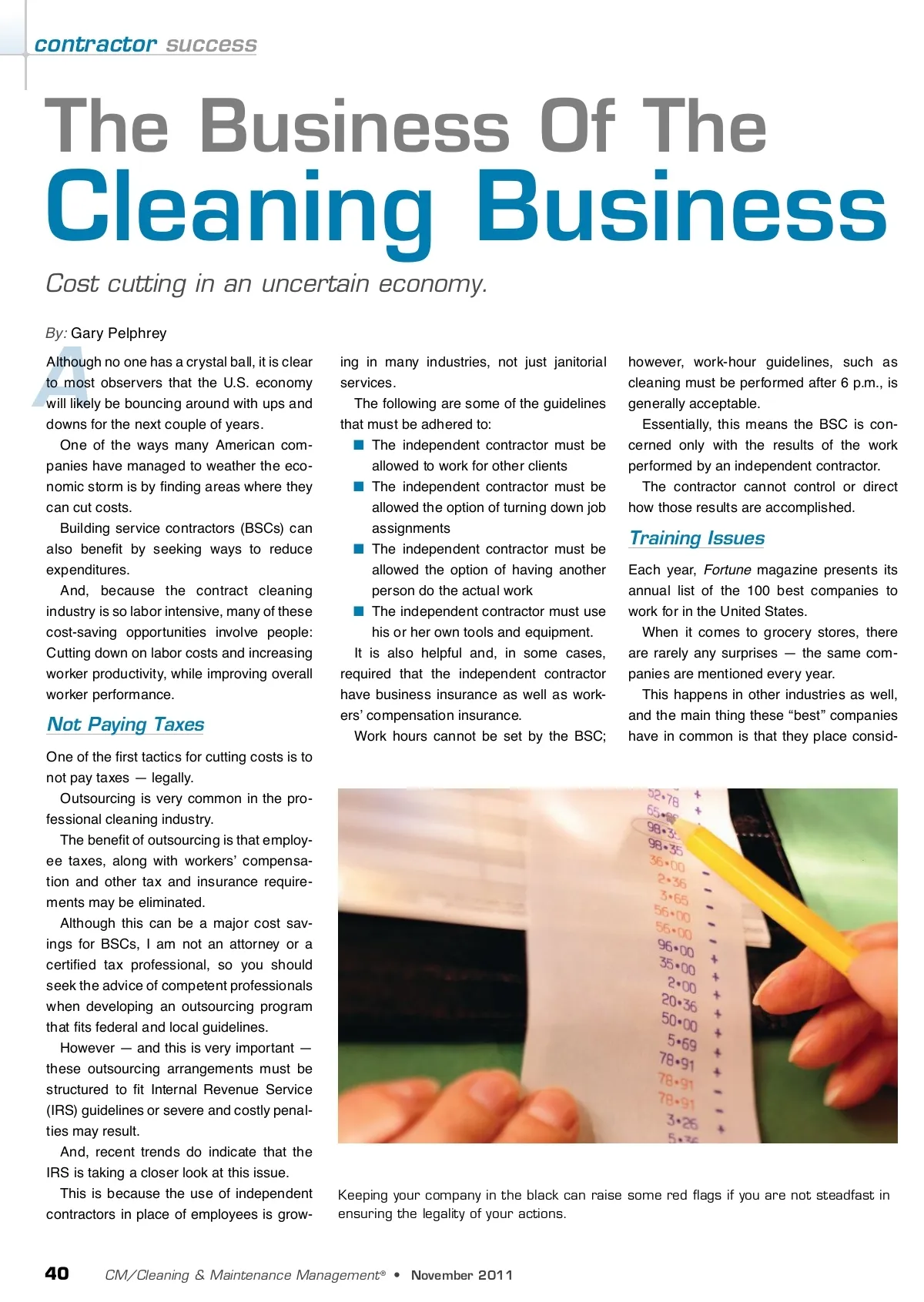
erable emphasis on training, usually much more than their competitors. The benefits of a well-trained worker are many. These workers typically have a “big pic-ture” view of their job and how their work and performance impacts the entire com-pany and its image. As to cost control, a well-trained worker is invariably more efficient and productive, has higher morale and experiences fewer accidents and injuries. For many BSCs, making a big investment in cleaning training can be a difficult consid-eration because turnover is typically so great. Why spend the time and money on train-ing workers if they just leave? But, another way to look at it is this: What if you don’t train them and they stay? Poorly trained workers cost money; well-trained workers ultimately make money for a company, not only because they are more productive and efficient, but also because they typically stay longer with the same company, which is a cost saver in and of itself. ISSA, through its Cleaning Industry Management Standard (CIMS) programs; the Institute of Inspection, Cleaning and Restoration Certification (IICRC); the International Executive Housekeepers Association (IEHA); and other organizations offer training in a variety of cleaning-related subjects. BSCs whose workers take advantage of these training programs can reap long-term dividends. Pitfalls Of Outsourcing One of the pitfalls of outsourcing is the fact that the BSC can only be concerned with the results of the independent contractors’ work and not how it is actually performed or the products used. Should the BSC want only green cleaning products to be used, for example, or clean-ing tasks performed in a specific way, these options are not available to the BSC. At one time, when labor costs were lower, and there were fewer concerns about the environmental impact of floor care, it was not uncommon for BSCs to strip and refinish a facility’s floors two, three or more times per year. Those days are long gone, though, and the current state of the economy appears to have put the final nails in that coffin. Today, BSCs delay or reduce refinishing cycles, which can protect the environment while also cutting costs by implementing interim floor care systems. Further, the size and type of floor care equipment selected can make a big differ-ence in the overall cost of floor care; the right machine can greatly improve worker productivity, thereby cutting costs. In general, when cleaning floor areas smaller than 1,500 square feet, a standard floor machine is suggested. In larger areas, a walk-behind scrubber or even a ride-on machine will result in signifi-cant cost savings. Some BSCs may be concerned about the initial cost of these larger floor machines. However, a walk-behind or ride-on scrub-ber will typically pay for itself in less than a year. It should be noted that BSCs may also be able to save on equipment costs by select-ing machines that can multitask. Equipment is now available that can clean many types of carpets and hard surface flooring. Obviously, this can prove to be a major cost savings. Don’t Forget Marketing In tough economic times, cutting costs is not the only concern. Employing an effective marketing pro-gram is also essential. A marketing program is just that: A pro-gram that establishes what kinds of market-ing you are going to do and when. It can be monthly, quarterly or annually, but it is essential; and, just as essential, it should be in writing. Among the things it should include are what marketing activities are to be performed every day, from contacting prospective cus-tomers by mail or e-mail to making cold calls. It should include an activity list indicating what tasks were performed, on what days, with whom and what the outcome was. Finally, it should include goals, which can also apply to cost savings. For example, BSCs may wish to establish a goal of increasing their business size by a certain percentage or a certain number of customers over a certain period of time. There is no question that the economy is rocky right now, and every company needs to consider how to keep budgets in check. For BSCs, outsourcing, proper worker training, the right equipment and an effec-tive marketing program can make the differ-ence between being in the red and finding success. CM The Equipment Factor A report released by Green Seal Inc. a few years ago estimated that, in the United States, more than $1 billion is spent annu-ally on floor care products such as strippers, polishes, sealers and cleaners. However, this only reflects about 10 per-cent of the total amount spent on floor cleaning, refinishing and polishing. The bulk of the costs involved in floor care come from labor, which can range anywhere from 70 percent to more than 90 percent of the total expense. Floor care is often the perfect example of where money can be lost and where it can be saved if more efficient cleaning proce-dures and equipment are employed. What Are Interim Floor Care Tasks? Interim floor care tasks can help reduce refinish-ing cycles, which are invariably costly and can have a negative impact on the environment. Interim floor care includes such things as: ■ Daily sweeping, vacuuming and mopping of floors ■ Spray-buffing and scrubbing on a set schedule based on traffic and soiling ■ Increasing cleaning frequency in high-traffic areas ■ Ensuring matting systems are placed at all key entries, at elevators and between warehouse and office areas of facilities. Gary Pelphrey, a marketing expert with more than 20 years of marketing and managerial experience, is the marketing director of Powr-Flite, a leading manufacturer and distributor of high-quality commercial floor care equipment. www.cmmonline.com 41
CMM – Archives Nov 2011: 41