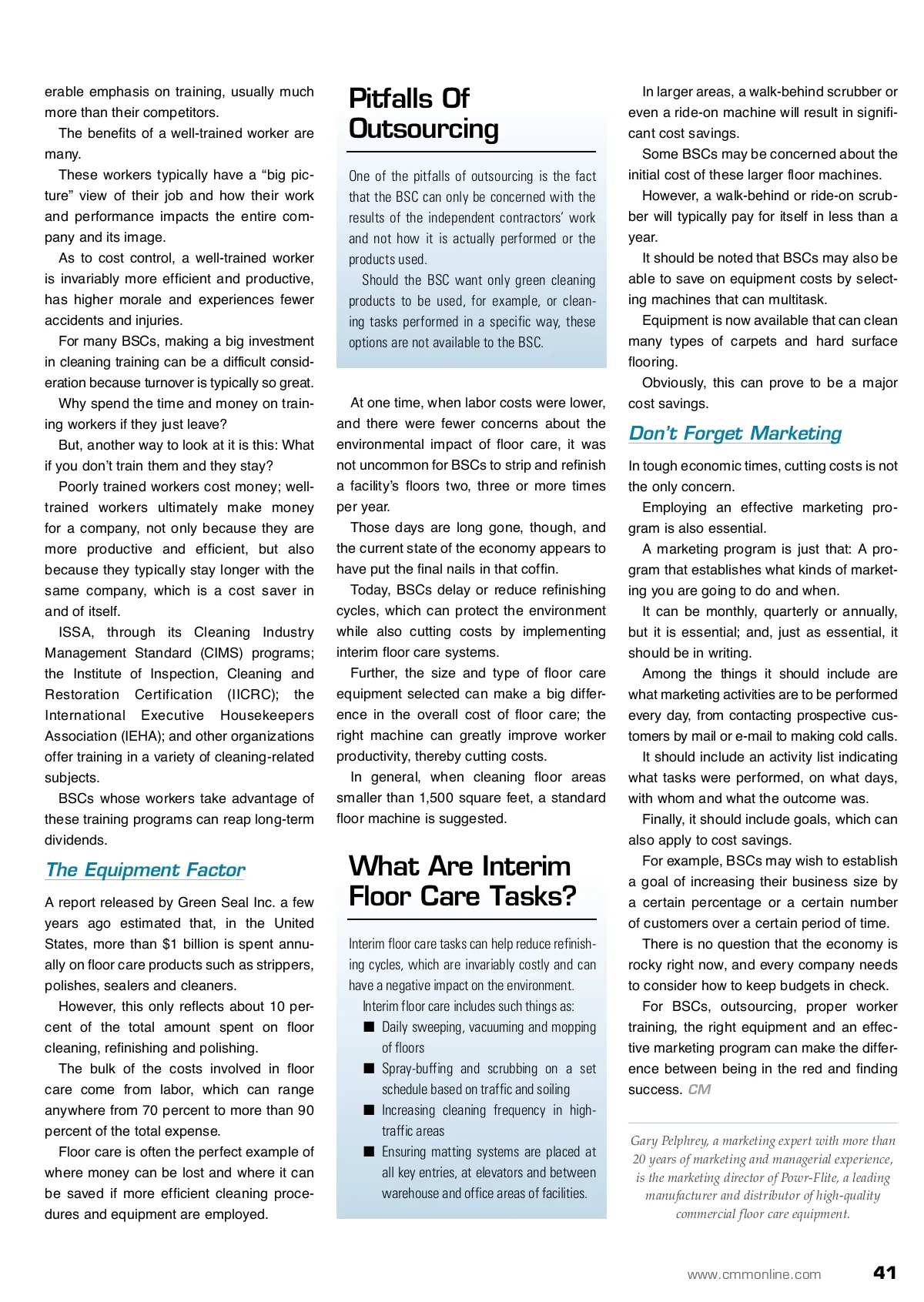
contractor success The Business Of The Cost cutting in an uncertain economy. By: Gary Pelphrey Cleaning Business A Although no one has a crystal ball, it is clear to most observers that the U.S. economy will likely be bouncing around with ups and downs for the next couple of years. One of the ways many American com-panies have managed to weather the eco-nomic storm is by finding areas where they can cut costs. Building service contractors (BSCs) can also benefit by seeking ways to reduce expenditures. And, because the contract cleaning industry is so labor intensive, many of these cost-saving opportunities involve people: Cutting down on labor costs and increasing worker productivity, while improving overall worker performance. ing in many industries, not just janitorial services. The following are some of the guidelines that must be adhered to: ■ The independent contractor must be allowed to work for other clients ■ The independent contractor must be allowed the option of turning down job assignments ■ The independent contractor must be allowed the option of having another person do the actual work ■ The independent contractor must use his or her own tools and equipment. It is also helpful and, in some cases, required that the independent contractor have business insurance as well as work-ers’ compensation insurance. Work hours cannot be set by the BSC; however, work-hour guidelines, such as cleaning must be performed after 6 p.m., is generally acceptable. Essentially, this means the BSC is con-cerned only with the results of the work performed by an independent contractor. The contractor cannot control or direct how those results are accomplished. Training Issues Each year, Fortune magazine presents its annual list of the 100 best companies to work for in the United States. When it comes to grocery stores, there are rarely any surprises — the same com-panies are mentioned every year. This happens in other industries as well, and the main thing these “best” companies have in common is that they place consid-Not Paying Taxes One of the first tactics for cutting costs is to not pay taxes — legally. Outsourcing is very common in the pro-fessional cleaning industry. The benefit of outsourcing is that employ-ee taxes, along with workers’ compensa-tion and other tax and insurance require-ments may be eliminated. Although this can be a major cost sav-ings for BSCs, I am not an attorney or a certified tax professional, so you should seek the advice of competent professionals when developing an outsourcing program that fits federal and local guidelines. However — and this is very important — these outsourcing arrangements must be structured to fit Internal Revenue Service (IRS) guidelines or severe and costly penal-ties may result. And, recent trends do indicate that the IRS is taking a closer look at this issue. This is because the use of independent contractors in place of employees is grow-Keeping your company in the black can raise some red flags if you are not steadfast in ensuring the legality of your actions. 40 CM/Cleaning & Maintenance Management ® • November 2011
CMM – Archives Nov 2011: 40