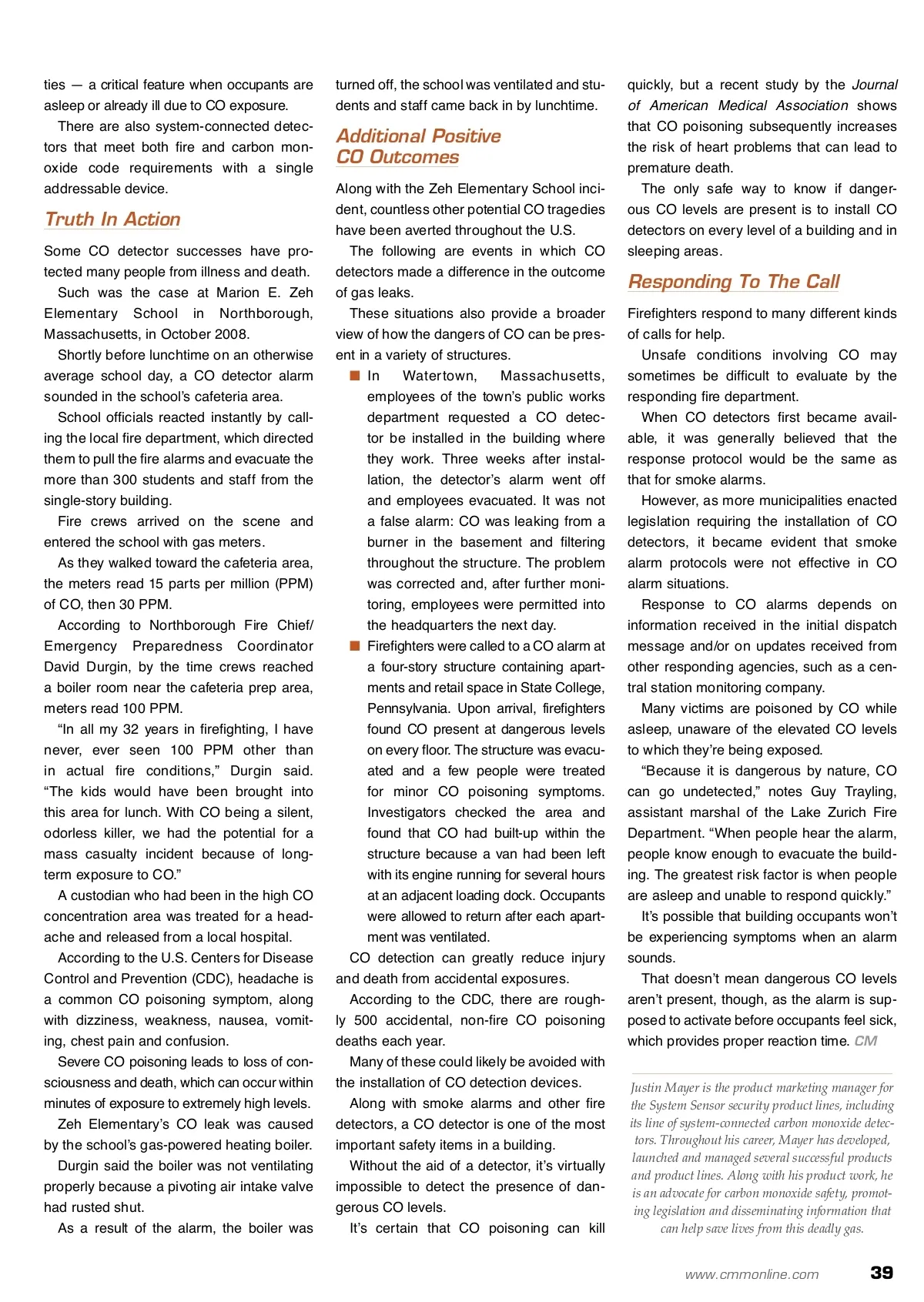
maintenance matters Tragedies Enhancing life safety through the installation of carbon monoxide detectors proves worthwhile time after time. By: Justin Mayer Carbon Monoxide CAN BE AVERTED N No one is immune to the dangers of carbon monoxide (CO) gas. It can be present in any structure in which mechanical equipment produces exhaust while burning fuel. Whether within a fraternity house or a public works building, the gas can be emitted by sources ranging from furnaces and water heaters to generators and other motorized devices. Because it’s colorless and odorless, it often goes unnoticed until occupants become ill. CO is harmful because, when breathed, it replaces the oxygen in the bloodstream that the human body requires to function properly. As CO education spreads, more commer-cial and multi-family housing building con-tractors are installing CO detectors, which can alert occupants to evacuate before they sense any symptoms of poisoning. This movement is further bolstered by the fact that, in some cases, CO detector instal-lation is required by law. But, it’s up to building owners and custo-dial service managers to comply — or risk the consequences if they choose to ignore legislation or good judgment. In order to avoid the deadly gas, CO detection is a necessity, and the technology has significantly improved since the first generation of standalone devices. System-connected, monitored CO detec-tors offer the highest level of protection because they can automatically alert authori-Because carbon monoxide gas is virtually undetectable without the help of sophisticated devices, many municipalities have made it mandatory to install and properly maintain sensors in commercial and residential spaces. 38 CM/Cleaning & Maintenance Management ® • November 2011 Image courtesy of System Sensor
CMM – Archives Nov 2011: 38