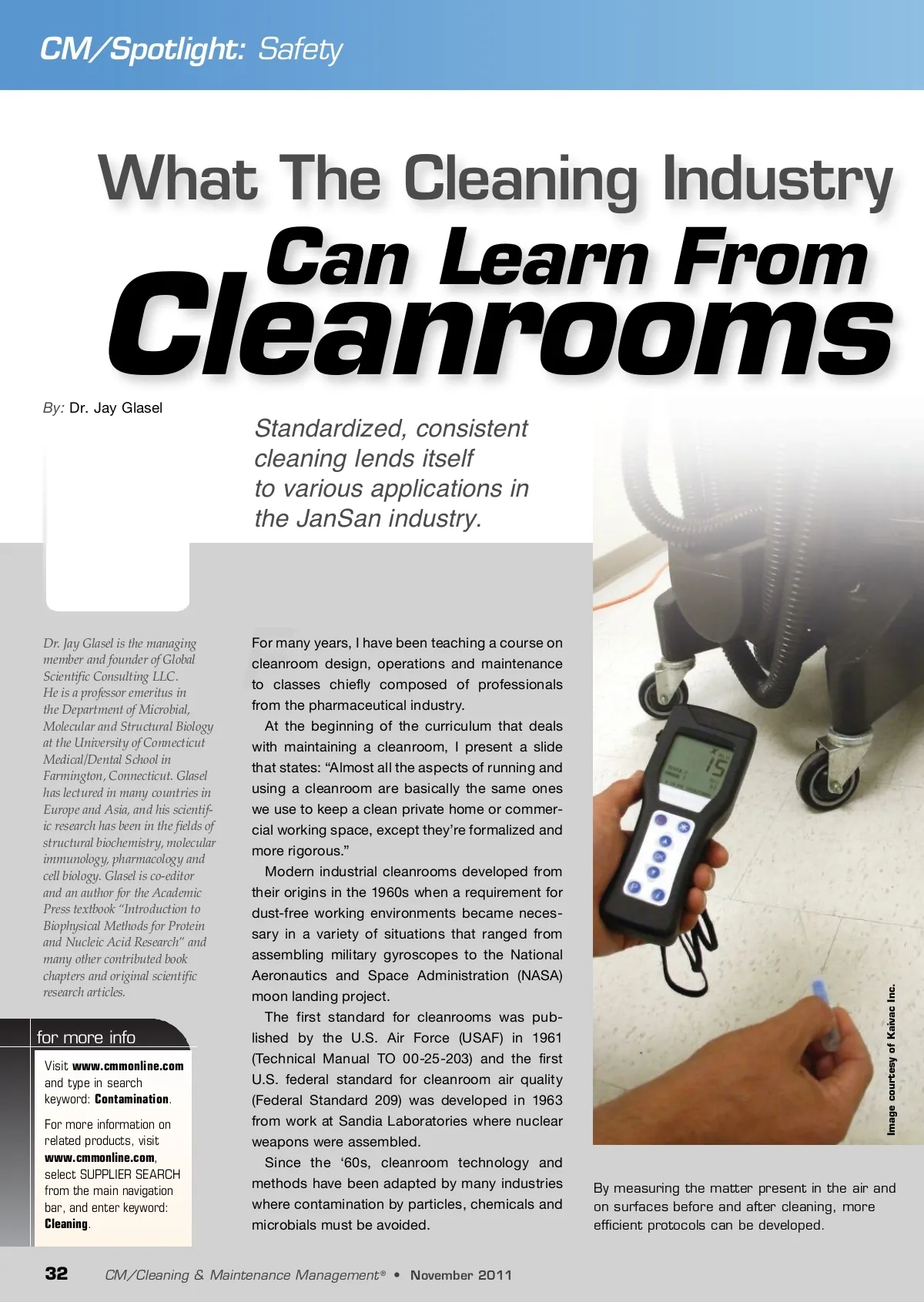
At present, the standards of airborne, surface particle and microbial contami-nation cleanliness for pharmaceutical cleanrooms in the U.S., Europe and Asia are developed and set by international non-governmental organizations but are accepted and enforced — with varying degrees of effectiveness — by governmen-tal regulatory agencies like the Food and Drug Administration (FDA) in the U.S. Effectiveness Of Cleanrooms Cleanrooms are classified by the cleanli-ness of the air in their interiors expressed as the number of airborne particles per cubic meter, known as the “airborne par-ticle density.” Typical town air that surrounds us in everyday life has a particle density of around 100 trillion particles per cubic meter. Contrast this with a typical pharmaceuti-cal cleanroom that has an airborne particle density of 1,000 particles per cubic meter or a typical semiconductor industry clean-room, which has an airborne particle den-sity of 2 particles per cubic meter, and it’s apparent that the technology and expertise exists to maintain a high degree of cleanli-ness in working spaces. The reason cleanrooms are classified according to the density of airborne par-ticles present is that, unless these particles are removed quickly and efficiently from the air in the workspace, a large number of them will inevitably settle on vertical and horizontal objects. From these objects, the contamination can be transferred to everything else in the workspace. The same problem with particle con-tamination exists in non-cleanroom work-ing spaces: Airborne contamination set-tles on surfaces and can be transferred from there to other objects or from person to person. The fundamental strategies for reducing airborne contamination in a cleanroom are: 1. Special design of cleanrooms, includ-ing airtightness, airlock entrances, special interior surface coatings, etc. 2. The extensive use of high-efficiency particulate air (HEPA) filters and recir-culation/filtering of a significant per-centage of room air 3. The use of special garments for per-sonnel working in the cleanroom 4. Rigorous and regular cleaning of sur-faces in the cleanroom 5. Rigorous and regular monitoring of airborne particle densities and sur-face contamination within the clean-room. Of these five strategies, numbers one and three are not practical in an existing commercial setting; numbers one, two and three are not practical in schools. All of these five strategies are possible in a hospital setting, although some or all of them are frequently not implemented even in modern surgical operating theaters. C On the other hand, with modifications M and simplifications, strategies number four Y and five, cleaning surfaces and monitoring CM for contamination, are possible to imple-MY ment in all non-cleanroom settings with the objective to decrease surface and airborne CY particle contamination. CMY Sources Of Particle Contamination K A question that cleaning and maintenance professionals may not ask themselves — because the answer may seem obvious — is: Where does most of the particle contamination come from? Most people believe contamination is tracked into work areas from the outside environment by personnel and, in addition, enters through unfiltered heating, ventila-tion and air conditioning (HVAC) systems from the surrounding atmosphere. Undoubtedly, these sources do con-tribute to airborne contamination in most working spaces. However, cleanroom professionals have long known that a major source of airborne and surface contamination in cleanrooms is the cleanroom personnel themselves. Specifically, skin particles that are shed by all humans. Consider these simple facts: ■ Each human being sheds approxi-mately a billion skin cells per day — Circle Product Information no. 212 on page 24 www.cmmonline.com 33
CMM – Archives Nov 2011: 33